Nikola Tesla Articles
Electricity at the World's Fair - Oct. 7, 1893
Awards formed the principal topic of discussion among the electrical exhibitors at the World's Fair last week. The exclusive publication of the list in the Western Electrician excited much interest, and the paper was in great demand. The comments were many and varied. Some exhibitors were jubilant; others were angry and disgusted, while not a few professed indifference, with the remark, "What do the awards amount to, anyway?" It was noticeable, however, that all seemed eager to secure the diplomas and medals before the list was posted. Many, also, were puzzled by the fact that several awards, in a number of cases, were given on one class of apparatus. This is explained by the fact that the judges did not consider the comparative merits of. exhibits in making awards. They examined each exhibit entered for an award separately, and if, in, their judgment, the article or group was found to be worthy of commendation an award was given it, the specific points of excellence being detailed in the diploma. It thus happened that on the commoner sorts of apparatus, such as arc lamps, for instance, a number of awards were given on the same class of exhibits, although the exact language of the awards, specifying the points of excellence, will not be alike on any two diplomas. In effect, the judges, by making an award, say that the exhibit, while perhaps not better than another, is excellent, and as such entitled to recommendation to the public. No effort was made to single out the best exhibit in each class for a solitary award. By bearing this distinction in mind a better understanding of the work of the judges will be had.
Some of the awards were based on tests and some were not, according to circumstances. The awards on storage batteries, incandescent lamps, insulated wires for electric lighting, standard cells and some of the transformers, however, were not included in the list published last week because tests on them were not completed. Some of these were announced later in the week, but it will be some time before the list is entirely complete. There were 183 awards in the list of September 26th, and it is expected that the total will reach 210. In the list published last week the General Electric company's award numbered 18, for "alternating current dynamos for series arc lighting," should have been omitted, and under the head of Germany "Gemelzen, Nuremburg," should read "C. Schmelzer, Nuremberg." Otherwise the list is correct — a gratifying result when consideration is taken of the haste that Prof. W. E. Anderson was obliged to make in preparing it, owing to the pressure of other duties. Additional awards have been announced as follows:
United States.
American Battery company, Chicago. — Storage batteries.
General Electric company, New York. — (30) Incandescent lights used in the decoration of rooms and other structures.
Elisha Gray, Highland Park, Ill. — The telautograph.
Westinghouse Electric & Manufacturing company, Pittsburg. — (13) High tension experimental apparatus.
Germany.
Gas Motoren Fabrik Deutz, Cologne. — Gas motor directly connected to dynamo.
Charles Pollak, Frankfort. — Storage batteries.
Great Britain.
Epstein Electric Accumulator company, London. — Storage batteries.
Austria.
Schindler & Jenny, Kemmelbach. — Electrical cooking apparatus.
The judges authorize the statement that the Allgemeine Elektricitaets Gesellschaft of Berlin received no award because its exhibit was hors concours, owing to the fact that Herr Rathenau, the managing director of the company, was a member of the committee of electrical judges. For a similar reason no award was given to the "Transactions of the American Institute of Electrical Engineers," the secretary of the Institute being a judge and many of the other judges being members of the Institute.
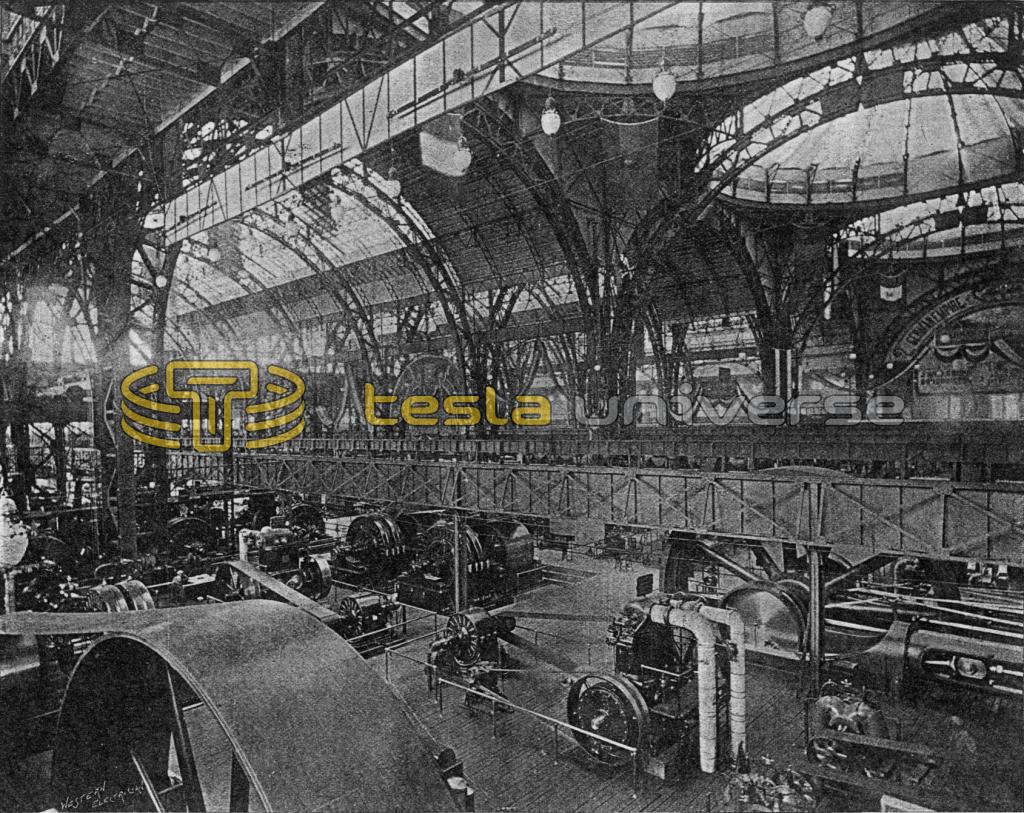
The illustration presented on this page gives an excellent idea of a portion of the Westinghouse incandescent lighting plant in machinery hall. The features of thi large and interesting installation have been before described in this journal The picture was taken from the second gallery of the Westinghouse switchboard. The two 10,000 light alternators belt-driven by the Allis 2,000 horse power engine are shown and also a general view of the plant. The fly-wheel shown prominently in the foreground is that of the Fraser & Chalmers 1,000 horse power engine. Fig. 2 shows the row of four directly connected Westinghouse engines and alternators. It is interesting for comparison with the belt-connected sets.
On a recent busy Saturday the Elektron company carried 3,111 persons in its electric elevator in electricity building.
The incandescent lamp test is proceeding satisfactorily. The General Electric company of London has submitted a number of 16 candle power, 100 volt lamps for alternating current, and these are being tested with the others. Several 32 candle power lamps are also being tested.
Among the floats to appear in the parade on Chicago day is one which will be furnished jointly by the General Electric company and the Chicago Edison company. The float will be 38 feet long, 28 feet high and 9 feet wide. The design chosen is that of an immense dragon made of papier mache. Not a sign of the latter material will be seen, for every spot on the dragon will be covered by miniature incandescent lamps, of which over 1,000 will be used. Beneath the truck a directly connected marine lighting set of 15 kilowatts capacity and wound for 80 volts will be placed, out of the sight of the spectator. By a switching arrangement the color of the dragon will be changed at intervals from green to red. The flaming breath and steaming nostrils will be supplied in a simple manner. The exhaust steam will be conducted through the throat and nostrils of the gleaming papier mache dragon. Dazzling lights will extend along the wings to the tips, which will be twenty-eight feet above the truck. Eight horses will draw this flaming creature, with its blazing red eyes and its chameleon-like hide. Immediately in front of the horses will be another truck, on which will stand the genius of electricity in the form of a woman. She will hold a fairy wand in her hand, at the tip of which will be placed a brilliant white light, supplied by a current from the dragon behind. The cost of the float will be more than $2,000.
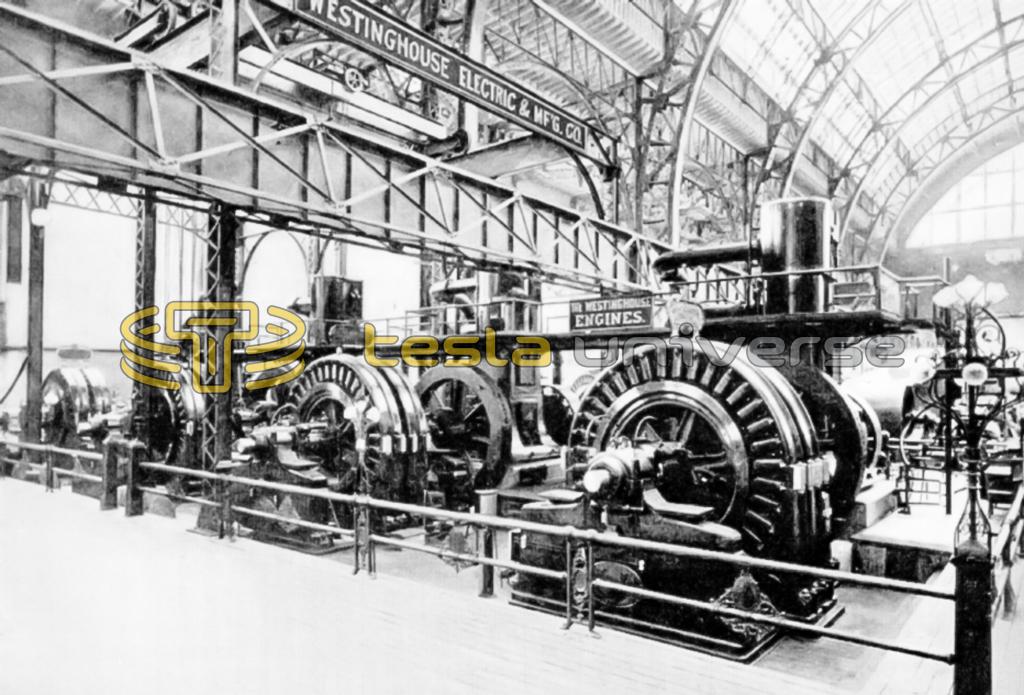
Fig. 3 shows the exhibit of the firm of Schuckert & Co., of Nuremberg, Germany. The display is located in the northeastern portion of electricity building, on the ground floor, and is devoted mainly to marine work and search-lights. Three projectors are exhibited, the largest, which is prominently shown in the illustration, being erected on a platform in the front of the exhibit space and seven feet above the floor. This search-light is operated every evening and has a mirror diameter of 90 centimeters. It has double dispersing lenses and is the largest type used in the German and other navies. Two projectors of this size and character are installed on the cruiser Kaiserin Augusta, which attracted much atten tion at the naval review in New York harbor last spring. The movement of the drum is accompanied by two motors in the base of the projector, which are controlled from a wall governor, which, on shipboard, can be located at any point desired. The lamp consumes 120 amperes of current, the potential at the carbons being 55 volts. Current is supplied from the adjacent Westinghouse exhibit. This projector is provided with a jalousie signaling apparatus consisting of an iron screen in front of the lenses which can be rapidly opened and closed and by which messages can be telegraphed through the atmosphere by dots and dashes of light. Back of the large elevated search-light are two others, each having a mirror diameter of 60 centimeters. The one on the north side of the space is intended for naval use, while the other, shown at the right in the picture, is intended for fortifications. Between the two smaller search-lights is an ingenious electric signaling device for naval use, designed as a means of communication between the commanding officer on the bridge and the engine room. By moving the handle of the instrument until a corresponding pointer rests on that portion of the dial marked with the order desired to be given, the officer causes a similar movement on the dial of a duplicate instrument in the engine room. The instrument is made double, so that the engineer can signal back the order, which is repeated on a second dial, thus preventing mistakes. An engine-dynamo for use on shipboard is shown in the center of the exhibit space. The combination is compact and strong and is said to have high efficiency. The engine runs at 450 revolutions per minute, and the dynamo has a capacity of 170 amperes at 70 volts. The latter has four poles and a Gramme armature. Two copper brushes set at an angle of 90° on the commutator are used. The machine is designed with the idea of supplying current for either search-lights or incandescent lamps. It is used to a considerable extent in the German navy. On a table is shown the horizontal arc lamp used for projectors, with a differential magnet for establishing the arc and a feeding magnet. A number of measuring instruments are shown, including a recording wattmeter and Hummel ammeters and voltmeters. The improved Pilsen arc lamp is exhibited in several forms, some of the fixtures, as shown by the illustration, being highly ornamental. About the walls of the booth are a number of photographs of central stations equipped by Schuckert & Co., as well as large diagrams showing the useful angles of light of the Mangin and Schuckert mirrors for search-lights, greatly to the advantage of the latter. An interesting automatic cut-out switch and a display of electrolytic zinc complete the exhibits. The latter display includes a plate of zinc four feet long and two feet wide produced by the Dieffenbach-Kittler electrolytic process at zinc mines in Westphalia. Granulated zinc is also shown. Both are produced directly from the ore. A display of carbons made by C. Schmelzer, of Nuremberg, is also made in this space.
In addition to the exhibit in electricity building Schuckert & Co. have four large search lights on the roof of the manufactures building, supply the arc lights in the German government building and show drawings of electric lighting stations in the German engineering exhibit in transportation building. In machinery hall there is a Deutz gas engine directly connected to a Schuckert in dynamo, which supplies current for arc and incandescent lamps.
The Washburn & Moen Manufacturing company has three exhibits at the World's Fair — a general exhibit manufactures building, a display of wire ropes, etc., in the mines building, and an exhibit of electrical wires and cables in electricity building. The first and last named are illustrated in Figs. 4 and 5. In the general display copper wire is shown in all stages, including ore, ingots, rods and all sizes of wire down to the finest that can be drawn, half the thickness of a human hair. This exhibit also includes piano wire, iron and steel wires, watch and clock springs, chains, tacks, nails, spikes, bale ties, bicycle spokes and many other kinds of hardware. Indeed it is asserted that there is hardly a house in the United States that does not include in its furnishings and fittings some article made by this company, which employs nearly 6,000 men in good times and possesses the oldest wire factory in the country. The electrical exhibit, Fig. 5, can be found near the center of the eastern gallery of electricity building. It consists of a large central show-case, apparatus for testing the "salamander" fire-proof wire and samples of all kinds of wire for electrical purposes. An interesting feature is a section of the largest insulated cable ever made, having a cross-section of copper of 2,500,000 circular mils. Feeders for electric railway lines having an area of 500,000 circular mils are also shown. An order for 145 miles of this feeder cable for the Brooklyn City Railway company has just been completed by the Washburn & Moen company. Smaller sizes of feeder cables are also shown and all sizes of weather-proof wire, ranging from No. 0000 to No. 20, rubber covered and both taped and braided. Magnet wires, both round and flat, are displayed. It is claimed that copper of a higher conductivity than any other is used for this wire. A complete exhibit of "salamander" insulated fire-proof wire, "salamander" lamp cord and "salamander" switch-board wire is made. A remarkable test of the fire-proof qualities of this insulation is shown. A sample is put in circuit with a piece of lead-covered cable at the testing table before alluded to. A current of 150 amperes from accumulators is then passed through the wires until the insulation and lead covering of the other wire are melted. The "salamander" wire is then taken out uninjured. A similar test is made with under-writers' wire and "salamander," heating the wire to a red heat and destroying the insulation on the under-writers' wire without affecting the fire-proof wire. The exhibit also comprises lead-encased cables, office and annunciator wire, hard drawn trolley wire, iron signal strand wire for electric railways, coils of tinned copper wire and rubber covered wire arranged in seven pyramids. The large central case contains a pyramid of "salamander" lamp cord in different colors, samples of all sizes of wire, bare and insulated, and coils of hard drawn and annealed copper wire, one of which is 35 miles long. A curiousity is a copper rod drawn from No. o size to No. 40, presenting the appearance of a metal whip. The electrical exhibit is a comprehensive and instructive one and is well worth a visit. Herbert Smith is in charge of all the exhibits of the Washburn & Moen company, while C. T. Suedekor has supervision of the display in electricity building.