Nikola Tesla Articles
The Ewing High Frequency Alternator
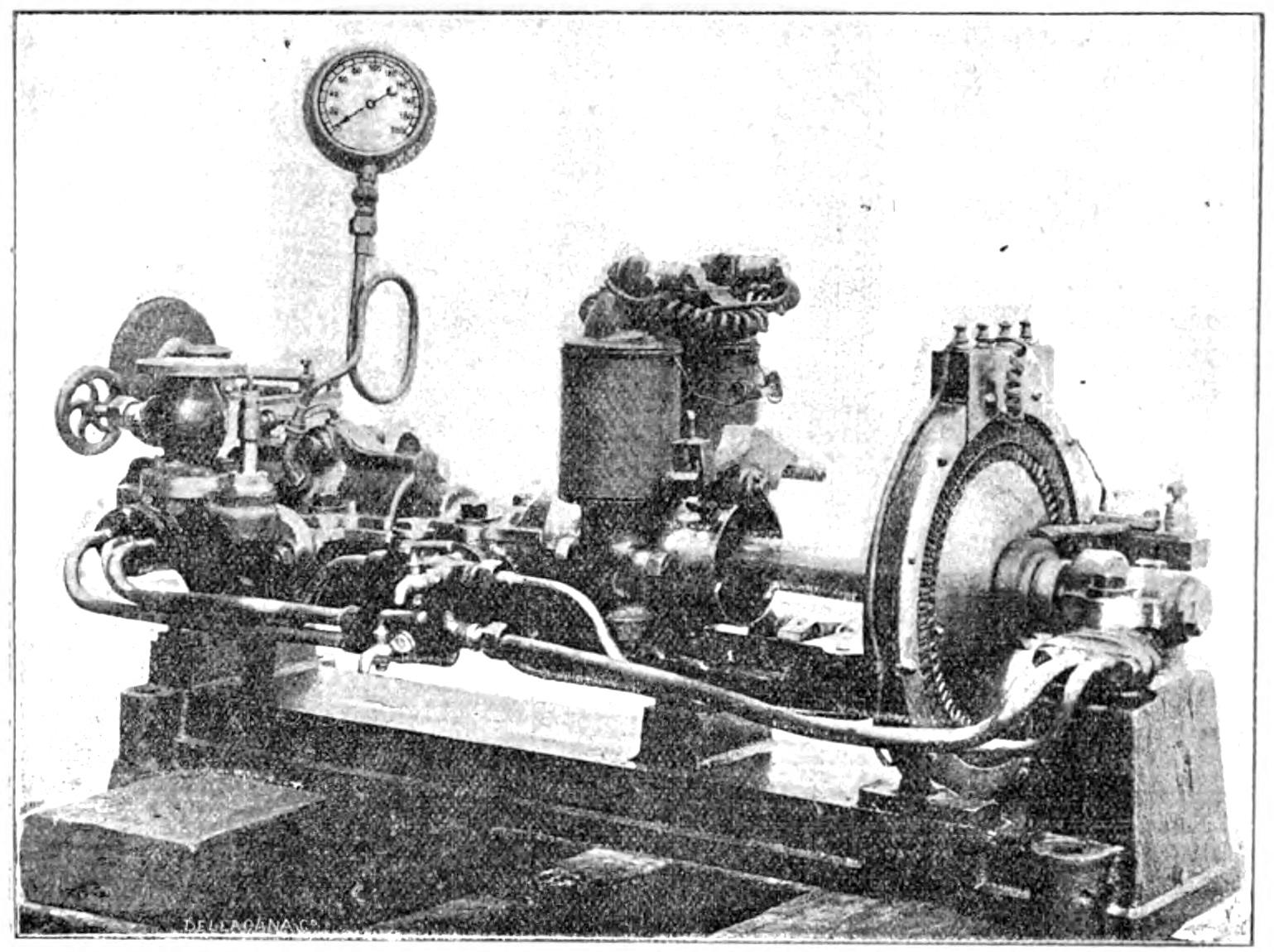
The steam turbine combined with two dynamos on one shaft, which we illustrate, has been presented by Messrs. C. A. Parsons and Co., of Newcastle, to the Engineering Laboratory of Cambridge. Its chief point of interest is that one of the dynamos, designed by Professor Ewing, has a periodicity of 14,000 complete cycles per second at 12,000 revolutions per minute.
There are two distinct dynamos — one of the usual two-poled type, with a continuous current armature for an output of 15 amperes at 100 volts. This armature can be converted into an alternator by slipping two contact rings on the commutator, each ring being connected to diametrically opposite segments of the commutator and insulated from the others; the magnets being in this case separately excited. An output of 20 amperes at 40 volts, with a periodicity of 200 cycles per second, is obtained.
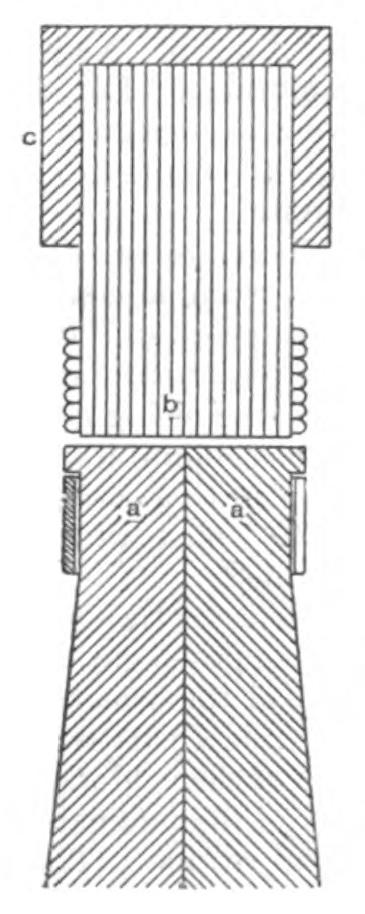
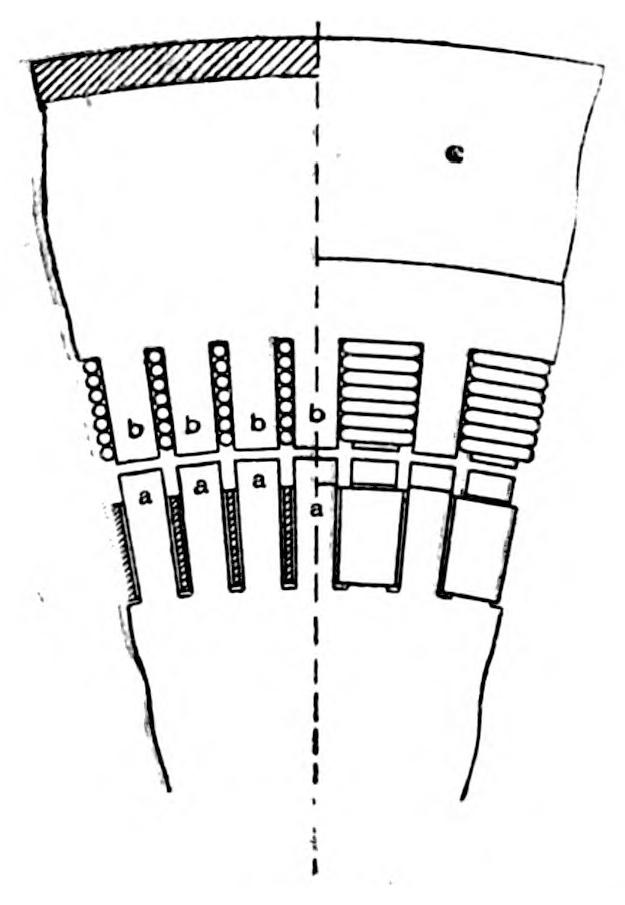
Professor Ewing's alternator is complete in itself, and is bolted on to a prolongation of the bedplate. The construction of the poles of the armature and field magnet is shown in Figs. 2 and 3. Fig. 2 is a part section and part elevation showing several poles. a a a of the field-magnet, which revolves, and corresponding poles b b b of the laminated armature, which is stationary. Fig. 3 is a radial section. The poles a a a (140 in number) are made by toothing a pair of mild steel discs which are placed back to back, as is shown in Fig. 3, and the poles b b b are made by toothing a ring of 60 sheet iron plates, each about 10 mils thick, which are clasped together by a cast-iron supporting ring c c. The armature ring is bored 1/32 in. larger than the magnet disc and sawn radially by 140 cuts 3/8 in. deep. The winding of a a a is done with insulated copper strip, which is held from flying out by the projecting lip or fillet which appears on each side of the poles in Fig. 3. The winding of the armature poles b b b is done with insulated wire of a considerably finer gauge than that shown in the illustration. Both windings are put on in zigzag fashion. The two discs into which the revolving field-magnet is divided are insulated from one another, and are used as conductors between the brushes by which the exciting current enters and the copper tape with which the teeth are wound. These two discs form mechanically a single disc of conical form, thickest near the axis to give it strength to resist the centrifugal force due to the high speed of rotation. The whole arrangement has the effect of reducing the revolving parts to the utmost simplicity — a matter of some consequence when the speed is 12,000 revolutions per minute.
It will be seen that there are 70 complete cycles of current per revolution, and at 12,000 revolutions per minute this gives 14,000 complete cycles per second. The output is about 5 amperes at 100 volts. It is, we believe, intended to carry out a series of experiments on the physiological effects of alternating currents of high frequency, as well as other interesting investigations.