Nikola Tesla Articles
Experiments with Currents of High Tension and Great Frequency
Mr. Tesla, on May 20, 1891, presented to Columbia College the striking results of his very original experiments with alternating currents of great frequency, and in 1892 came to Paris and repeated his experiments before the Society of Physics and the Society of Electricians. Mr. Tesla pointed out a simple method of producing alternating currents of great frequency based upon the properties of induction coils and condensers.
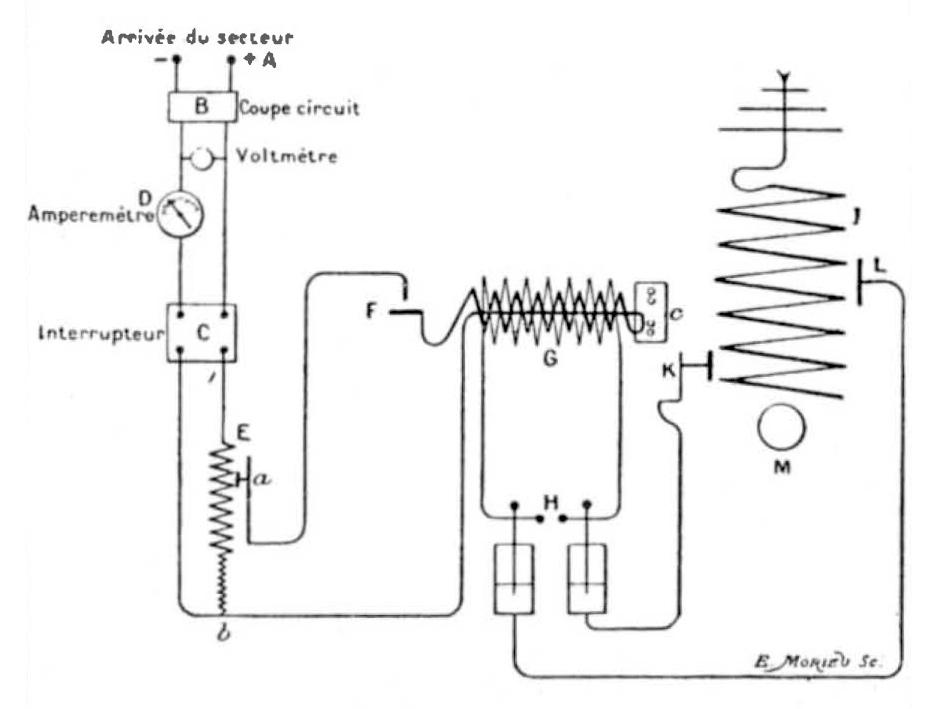
A, beginning of the sector; B, circuit breaker; C, bipolar interrupter; D, amperemeter; E, potential reducer; F, vibrator; G, induction coil; H, the D'Arsonval arrangement; K, L, contacts upon the resonator; I, resonator; M, handwheel.
The secondary terminals of a high tension coil are connected with the internal armatures of a Leyden jar which discharges itself disruptively. This disruptive discharge produces alternating currents of great frequency. This process presents a great interest, in that it permits of resuming and completing Tesla's experiments without having recourse to special apparatus that few scientists have at their disposal. The experiments, in fact, have been very numerous, the apparatus have been improved, and new results have been obtained in every direction. We have no intention of speaking of all these experiments and of all these apparatus, and much less of the diverse theories that have been put forth to explain the phenomena. We desire simply to describe the various experiments that M. Radiguet recently performed at the Exposition of the Centennial of the Conservatoire des Arts et Metiers in employing Dr. Oudin's resonators of great frequency. The principle of the production of currents of great frequency is the same as that indicated above. The diagram in Fig. 1 shows the whole arrangement employed. A derived current of 110 volts is taken upon the sector at A. This traverses a circuit breaker, B, an interrupter, C, an amperemeter, D, and a potential reducing rheostat, E. By means of the wire fixed at b, the current passes into the primary circuit of the coil, G, traverses a special interrupter, F, and returns, at a, to a sliding contact capable of moving over the spirals of the rheostat. At the terminals of the secondary circuit of the coil there is, at H, the D'Arsonval arrangement for the production of currents of great frequency by means of an arc between the two armatures of a Leyden jar. The two external armatures of the jar are connected with the resonator, I. We shall now enter into the details of the various apparatus.
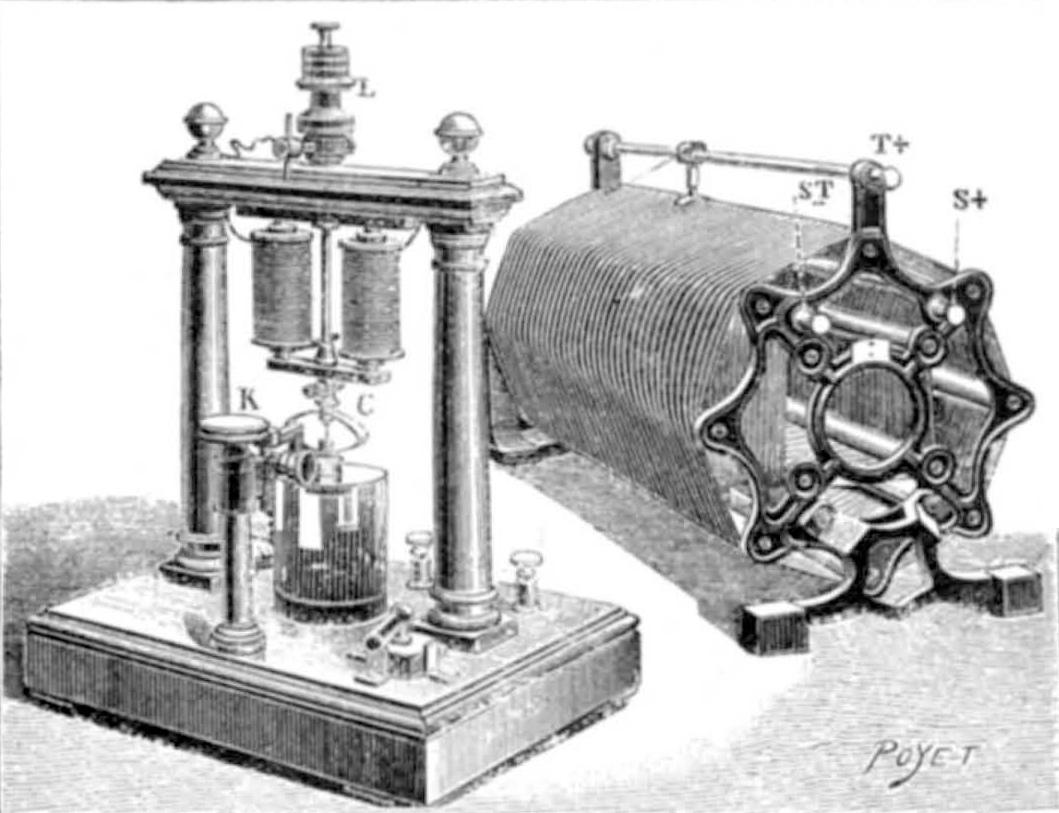
The potential reducing rheostat (Fig. 2) is formed of a German silver wire wound around a frame. This wire is of great length. It will be remarked, also, that in the interior there is a second frame upon which wire is wound. This rheostat is placed directly upon the 110 volt circuit. The intensity that traverses it during the experiments varies from 2 to 12 amperes, and the maximum resistance is 200 ohms. It is, as we have pointed out, by means of collectors at the different points of the resistance that we obtain the difference of potential and the intensity necessary for the operation of the induction coil.
The regulation is very easy, in consequence of the diameter of the wire, which permits of a ready sliding of the external terminal.
The interrupter, F (Fig. 2), is formed of a double electromagnet held between two columns. At the center there is a rod which carries a soft iron armature movable in front of the poles of the electromagnets. A screw, L, placed at the upper part, permits of regulating the travel of the armature. This latter carries a small copper rod, which rests upon a spring formed of two curved strips of copper, C. At the extremity of the spring is placed a slightly conical copper rod.
Beneath the latter there is arranged a block of copper held upon the side by a curved rod with a micrometer screw, K, that permits of displacing the block at will. It is between the conical rod and the block of copper that appears the rupture arc, which is analogous to the voltaic. In order to prevent rapid deterioration, the contacts are immersed in kerosene contained in the vessel that may be seen in the figure. It is thus possible to regulate the contacts very easily by acting upon the travel of the armature and the block of copper. This interrupter operates very rapidly and answers very well for great frequencies.
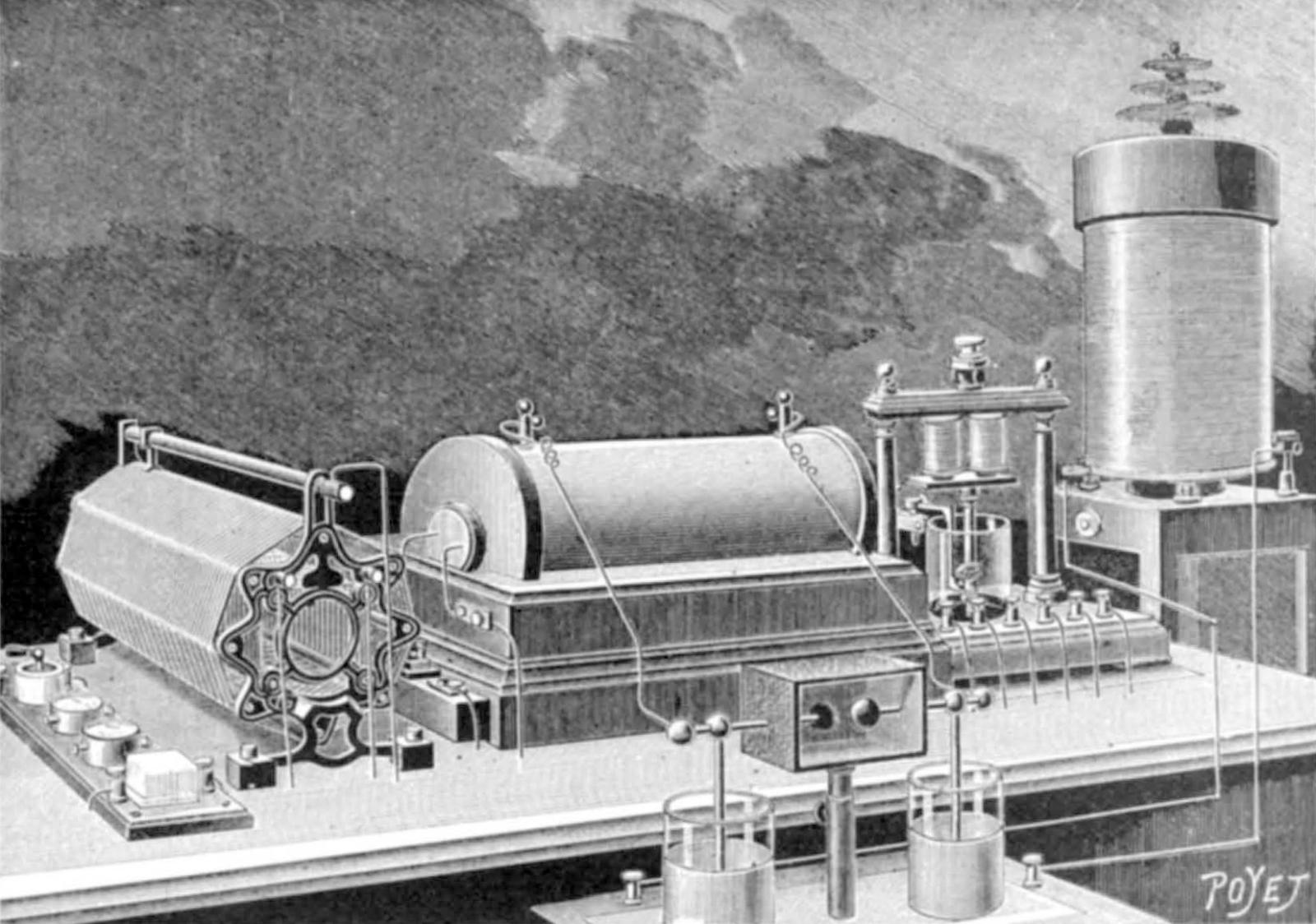
At G is the induction coil, which gives22 inch sparks, and which is mounted in a bath of paraffine, which insulates the lower parts of the condensers. At c, upon the side, are the collectors for the condensers of variable capacity, permitting of causing the effects to vary.
Afterward, at H, we find the D'Arsonval arrangement for the production of alternating currents of great frequency. The extremities of the induced wire of the induction coil are connected with the internal armatures of a Leyden jar. The external armatures are connected with the Oudin resonator, I.
Dr. Oudin, as long ago as 1892, showed that it was possible to obtain currents of very high tension by employing a sort of resonator formed of a solenoid composed of several spirals of coarse wire of feeble resistance. The extremities of this wire are connected with the terminals of a source of currents of great frequency. Such a result is obtained only for certain determinate values of capacity and of self-induction of the solenoid. A general view of the apparatus used for such experiments is given in Fig. 4.
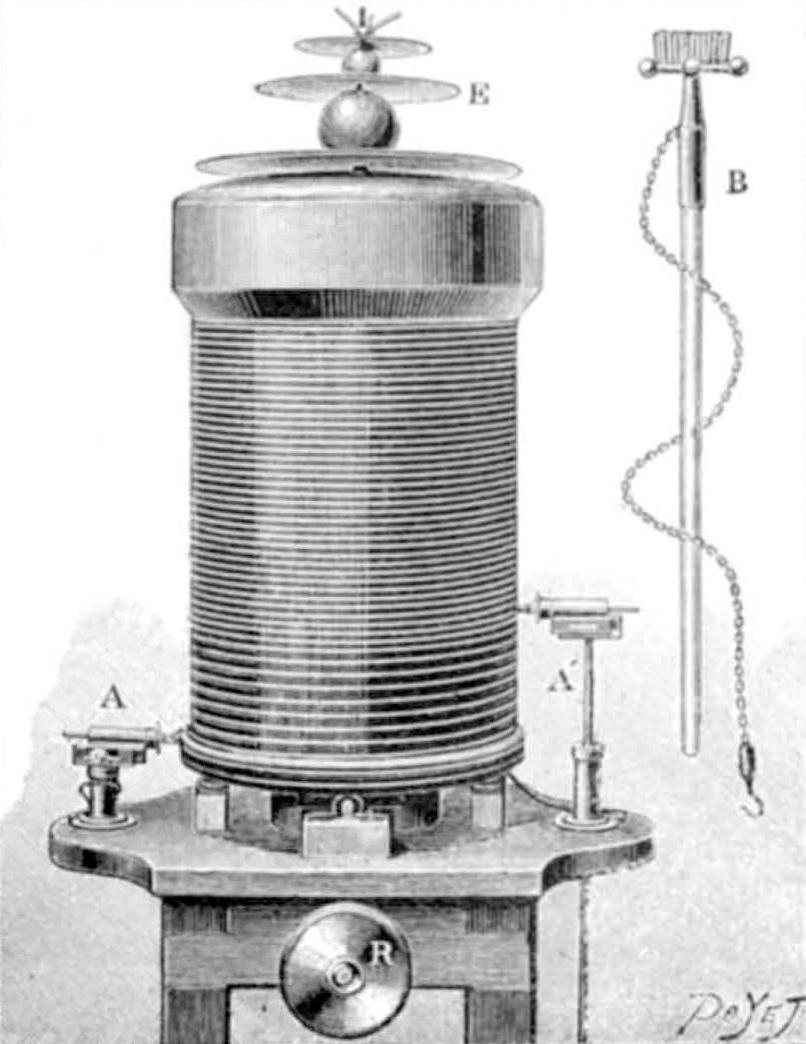
M. Radiguet, from instructions given by Dr. Oudin, has constructed a new resonator (Fig. 3) formed of a solenoid of noninsulated copper wire surrounding a cylinder of paraffined wood. The wire is 1/10 inch in diameter and 195 feet in length, and the spacing of the spirals is 4/10 inch. One of the external armatures in the D'Arsonval arrangement is connected directly with a sliding contact, A, at the extremity of the solenoid. The other ends at a contact, A', placed upon the side at a higher level. The contacts are fixed and the solenoid is movable around a vertical axis. It may be displaced by means of a tangent screw, through a handwheel, R, so as to increase or diminish the number of the spirals in each of the parts of the solenoid. The resonator is thus divided into two parts. At the lower part are produced the oscillations of great frequency and at the upper part are found the currents of great frequency and of very high tension.
This apparatus, which Dr. Oudin studied with a purely therapeutic object in view, has been ably put to profit by Mr. Radiguet in the performance of the most curious and suggestive experiments, some of which are represented in Fig. 5. After the apparatus has been thoroughly regulated, we may, upon placing the hand near it, see violet aigrettes from 6 to 8 inches in length make their appearance. The resonator creates all around it, from top to bottom within a circle of 6 1/2 feet radius, a very intense alternating electrostatic field, and it is possible, by simply holding them in the hand, to render a number of Geissler or Crookes tubes luminous. The number of the experiments may be varied to infinity. We may mention in particular those of the umbrella and the cord shown in our figure. If a wire be attached to the upper part of the resonator and be made to revolve, we shall perceive a luminous cord whence shoots a series of violet aigrettes; so, too, if an umbrella be placed in the field, we shall see all the ribs become luminous.
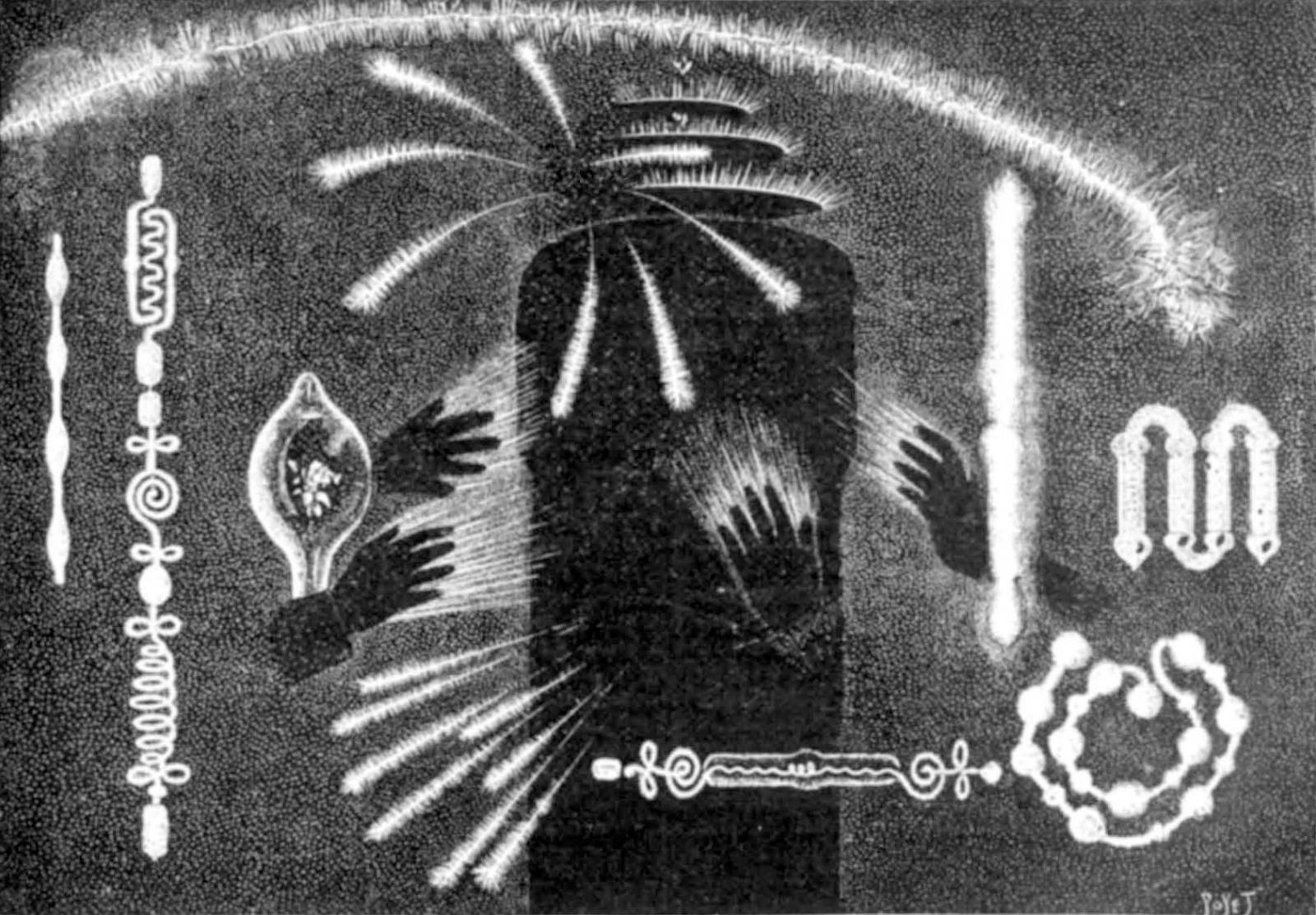
This is only the beginning of the applications of this apparatus; but who can say where we shall stop, now that it is possible easily to create a powerful and quite extensive electrostatic field? In a short time dancers will appear upon the stage of the theater carrying objects that will be luminous without being connected with any source. The success obtained by M. Radiguet at the Exposition of the Centennial of the Conservatoire des Arts et Metiers is a sure guarantee to us that his experiments greatly interested the scientific world and the public.
For the above particulars and the illustrations we are indebted to La Nature.