Nikola Tesla Articles
Tesla's Utilization of Electrical Effects and Radiant Energy
Following close upon the patent for “Means for Increasing the Intensity of Electrical Oscillations” that was granted to Nikola Tesla on October 22d (illustrated description of which was given in the Western Electrician of November 2d) comes a series of six patents relating to the utilization of radiant energy and effects transmitted through natural media, such as the air and earth, that, seemingly, are of much greater importance. These patents, numbered consecutively from 685,953 to 685,958, were issued by the United States Patent Office on November 5th. From their evident basic nature the patents may have an important bearing upon the project for the transmission of messages long distances through space, which Mr. Tesla is known to have been working upon for some time.
In his introductory remarks Mr. Tesla recognizes that in wireless telegraphy, as commonly known, the electrical impulses reach a very distant receiving station in an extremely feeble and attenuated condition. So extremely feeble are these impulses that it is easy to discern the limitations of wireless telegraphy as today practiced.
Generally expressed, Mr. Tesla seeks to achieve results hitherto unobtainable in utilizing the feeble electrical effects transmitted through the air or the earth, by accumulating in a “storage device” the energy of succeeding impulses for a sufficient interval of time to render the sudden liberation of the accumulated charge highly effective in operating a receiver. He uses as a “storage device” a condenser. This he deems the most efficient electrical storage device known to him for this purpose.
A crude illustration of the method underlying the patents may be taken by considering a small waterwheel and a tiny stream of water — so tiny that one could hardly see or feel it — a stream that comes really not in a steady stream but in impulses, so to speak, one little spurt of water at a time. The question of having this tiny stream of impulses, each impulse having but very little energy, move and drive a comparatively bulky waterwheel is somewhat analogous to the problem Mr. Tesla has undertaken to solve — that of utilizing the feeble electrical effects transmitted through a considerable distance. In the hydraulic analogy a solution would be to collect the water of the tiny stream in a reservoir, and, when enough has accumulated to produce the desired movement, to turn it upon the wheel. Mr. Tesla’s solution of the electrical problem is to employ a “storage device” — preferably a condenser.
The six patents to be described may be considered in three sets of two each. In patent No. 685,954, the application for which was filed on August 1, 1899, and renewed on May 29, 1901, the inventor describes a “Method of Utilizing Effects Transmitted Through Natural Media.” In describing his invention Mr. Tesla writes as follows:
“My invention is particularly useful in connection with methods and apparatus for operating distant receiving devices by means of electrical disturbances produced by proper transmitters and conveyed to such receiving devices through the natural media; but it obviously has a wider range of applicability and may be employed, for example, in the investigation or utilization of terrestrial, solar, or other disturbances produced by natural causes.
“Several ways or methods of transmitting electrical disturbances through the natural media and utilizing them to operate distant receivers are now known and have been applied with more or less success for accomplishing a variety of useful results.
“One of these ways consists in producing, by a suitable apparatus, rays or radiations — that is, disturbances — which are propagated in straight lines through space, directing them upon a receiving or recording apparatus at a distance, and thereby bringing the latter into action. This method is the oldest and best known and has been brought particularly into prominence in recent years through the investigations of Heinrich Hertz.
“Another method consists in passing a current through a circuit, preferably one enclosing a very large area, inducing thereby in a similar circuit situated at a distance another current and affecting by the same in any convenient way a receiving device.
“Still another way, which has also been known for many years, is to pass in any suitable manner a current through a portion of the ground, as by connecting to two points of the same, preferably at a considerable distance from each other, the two terminals of a generator and to energize by a part of the current diffused through the earth a distant circuit, which is similarly arranged and grounded at two points widely apart and which is made to act upon a sensitive receiver.
“These various methods have their limitations, one especially, which is common to all, being that the receiving circuit or instrument must be maintained in a definite position with respect to the transmitting apparatus, which often imposes great disadvantages upon the use of the apparatus.
“In several applications filed by me and patents granted to me I have disclosed other methods of accomplishing results of this nature, which may be briefly described as follows: In one system the potential of a point or region of the earth is varied by imparting to it intermittent or alternating electrifications through one of the terminals of a suitable source of electrical disturbances, which, to heighten the effect, has its other terminal connected to an insulated body, preferably of large surface and at an elevation. The electrifications communicated to the earth spread in all directions through the same, reaching a distant circuit, which generally has its terminals arranged and connected similarly to those of the transmitting source and operates upon a highly sensitive receiver.
“Another method is based upon the fact that the atmospheric air, which behaves as an excellent insulator to currents generated by ordinary apparatus, becomes a conductor under the influence of currents or impulses of enormously high electromotive force which I have devised means for generating. By such means air strata, which are easily accessible, are rendered available for the production of many desired effects at distances however great. This method, furthermore, allowed advantage to be taken of many of those improvements which are practicable in the ordinary systems of transmission involving the use of a metallic conductor.
“Obviously, whatever method be employed, it is desirable that the disturbances produced by the transmitting apparatus should be as powerful as possible, and by the use of certain forms of high frequency apparatus which I have devised and which are now well known, important practical advantages are in this respect secured.
“Furthermore, since in most cases the amount of energy conveyed to the distant circuit is but a minute fraction of the total energy emanating from the source, it is necessary, for the attainment of the best results, that whatever the character of the receiver and the nature of the disturbances as much as possible of the energy conveyed should be made available for the operation of the receiver, and, with this object in view, I have, heretofore, among other means, employed a receiving circuit of high self-induction and very small resistance and of a period such as to vibrate in synchronism with the disturbances, whereby a number of separate impulses from the source were made to co-operate, thus magnifying the effect exerted upon and insuring the action of the receiving device. By these means decided advantages have been secured in many instances; but very often the improvement is either not applicable at all, or, if so, the gain is very slight.
“Evidently, when the source is one producing a continuous pressure or delivering impulses of long duration, it is impracticable to magnify the effects in this manner, and when, on the other hand, it is one furnishing short impulses of extreme rapidity of succession, the advantage obtained in this way is insignificant, owing to the radiation and the unavoidable frictional waste in the receiving circuit. These losses reduce greatly both the intensity and the number of the co-operative impulses, and, since the initial intensity of each of these is necessarily limited only an insignificant amount of energy is thus made available for a single operation of the receiver. As this amount is consequently dependent on the energy conveyed to the receiver by one single impulse, it is evidently necessary to employ either a very large and costly, and therefore objectionable transmitter or else to resort to the equally objectionable use of a receiving device too delicate and too easily deranged. Furthermore, the energy obtained through the co-operation of the impulses is in the form of extremely rapid vibrations, and, because of this, unsuitable for the operation of ordinary receivers, the more so as this form of energy imposes narrow restrictions in regard to the mode and time of its application to such devices.
“To overcome these and other limitations and disadvantages that have heretofore existed in such systems of transmission of signals or intelligence and to render possible an investigation of impulses or disturbances propagated through the natural media from any kind of source and their practical utilization for any purpose to which they are applicable, I have devised a novel method, which, broadly stated, consists in effecting during any desired time interval a storage of energy derived from such impulses and utilizing the potential energy so obtained for operating a receiving device.
“The best way of carrying out my invention which I at present know is to store electrical energy obtained from a suitable electrical generator in a condenser and to control the storage or the application of this energy by means of a sensitive device acted upon by the effects or disturbances, and thereby cause the operation of the receiver.
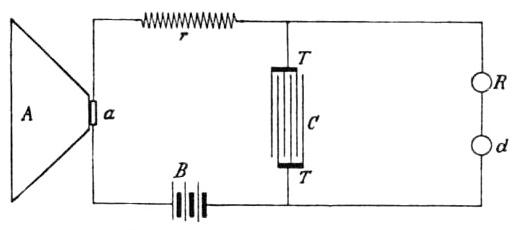
“The general principle underlying my invention and the operation of the various devices used will be clearly understood by a reference to the accompanying drawing (Fig. 1), which is a diagram illustrating a typical arrangement of apparatus which may be used in carrying my method into practice. “In Fig. 1 (C) is a condenser, to the terminals (T) and (T) of which is connected a charging circuit including a battery (B), a sensitive device (a), and a resistance (r), all connected in series, as illustrated. The battery should be preferably of very constant electromotive force and of an intensity carefully determined to secure the best results. The resistance (r), which may be a frictional or an inductive one, is not absolutely necessary; but it is of advantage to use it in order to facilitate adjustment, and for this purpose it may be made variable in any convenient and preferably continuous manner.
“Assuming that the disturbances which are to be investigated or utilized for some practical end are rays identical with or resembling those of ordinary light, the sensitive device (a) may be a selenium cell properly prepared, so as to be highly susceptible to the influence of the rays, the action of which should be intensified by the use of a reflector (A), shown in the drawing. It is well known that when cells of this kind are exposed to such rays of greatly varying intensity they undergo corresponding modifications of their electrical resistance; but in the ways they have been heretofore used they have been of very limited utility.
“In addition to the circuit including the sensitive device or cell (a), another circuit is provided, which is likewise connected to the terminals (T) (T) of the condenser. This circuit, which may be called the ‘receiving circuit,’ includes the receiver (R), and in series with it a device (d) before referred to, which performs the duty of periodically discharging the condenser through the receiver.
“From the foregoing the operation of the apparatus as illustrated in Fig. 1 will be at once understood. Normally — that is, when it is not influenced by the rays at all or very slightly — the cell (a) being of a comparatively high resistance, permits only a relatively feeble current to pass from the battery into the condenser, and hence the latter is charged at too slow a rate to accumulate during the time interval between two succeeding operations of the device (d), sufficient energy to operate the receiver, or, generally speaking, to produce the required change in the receiving circuit.
“This condition is readily secured by a proper selection and adjustment of the various devices described, so that the receiver will remain unresponsive to the feeble discharges of the condenser, which may take place when the cell (a) is acted upon but slightly or not at all by the rays or disturbances; but if now new rays are permitted to fall upon the cell or if the intensity of those already acting upon it be increased by any cause, then its resistance will be diminished and the condenser will be charged by the battery at a more rapid rate, enabling sufficient potential energy to be stored in the condenser during the period of inaction of the device (d) to operate the receiver or to bring about any desired change in the receiving circuit when the device (d) acts.
“If the rays acting upon the cell or sensitive device (a) are varied or intermitted in any arbitrary manner, as when transmitting intelligence in the usual way from a distant station by means of short and long signals, the apparatus may readily be made to record or to enable an operator to read the message, since the receiver, supposing it to be an ordinary magnetic relay, for example, will be operated by each signal from the sending station a certain number of times having some relation to the duration of each signal. It will be readily seen, however, that if the rays are varied in any other way, as by impressing upon them changes in intensity, the succeeding condenser discharges will undergo corresponding changes in intensity, which may be indicated or recorded by a suitable receiver and distinguished irrespectively of duration.
“It will be observed that the condenser is an important element in the combination. I have shown that, by reason of its unique properties, it greatly adds to the efficacy of this method. It allows the energy accumulated in it to be discharged instantaneously, and therefore in a highly effective manner. It magnifies in a large degree the current supplied from the battery, and, owing to these features, it permits energy to be stored and discharged at practically any rate desired, and thereby makes it possible to receive in the retaining circuit very great changes of the current strength by impressing upon the battery current very small variations. Other means of storage possessing these characteristics to a useful degree may be employed without departing from the broad spirit of my invention; but I prefer to use a condenser, since, in these respects, it excels any other storage device of which I have knowledge.
“By carefully observing well-known rules of scientific design and adjustment of the instruments the apparatus may be made extremely sensitive and capable of responding to the feeblest influences, thus making it possible to utilize impulses or disturbances transmitted from very great distances and too feeble to be detected or utilized in any of the ways heretofore known, and, on this account, the method here described lends itself to many scientific and practical uses of great value.” Patent No. 685,956, the application for which is a division of the original application which included the preceding patent, covers the "Apparatus for Utilizing Effects Transmitted Through Natural Media" and is essentially the same as the "method" patent just described.
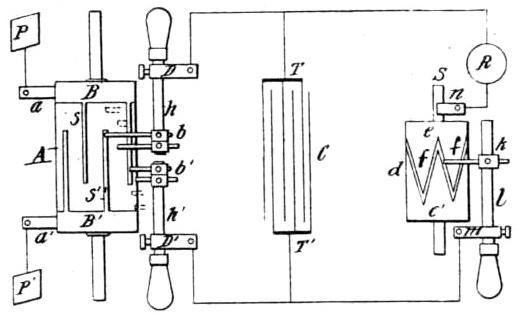
To intensify the feeble and attenuated electrical effects referred to in the first patent, Mr. Tesla employs a method, the apparatus for which is diagrammatically illustrated in Fig. 2. This method is patented under No. 685,953, while the apparatus therefor is covered by patent No. 685,955, its application being a division of the original "method" application, which was filed on June 24, 1899, and renewed on May 29, 1901.
This apparatus consists of a cylinder (A) of insulating material, which is moved at a uniform rate of speed by clockwork or other suitable motive power, and is provided with two metal rings (B) (B'), upon which bear brushes (a) and (a'), which are connected, respectively, to the terminal plates (P) and (P'). From the rings (B) (B') extend narrow metallic segments (s) and (s'), which, by the rotation of the cylinder (A) are brought alternately into contact with double brushes (b) and (b'), carried by and in contact with conducting holders (h) and (h'), which are adjustable longitudinally in the metallic supports (D) and (D'). The latter are connected to the terminals (T) and (T') of a condenser (C), and are capable of angular displacement, as ordinary brush supports. The object of using two brushes, as (b) and (b'), in each of the holders (h) and (h'), is to vary at will the duration of the electric contact of the plates (P) and (P') with the terminals (T) and (T'), to which is connected a receiving circuit, including a receiver (R) and a device (d), which performs the duty of closing the receiving circuit at predetermined intervals of time and discharging the stored energy through the receiver.
In the present case this device consists of a cylinder (d), made partly of conducting and partly of insulating material (e) and (e'), respectively, which is rotated at the desired rate of speed by any suitable means. The conducting part (e) is in good electrical connection with the shaft (S), and is provided with tapering segments (f) (f), upon which slides a brush (k), supported on a conducting rod (l), capable of longitudinal adjustment in a metallic support (m). Another brush (n) is arranged to bear upon the shaft (S), and it will be seen that whenever one of the segments (f) comes in contact with the brush (k) the circuit, including the receiver (R), is completed and the condenser discharged through the same.
By an adjustment of the speed of rotation of the cylinder (d) and a displacement of the brush (k) along the cylinder the circuit may be made to open and close in as rapid succession and remain open or closed during such intervals of time as may be desired. The plates (P) and (P'), through which the electrifications are conveyed to the brushes (a) and (a'), may be at a considerable distance from each other and both in the ground or both in the air, or one in the ground and the other in the air, preferably at some height, or they may be connected to conductors extending to some distance or to the terminals of any kind of apparatus supplying electrical energy which is obtained from the energy of the impulses or disturbances transmitted from a distance through the natural media.
It is the function of the cylinder (A) with its brushes and connections to render the electrical impulses coming from the plates (P) and (P') suitable for charging the condenser by rectifying them when they are originally alternating in direction or by selecting such parts of them as are suitable when all are not.
When the apparatus is used in connection with the transmission of signals or intelligence, "it will, of course, be understood," says Mr. Tesla, "that the transmitter is operated in such a way as to produce disturbances or effects which are varied or intermitted in some arbitrary manner — for example, to produce longer and shorter successions of impulses, corresponding to the dashes and dots of the Morse alphabet — and the receiving device will respond to and indicate these variations or intermittences, since the storage device will be charged and discharged a number of times corresponding to the duration of the successions of impulses received."
Referring to the importance of this invention, Mr. Tesla says: "It will be seen that by the use of my invention results hitherto unattainable in utilizing disturbances or effects transmitted through natural media may be readily attained, since however great the disturbance of such transmission and however feeble or attenuated the impulses received enough energy may be accumulated from them by storing up the energy of succeeding impulses for a sufficient interval of time to render the sudden liberation of it highly effective in operating a receiver. In this way receivers of a variety of forms may be made to respond effectively to impulses too feeble to be detected or to be made to produce any sensible effect in any other way of which I am aware — a result of great value in scientific research, as well as in various applications to practical use."
The third set of Mr. Tesla's patents, Nos. 685,957 and 685,958, cover, respectively, the apparatus and the method of utilizing radiant energy. Applications for both were filed on March 21, 1901. The invention described bears a close connection to those described in the preceding patents and is exceedingly interesting and novel. In his description he says:
"It is well known that certain radiations — such as those of ultra-violet light, cathodic, Roentgen rays, or the like — possess the property of charging and discharging conductors of electricity, the discharge being particularly noticeable when the conductor upon which the rays impinge is negatively electrified. These radiations are generally considered to be ether vibrations of extremely small wave lengths, and in explanation of the phenomena noted it has been assumed by some authorities that they ionize or render conducting the atmosphere through which they are propagated. My own experiments and observations, however, lead me to conclusions more in accord with the theory heretofore advanced by me that sources of such radiant energy throw off with great velocity minute particles of matter which are strongly electrified, and therefore capable of charging an electrical conductor, or, even if not so, may at any rate discharge an electrified conductor, either by carrying off bodily its charge or otherwise.
"My present application is based upon a discovery which I have made that when rays or radiations of the above kind are permitted to fall upon an insulated conducting body connected to one of the terminals of a condenser, while the other terminal of the same is made by independent means to receive or to carry away electricity, a current flows into the condenser so long as the insulated body is exposed to the rays, and under the conditions hereinafter specified an indefinite accumulation of electrical energy in the condenser takes place. This energy, after a suitable time interval, during which the rays are allowed to act, may manifest itself in a powerful discharge, which may be utilized for the operation or control of mechanical or electrical devices or rendered useful in many other ways.
"In applying my discovery I provide a condenser, preferably of considerable electrostatic capacity, and connect one of its terminals to an insulated metal plate or other conducting body exposed to the rays or streams of radiant matter. It is very important, particularly in view of the fact that electrical energy is generally supplied at a very slow rate to the condenser, to construct the same with the greatest care. I use by preference the best quality of mica as dielectric, taking every possible precaution in insulating the armatures, so that the instrument may withstand great electrical pressures without leaking, and may leave no perceptible electrification when discharging instantaneously. In practice I have found that the best results are obtained with condensers treated in the manner described in a patent granted to me February 23, 1897, No. 577,671.
"The rays or radiations which are to be utilized for the operation of the apparatus may be derived from a natural source, as the sun, or may be artificially produced by such means, for example, as an arc lamp, a Roentgen tube, and the like, and they may be employed for a great variety of useful purposes.
"My discovery will be more fully understood from the following detailed description and annexed drawing, to which reference is now made.
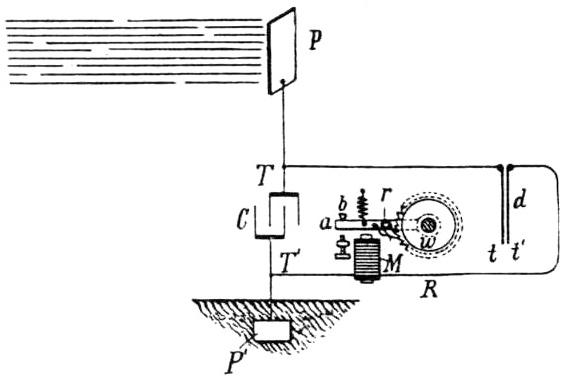
"Fig. 3 is a diagram showing typical forms of the devices or elements as arranged and connected in applying the method for the operation of a mechanical contrivance or instrument solely by the energy stored. (C) is the condenser, (P) the insulated plate or conducting body, which is exposed to the rays, and (P') another plate or conductor, all being joined in series, as shown. The terminals (T) (T') of the condenser are also connected to a circuit including a receiver (R) which is to be operated and a circuit-controlling device (d), which, in this case, is composed of two very thin conducting plates (t) (t'), placed in close proximity and very mobile, either by reason of extreme flexibility or owing to the character of their support. To improve their action, they should be enclosed in a receptacle from which the air may be exhausted. The receiver (R) is shown as consisting of an electromagnet (M), a movable armature (a), a retractile spring (b), and a ratchet wheel (w), provided with a spring pawl (r), which is pivoted to armature (a). The apparatus being arranged as shown, it will be found that when the radiations of the sun or of any other source capable of producing the effects before described, fall upon the plate (P) an accumulation of electrical energy in the condenser (C) will result. This phenomenon, I believe, is best explained as follows: The sun, as well as other sources of radiant energy, throw off minute particles of matter positively electrified, which, impinging upon the plate (P), communicate an electrical charge to the same. The opposite terminal of the condenser being connected to the ground, which may be considered as a vast reservoir of negative electricity, a feeble current flows continuously into the condenser, and, inasmuch as these supposed particles are of inconceivably small radius or curvature, and consequently charged to a relatively very high potential, this charging of the condenser may continue, as I have found in practice, almost indefinitely, even to the point of rupturing the dielectric. Obviously, whatever circuit controller be employed, it should operate to close the circuit in which it is included when the potential in the condenser has reached the desired magnitude.