Nikola Tesla Articles
Fluid Propulsion
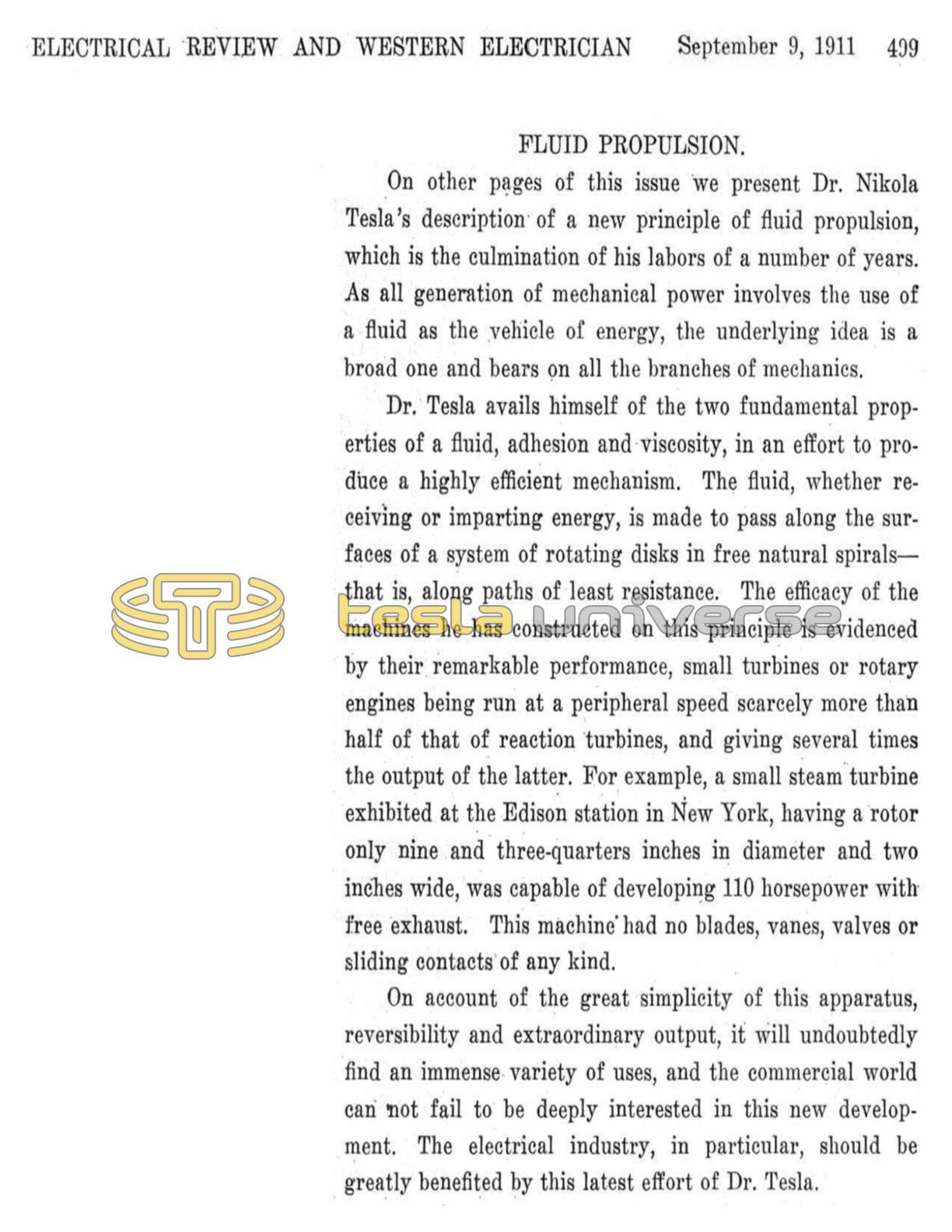
On other pages of this issue we present Dr. Nikola Tesla's description of a new principle of fluid propulsion, which is the culmination of his labors of a number of years. As all generation of mechanical power involves the use of a fluid as the vehicle of energy, the underlying idea is a broad one and bears on all the branches of mechanics.
Dr. Tesla avails himself of the two fundamental properties of a fluid, adhesion and viscosity, in an effort to produce a highly efficient mechanism. The fluid, whether receiving or imparting energy, is made to pass along the surfaces of a system of rotating disks in free natural spirals - that is, along paths of least resistance. The efficacy of the machines he has constructed on this principle is evidenced by their remarkable performance, small turbines or rotary engines being run at a peripheral speed scarcely more than half of that of reaction turbines, and giving several times the output of the latter. For example, a small steam turbine exhibited at the Edison station in New York, having a rotor only nine and three-quarters inches in diameter and two inches wide, was capable of developing 110 horsepower with free exhaust. This machine had no blades, vanes, valves or sliding contacts of any kind.
On account of the great simplicity of this apparatus, reversibility and extraordinary output, it will undoubtedly find an immense variety of uses, and the commercial world can not fail to be deeply interested in this new development. The electrical industry, in particular, should be greatly benefited by this latest effort of Dr. Tesla.