Nikola Tesla Articles
High Frequency Experiments
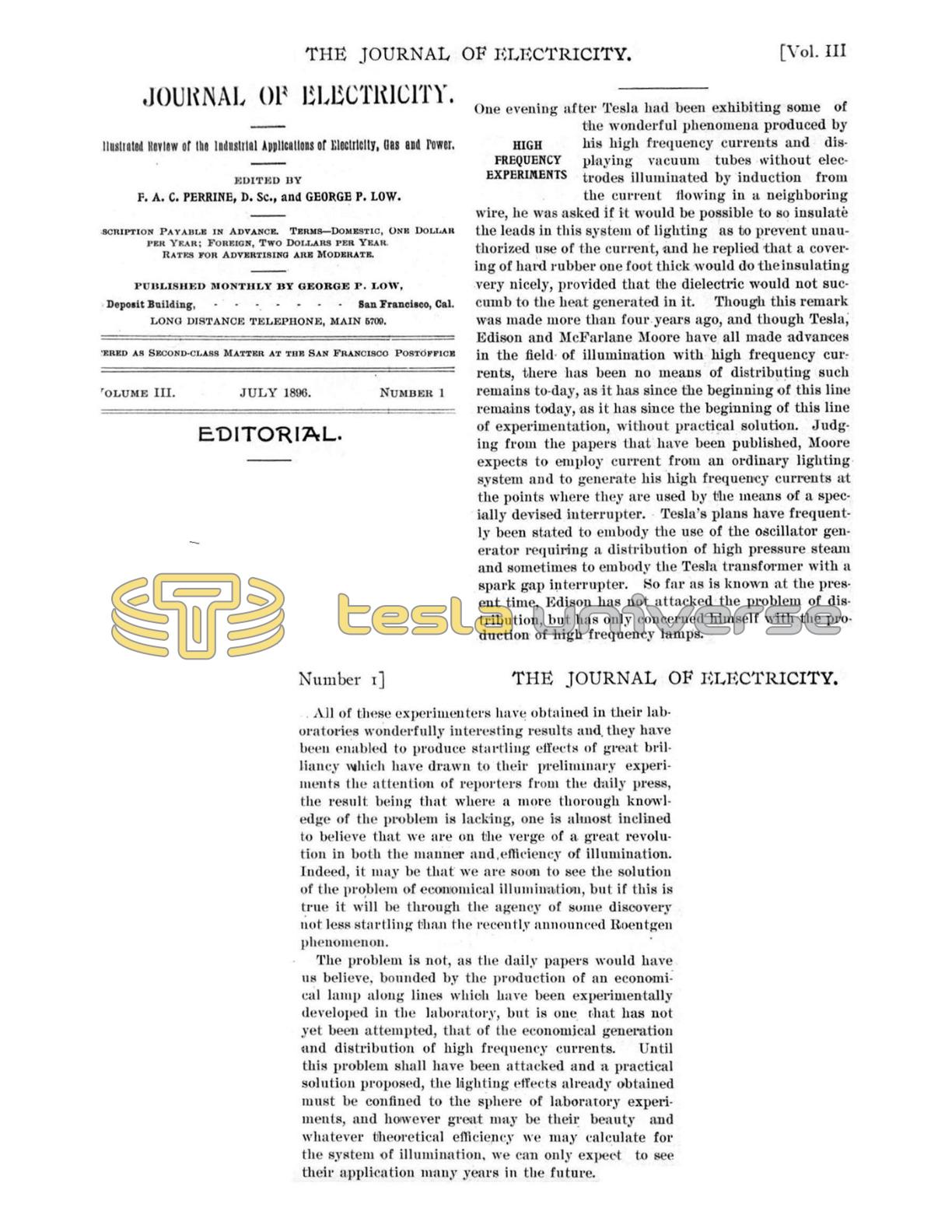
One evening after Tesla had been exhibiting some of the wonderful phenomena produced by his high frequency currents and displaying vacuum tubes without electrodes illuminated by induction from the current flowing in a neighboring wire, he was asked if it would be possible to so insulate the leads in this system of lighting as to prevent unauthorized use of the current, and he replied that a covering of hard rubber one foot thick would do the insulating very nicely, provided that the dielectric would not succumb to the heat generated in it. Though this remark was made more than four years ago, and though Tesla, Edison and McFarlane Moore have all made advances in the field of illumination with high frequency currents, there has been no means of distributing such remains to-day, as it has since the beginning of this line remains today, as it has since the beginning of this line of experimentation, without practical solution. Judg. ing from the papers that have been published, Moore expects to employ current from an ordinary lighting. system and to generate his high frequency currents at the points where they are used by the means of a specially devised interrupter. Tesla's plans have frequently been stated to embody the use of the oscillator generator requiring a distribution of high pressure steam and sometimes to embody the Tesla transformer with a spark gap interrupter. So far as is known at the present time, Edison has not attacked the problem of distribution, but has only concerned himself with the production of high frequency lamps. .. All of these experimenters have obtained in their laboratories wonderfully interesting results and they have been enabled to produce startling effects of great brilliancy which have drawn to their preliminary experiments the attention of reporters from the daily press, the result being that where a more thorough knowledge of the problem is lacking, one is almost inclined to believe that we are on the verge of a great revolution in both the manner and, efficiency of illumination. Indeed, it may be that we are soon to see the solution of the problem of economical illumination, but if this is true it will be through the agency of some discovery not less startling than the recently announced Roentgen phenomenon. The problem is not, as the daily papers would have us believe, bounded by the production of an economical lamp along lines which have been experimentally developed in the laboratory, but is one that has not yet been attempted, that of the economical generation and distribution of high frequency currents. Until this problem shall have been attacked and a practical solution proposed, the lighting effects already obtained must be confined to the sphere of laboratory experiments, and however great may be their beauty and whatever theoretical efficiency we may calculate for the system of illumination, we can only expect to see their application many years in the future.