Nikola Tesla Articles
An Interview with Nikola Tesla
At the present day when many momentous problems in science and international politics are being weighed in the balance of logic and reason, it is a very opportune time, it seems, to listen to the views and ideas entertained on some of these problems by such a famous engineer and scientist as Dr. Nikola Tesla. The interviewer wended his way across Bryant Park in the shadow of the great Astor Library and ascended the 20th floor of an adjoining skyscraper, where Dr. Tesla has his offices and laboratory. Having made known my mission, I asked Dr. Tesla the following questions.
The Disarmament Conference
Q. Do you believe that the Disarmament Conference now being held at Washington will do much good, especially with respect to prevention of war?
A. The extraordinary proposal of Secretary Hughes has produced a favorable impression thruout the world and the remarkable readiness with which it was taken up by the foreign governments is an auspicious beginning. Some agreements as to naval expenditures and status of the Powers in the Pacific have already materialized and that other results of value will follow there can be no doubt. But it is equally evident that they will consist merely of economic measures, which can have only a negligible influence as preventatives of war.
The primary object of the Conference is the reduction of armaments. As the safety of any country depends not on the absolute, but relative, military strength a proportionate reduction of the force and equipment suggests itself naturally as a means of lessening the cost of upkeep. This is a very old idea in the practical application of which insuperable difficulties have been encountered heretofore for want of proper standard of reference. The requirements are different in each individual case and an attempt to make the reduction on the basis of population, area, resources, industry, commerce, or any other national asset, would be manifestly futile. Moreover, participation by every nation is essential to the thoro execution of such a plan, and to arrive at an adjustment satisfactory to all would be next to impossible. All that can be accomplished at present is some equitable treaty between the few leading countries for minimizing the burdens of war, which is highly desirable for economic reasons but leaves the main problem unsolved. The idea that armed conflicts between nations can be prevented by written covenants involves a scientific fallacy. It is an attempt to put effect before the cause. Experience must precede the formulation of laws. Universal peace may be eventually brought about by civilizing forces and agents and international conferences will then only serve the purpose of giving clearer expression to a common desire. Nevertheless, the conclusions reached at Washington may prove of tremendous consequence in time to come, especially for this country which, until lately, has adhered to its traditional policy of isolation.
Nikola Tesla has no doubt one of the greatest intellects of his time. Our readers will be pleased to peruse his latest ideas concerning world matters of interest to all of us. We have stated in our columns before that Dr. Tesla is at least 100 years ahead of our times. Many of his prophecies have come true in the past, and we believe that the words which he addresses to the world thru Science and Invention will be listened to attentively by all.
-EDITOR.
On general principles three courses are open to the United States. One is to continue arming and maintain an overwhelming superiority over other nations. The inexhaustible wealth of this country would easily enable it to keep up the pace and if safety is placed above every other consideration this should be done. The carrying out of the program would call for vast outlays but under the conditions existing American military supremacy might, perhaps, be the best means of insuring general prosperity and welfare. The second is to advocate complete disarmament insofar as the enforcement of law and order would permit. In that case this country would still be safe, as its resources would enable it to prepare for war quicker than any foe. The third is to enter an agreement with other powers, limiting the armaments, which would virtually mean an alliance involving more or less hazard and peril.
As regards the abolishment of war, the measures adopted by the Conference to this end will be as futile as all the previous ones. Opinions on this subject are divided. In the view of some, war is the greatest curse; others think it is a psychological necessity and beneficial — like a storm which clears the atmosphere. There is a perpetual conflict going on between nations as well as individuals. Ordinarily it is merely a competitive struggle, occasionally it becomes a deadly strife. This is primarily due to imperfect mutual understanding and the basic physical cause is the immense extent of the terrestrial globe. The most effective means towards insuring universal harmony and peace is, accordingly the annihilation of distance which must be brought about in three distinct respects: (1) dissemination of intelligence; (2) transmission of energy, and (3) transport of bodies and materials. All this can be done thru the development of the wireless art. As the first step I proposed twenty years ago my World- System which would leave all the present means intact and enable instantaneous transmission from one to any other point of the globe, of signals, speech, pictures and characters of every description. have made important improvements since and am almost assured that a number of comparatively very small and compact plants, with a telephonic range of twelve thousand miles and devoid of high towers, will be put in operation in various countries. Of immeasurably greater consequence, however, will be the wireless transmission of energy, which can be successfully effected by the use of the same underlying principles and will make cheap motive power for all purposes available everywhere. Then it will be possible to propel flying machines at great speed without fuel and thus space will be annihilated and the impediments to contact and mutual understanding removed.
Future Wars
Q. What are your views on science in respect to future wars?
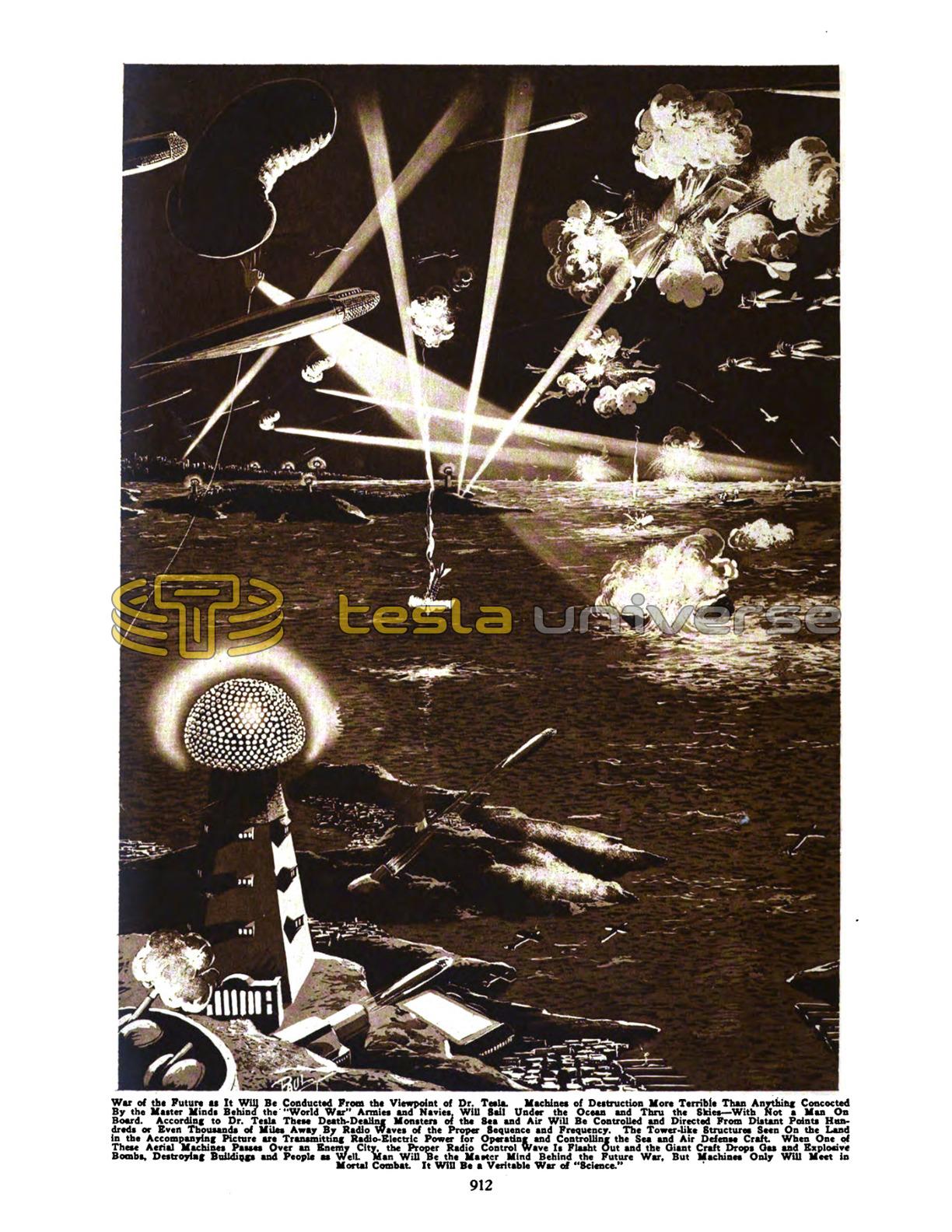
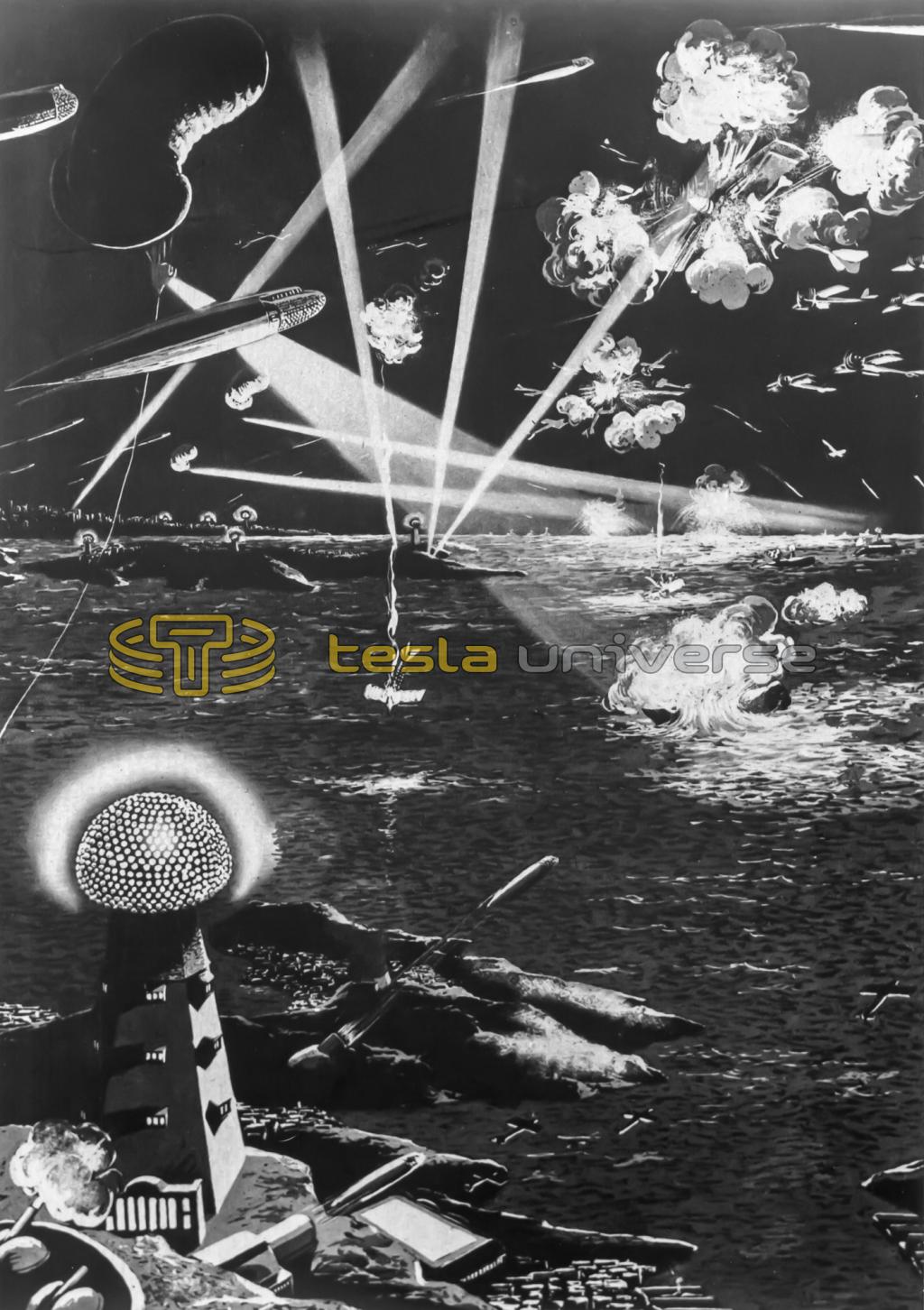
A. Discovery and invention ever tend to intensify the forces and agents for attack and defense. The wars of the future will have no semblance to those waged up to now. They will cause less physical suffering but will be all the more terrible. The countries engaged in the conflict will not send out armies, fleets, or aerial squadrons to meet in battle, but crewless vessels will be launched from one to the other with enormous speed and at distances of thousands of miles. Such apparatus does not exist but could be speedily constructed and in an article on "Telautomatics" which appeared in the ELECTRICAL EXPERIMENTER (former name of SCIENCE AND INVENTION) of October, 1919, I have endeavored to convey an idea of the same. These infernal engines will drop quantities of poisonous gases and other destructive chemicals on any city or place, the geographical position of which is accurately known. Battleships, guns, torpedoes, submarines and even manned flying machines will become of trifling importance and there will be no need for admirals, generals, or commanders of forces, as all the work will be done by electricians, engineers and mechanics.
International agreements will not stop war, for the simple reason that they will be ignored the moment the life of the nation is at stake. To preserve itself it will sacrifice everything else. That is why Germany violated the neutrality of Belgium and why Italy deserted her allies. Before universal peace can be attained the whole human race must be changed for the better, thru closer contact and cultivation of a higher ideal, which will gradually supplant that of patriotism.
Is There Vegetation and Life on the Moon?
Q. Do you believe that there is vegetation and life on the moon, which we have always been taught possesses no atmosphere capable of supporting such?
A. I have read with great interest the announcements of Professor Pickering, as well as some adverse comments on the same. Personally I am inclined to place greater faith in the statements of a pains-taking specialist than in the opinions of those who have not studied the subject, however competent they might be otherwise. The observations of this astronomer, if confirmed, will be of great importance, not only to science, but because of the psychological effect on human beings. I have always thought that any evidences of life on other planets would be of incalculable benefit to our world, and this is why I have devoted much of my energies to interplanetary communication ever since I received, in 1899, the singular disturbances that, according to all experimental evidence, emanated from Mars.
Future of Electrical Engineers
Q. What are the chances today and in the immediate future for electrical and radio engineers?
A. As regards the application of electricity, although the development of late years has been proceeding at a bewildering pace, the future offers incomparably greater possibilities. Especially bright appear to be the prospects for wireless experts if the art is permitted to expand freely and the enterprises are raised to a higher level and dignity.
The Edison Questionnaire
Q. With especial regard to the Edison questionnaire, do you believe this to be a good way to select an employe? How do you select employees?
A. I regret to state that I cannot agree with Edison. I may say, in fact, that my views are diametrically opposite. A young man with a good college education will always have an overwhelming advantage in working out the problems of his life. Edison attaches too great a value to mere memory. The imitative gift, altho useful, is not of very high order. Some monkeys, for instance, which are possest of but rudimentary intelligence, exhibit it to an astonishing degree. Encyclopedias are now within the reach of every employe and there is no necessity for surcharging the mind with virtually useless knowledge. I prefer to test the worth of an employe by giving him some problems to solve. This involves the exercise of his highest faculties. As an assistant who can solve problems is worth a hundred of those who are able to tell what has been done. But, perhaps, the best is the method followed by the great J. Pierpont Morgan, who placed character above all and never made a mistake. Character implies intelligence, devotion to the task, loyalty, honesty, good sense, and other qualities which are especially valuable in an associate.
Spiritualism
Q. Do you believe in spiritualism to any degree? Do you really believe that a full life-size materialization of a human body has ever been produced at a spiritualistic séance?
A. Most certainly I do not believe in any such manifestation, but I have no prejudice against anyone who gives himself to these illusions, except those who are cunningly exploiting the public. I have proved to my complete satisfaction, thru continuous observation, that we are automatic engines, the actions of which are governed from the outside chiefly by rays of light. Being of identical construction. and subject to the same influences, we respond in like manner. This concord- ance of action makes possible mutual understanding, and is the basis of what we term "reason." Our minds are blank, there is no stored knowledge, and memory is simply the increased facility of response to repeated impressions. It is like an echo in a forest which only occurs in answer to a call.
Will Radiophone Supplant Present Wire System?
Q. Do you think that radio telephones will supplant the wire telephone in the near future? Do you believe that several hundred thousand radiophone stations could operate in an area no larger than that covered by New York, all using different wave lengths, without troublesome interference?
A. I do not think that the development of the wireless telephone will be hurtful to intelligence transmission thru wires.
On the contrary, it will be extremely helpful. This is precisely one of the advantages of my World System to which I have referred. As to multiplex wireless telephony, there are means available which will make it possible to operate as many telephones as there are human beings on the globe, entirely without mutual interference.
Q. Do you think that the high frequency alternator, the Poulsen arc, or the vacuum tube will survive the test of time, and which one of these will be used in future radio transmitters?
A. It affords me great gratification to observe that the frequencies of alternators, which I built and exhibited in 1891, have been universally adopted as the most effective. The so-called "Poulsen arc" and de Forest "Oscillion" are, if I understand correctly, nothing but my oscillatory transformers in which a hydrogen gap or vacuum tube is employed instead of an air space. In my early work I have described and used such means. Certain defects are inherent to all of these devices, and I have satisfied myself that another method of generating electrical oscillations, which I have invented, will prove the best. I expect to disclose it in the near future.
Will Electric Auto Supplant Gasoline Type?
Q. Is the gasoline motor car here to stay or do you thing it possible that a revolutionary discovery will be made in the near future of a storage battery which will re-establish the popularity of the electrically propelled automobile?
A. The internal combustion motor has very nearly attained the limit of perfection under the immense stimulus of the war. Thru careful study of the prime-mover problems, during the past six or seven years, I have come to the conclusion that a novel type of gas turbine, brought out by me some years ago, will be the next commercial type. Its characteristics are such that it is bound to find extensive use. It is so simple and effective that it is likely to displace even the electric drive. Fuel efficiencies, approximately equal to those of the Diesel engine, are obtainable, while at the same time an enormous saving in weight, space and cost of first installment results. It is doubtful that anything revolutionary in storage batteries will be produced as long as we use metals but a successful oxy-hydrogen battery is possible.
Q. In the October, 1921, number of Radio News there appeared a description of a new direct current transformer. If the interviewer recollects correctly you intimated some years ago that you had devised a D.C. transformer working on a very simple principle. Could you give a diagram of your arrangement, and what do you think of such apparatus as to operation and efficiency, all things considered?
A. I have not had the time to peruse the article referred to, but understand that it deals with a new kind of rectifier. We can now obtain in several ways direct from alternating currents, but, of course, there is always room for further improvement. Many years ago I exhibited before engineers an alternator which was excited without a commutator. I have never had the opportunity to give a description of the invention in detail, but may state, in a general way, that currents of one direction can be obtained from it without com- mutation, and I have not given up hope that it may yet be put to some practical use.
The Future Phonograph
Q. It is agreed, it seems, in a general way, that the present-day talking machine, of no matter what make, is not the phonograph that we will expect to see tomorrow. In what way and along what lines do you believe that the future phonograph will be designed and built? Do you think the Poulsen telegraphone principle a good one to follow in further research toward perfecting a more perfect and scratchless talking machine, which will absolutely reproduce the human voice with true fidelity?
A. I have devoted considerable thought to improving the rendition of the voice in a phonograph, and sometime ago I produced an apparatus which is capable of making much longer records, at the same time yielding a better quality of tone. Owing to unfavorable conditions, nothing has yet been done with it in a commercial way. There will be in the future opportunities for use of the mechanical as well as the magnetic method. When it is desired to preserve the impressions for considerable periods of time the mechanical record will have to be employed, but when speed is the main object the magnetic will be generally more preferable.