Nikola Tesla Articles
Les Drysdale on His Tesla Monument
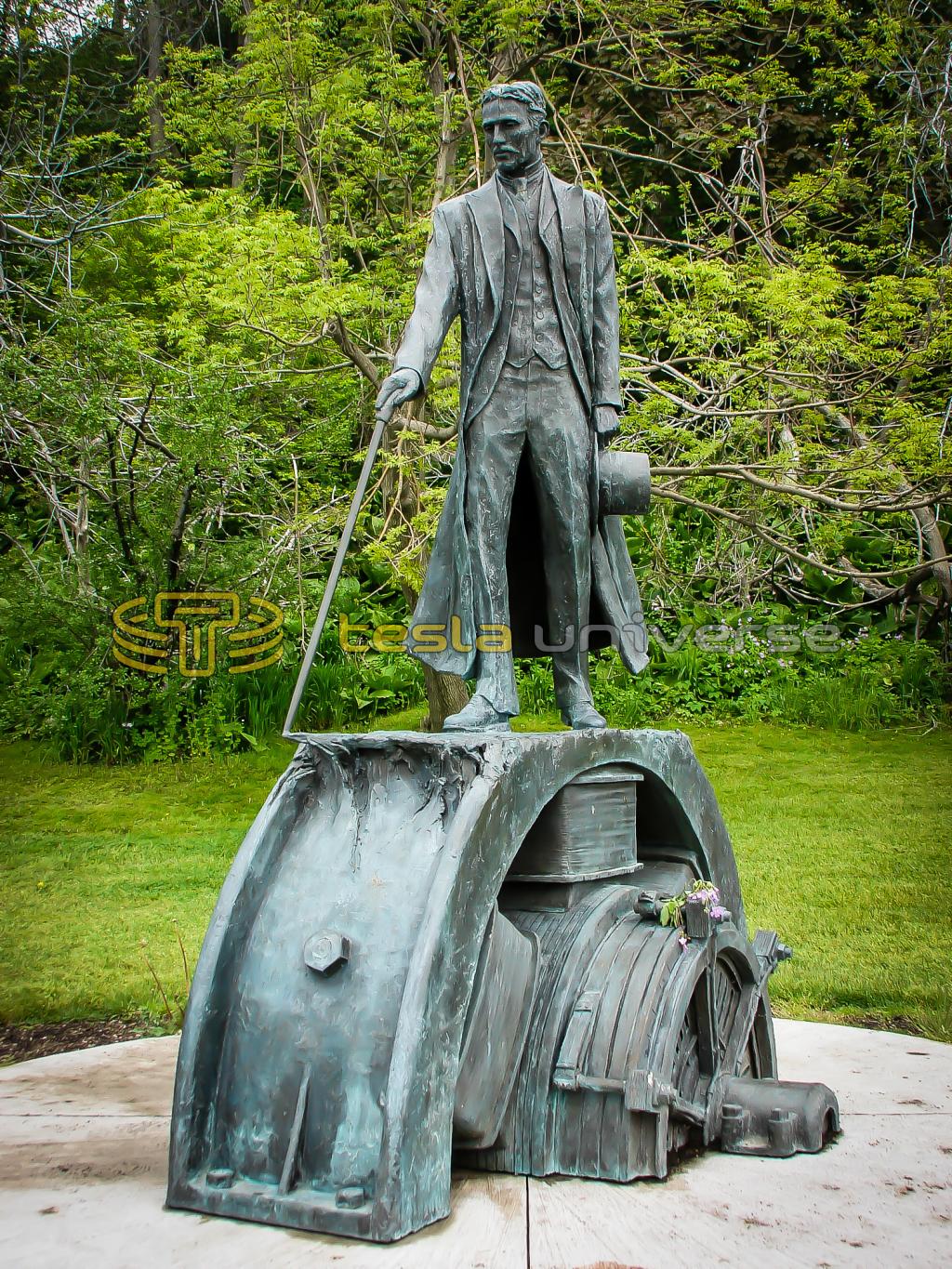
The Serbian community in Niagara Falls, throughout Canada and around the world witnessed an historical moment — the unveiling of the magnificent Tesla Memorial Monument in Niagara Falls on July 9, 2006 which marked the 150th anniversary of the birth of the great Serbian genius and inventor. The creator of the Tesla Monument is Les Drysdale, a young artist from Hamilton, Ontario. On that day and during the opening ceremony, the eyes of the public were focused on the superbly sculpted monument as well as on the artist himself. The monument of Nikola Tesla in Niagara Falls entered Les Drysdale's name into the annals of Canadian and Serbian history. I taped an interview with Les Drysdale for the "Voice of Canadian Serbs" and offer here an edited sequence of our conversation which took place just after the unveiling.
Q. How did you come about to work on Tesla's monument?
L.D: I was informed that there was going to be a competition for a monument for Niagara Falls. I really did not know much about it other than my previous interest in Nikola Tesla. I submitted some of my previous works to the commission. They asked me to submit a design. After a while I received a phone call from them telling me that they loved it.
Q. There are millions of Tesla's admirers round the world. Did you feel any pressure while working on the monument?
L.D: If I had known that there were so many admirers of Tesla, I would have felt a great deal more pressure. I think I worked in an ignorant bliss, which worked out well for me. If I had felt pressure it would have been quite intimidating. Maybe that would have changed the design of the work and made it more conservative, or it could have made me take a different approach; or try to be more wide spread in talking about different aspects of Tesla's work. This way, I just combined all the research and came up with something I felt worked beautifully in the sight.
Q. The monument looks absolutely stunning. Describe the monument for our readers, please.
L.D: From far it looks like a figure of a man on top of a motor. It is not really that at all. The concept of the whole design is based on the Tesla quote, which is inscribed in the outside housing in the motor. It basically says that: "My imaginings became my reality." That was the secret of his success. He used his imagination to create things, which were real in his mind. The idea for the monument is based on the story in Budapest, where Tesla walked with a friend and drew an actual AC motor. What I have him drawing with his cane is three sine waves that are out of sync by 120 degrees. And that to an engineer is AC electricity. The lines of the sine waves flow down and the ground he walks on is kind of broken up and it dissolves and evolves into an actual AC motor. That is the whole idea of my, trying to encompass everything he did and everything he believed in.
Q. There are two coins on the top of the motor. Is there any story behind that or are they there by coincidence?
L.D: There is nothing in the sculpture that was not placed there purposely. The coin behind Tesla is a Serbian coin from 1879, which was around the time where Tesla did the original design for the alternator and AC motor and in front of Tesla is a Canadian coin from 1923, the year he designed the power station for Niagara Falls. So, from the old world to the new, from the time that he started the design to the time he finished it.
There is another detail in it. Tesla loved pigeons and doves. When Tesla lived in The Waldorf Astoria and The New Yorker hotel, and when he had to move do different apartments there was one bird in particular, his favorite dove who would followed Tesla. I told the Tesla committee that I would put a dove in there for real Tesla files, but I have never told them where I put it. But it is there!
Q. Tesla monument is not the only work you have done so far. Tell us more about your work.
L.D: My recent commissioned work has been historical sculpture. The latest was based on Augustus Jones, who was a chief surveyor of the Niagara Peninsula in the 1790s. The sculpture was placed last summer in the town square in Stoney Creek, Ontario. Augustus Jones was involved in a major program of surveying from Niagara all the way into Young Street in Toronto. The sculpture is designed to give a glimpse of history he is surveying across a body of water with the tools of his trade. I also incorporated the natural environment in which he worked that is so unique to the area and to North America, the flora and fauna of the Carolinian forest.
Prior to that was another historical portrait of the first woman MP and legislator in Canada. Agnes McPhail. It is in the Ontario legislature, Queens Park.
And before that, there are various other public commissions and a lot of my own gallery work. Much of those sculptures are based on mythical forms: some are my own created myths and some are from the ancient mythology. There are several of Icaruses that I have done. I also created a series of formidable guardians — to make sure I was a successful Canadian artist — added Les Drysdale with a smile.
Les Drysdale has been a fulltime professional sculptor since 1987, as well as working at the Burlington Art Centre as a drawing and sculpture instructor. He has exhibited in a variety of venues including; The Canadian Sculpture Gallery, Theatre Aquarius, Vineland Estates, Burlington Arts Centre, and The Gallery on the Lake. His work is represented by Gallery Gevik in Toronto.