
Nikola Tesla Articles
Magazines for June (1900)
Facts About the Increasing Size of American Locomotives.
ELECTRICITY WITHOUT WIRES.
The Possibility of Communicating With the Nearer Planets — Pen Picture of the Christ of the Passion Play — Cabling Without Wires — The Passion Play’s Earnings.
...
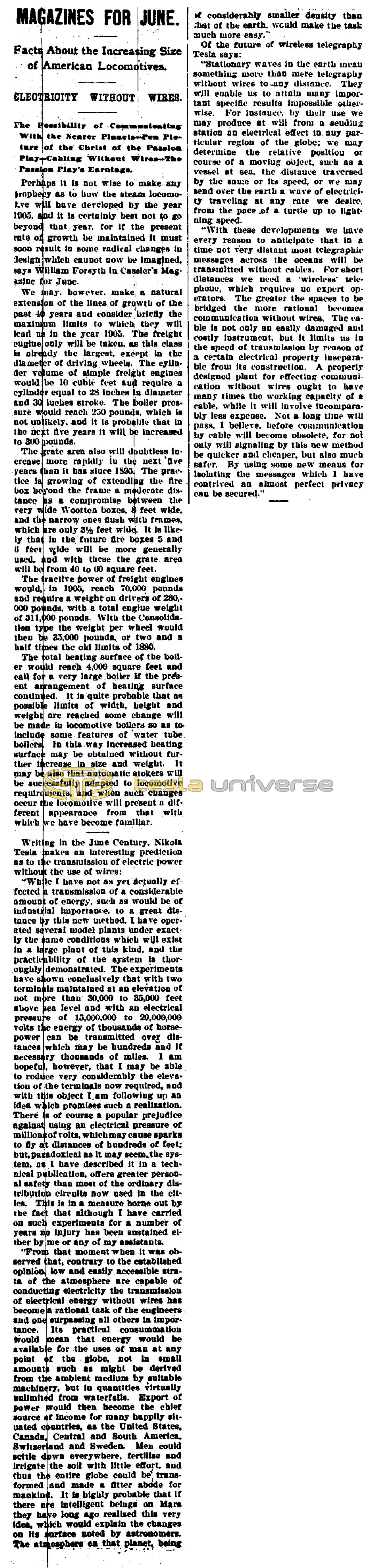
Writing in the June Century, Nikola Tesla makes an interesting prediction as to the transmission of electric power without the use of wires:
“While I have not as yet actually effected a transmission of a considerable amount of energy, such as would be of industrial importance, to a great distance by this new method, I have operated several model plants under exactly the same conditions which will exist in a large plant of this kind, and the practicability of the system is thoroughly demonstrated. The experiments have shown conclusively that with two terminals maintained at an elevation of not more than 30,000 to 35,000 feet above sea level and with an electrical pressure of 15,000,000 to 20,000,000 volts the energy of thousands of horsepower can be transmitted over distances which may be hundreds and if necessary thousands of miles. I am hopeful, however, that I may be able to reduce very considerably the elevation of the terminals now required, and with this object I am following up an idea which promises such a realization. There is of course a popular prejudice against using an electrical pressure of millions of volts, which may cause sparks to fly at distances of hundreds of feet; but, paradoxical as it may seem, the system, as I have described it in a technical publication, offers greater personal safety than most of the ordinary distribution circuits now used in the cities. This is in a measure borne out by the fact that although I have carried on such experiments for a number of years no injury has been sustained either by me or any of my assistants.
“From that moment when it was observed that, contrary to the established opinion, low and easily accessible strata of the atmosphere are capable of conducting electricity the transmission of electrical energy without wires has become a rational task of the engineers and one surpassing all others in importance. Its practical consummation would mean that energy would be available for the uses of man at any point of the globe, not in small amounts such as might be derived from the ambient medium by suitable machinery, but in quantities virtually unlimited from waterfalls. Export of power would then become the chief source of income for many happily situated countries, as the United States, Canada, Central and South America, Switzerland and Sweden. Men could settle down everywhere, fertilize and irrigate the soil with little effort, and thus the entire globe could be transformed and made a fitter abode for mankind. It is highly probable that if there are intelligent beings on Mars they have long ago realized this very idea, which would explain the changes on its surface noted by astronomers. The atmosphere on that planet, being of considerably smaller density than that of the earth, would make the task much more easy.”
Of the future of wireless telegraphy Tesla says:
“Stationary waves in the earth mean something more than mere telegraphy without wires to any distance. They will enable us to attain many important specific results impossible otherwise. For instance, by their use we may produce at will from a sending station an electrical effect in any particular region of the globe; we may determine the relative position or course of a moving object, such as a vessel at sea, the distance traversed by the same or its speed, or we may send over the earth a wave of electricity traveling at any rate we desire, from the pace of a turtle up to lightning speed.
“With these developments we have every reason to anticipate that in a time not very distant most telegraphic messages across the oceans will be transmitted without cables. For short distances we need a ‘wireless’ telephone, which requires no expert operators. The greater the spaces to be bridged the more rational becomes communication without wires. The cable is not only an easily damaged and costly instrument, but it limits us in the speed of transmission by reason of a certain electrical property inseparable from its construction. A properly designed plant for effecting communication without wires ought to have many times the working capacity of a cable, while it will involve incomparably less expense. Not a long time will pass, I believe, before communication by cable will become obsolete, for not only will signaling by this new method be quicker and cheaper, but also much safer. By using some new means for isolating the messages which I have contrived an almost perfect privacy can be secured.”
Reprints
- Magazines for June (1900) (reprint)Cayuga Chief — June 2nd, 1900