Nikola Tesla Articles
The Master of Movie Thrills
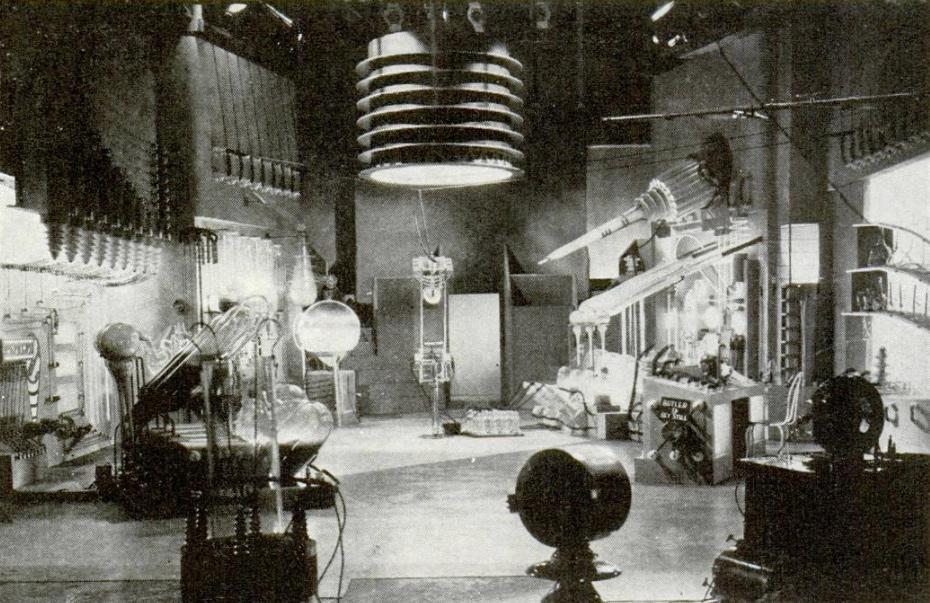
A few years ago Kenneth Strickfaden, a world war veteran, started experimenting with electricity in his home workshop. Today he provides many of the weird electrical effects seen in moving pictures.
He began his experiments with a simple Tesla coil, such as any hobbyist might build in his garage or basement workshop and developed many pieces of equipment of his own design and worked out sensational and bizarre electrical effects for his own amusement. When a vogue for the mystery thriller picture hit the studios, the young experimenter got his chance to develop into the screen's foremost inventor of horror devices. His first work was the creation of the realistic sound of an electric chair snuffing out its victim's life. A high frequency current sent through a piece of wood did the trick. The resistance the wood offered the current produced a sizzling sound and the smoke drifted across the set producing a realistic effect.
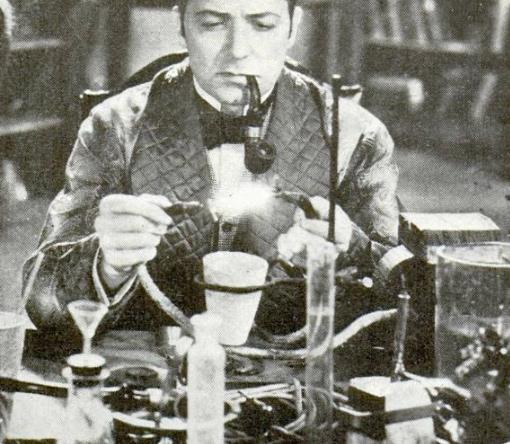
Next he blew up a tree with lightning for a movie. It was just a matter of running some wire up a "prop" tree. The high voltage generator did the rest. There was a flash of light as the tree crashed and demolished a native hut as it fell. Then he rigged up a rotary spark gap for a wireless station sound effect on board ship. A high voltage spark condensed to give out a pleasing tone accomplished the result. A more difficult stunt was the building of a machine supposed to send out a ray that would interfere with the ignition of an automobile. It consisted of a boxlike cabinet with a complex array of lenses, bulbs, coils, and dials. It was definitely a "prop" but it was authentic enough to seem capable of sending out all kinds of rays.
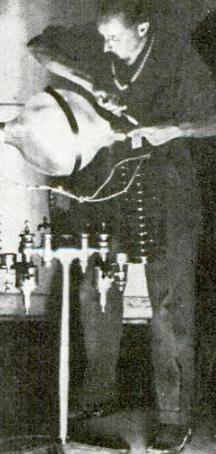
In the picture, "Frankenstein," the script called for the tapping of lightning to give the monster Frankenstein life. For this Strickfaden devised a piece of apparatus based on the principle of the horn gap and dubbed it the lightning bridge. The construction of the set and the requirements of the sensational effect desired necessitated moving half a ton of equipment overhead where it was very difficult to work. The type of picture based on weird electrical effects makes a difficult job for the technician for it calls for authentic apparatus that will perform sensational feats usually possible only in large electrical research laboratories furnished with thousands of dollars worth of equipment. Not only must effects be produced to satisfy the requirements of the story, but this or that space must be filled with a specially constructed piece of apparatus for atmosphere even though it plays no part in the electrical effects achieved. The electrical expert is expected to have in stock every conceivable kind of apparatus.
"If a picture requires a special type of machine that no one has ever heard of, I always assure the director that I have it," Mr. Strickfaden said. "Then I go home and work until I have a machine that will fulfill the need."
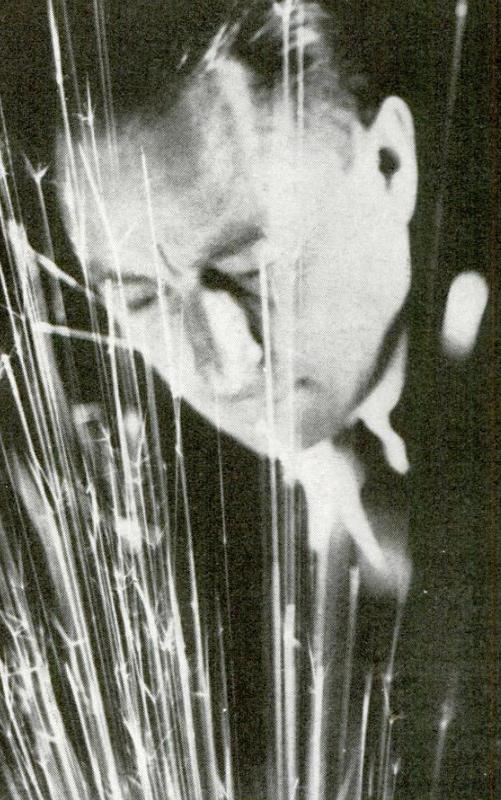
He pointed to an intricate and dustcovered piece of apparatus in a far corner of the laboratory. "That," he said, "was used on one of the sets for a 'Connecticut Yankee in King Arthur's Court.' It was supposed to have the power of bringing back the sounds of past ages. I called it the retrogressive wave charger. It was used in connection with a high frequency generator which produced artificial lightning. In those days before directors had learned the full possibilities of electrical effects, life was simple. In later pictures, like 'Chandu,' studio officials wanted sparks all over a gun, they wanted the barrel to melt, and as a final touch the handle of an electrical control must be burned off and drop to the floor. This called for the handling of huge amperages to produce instantaneous heat, and the use of complicated and delicate resonator apparatus to produce a spark six feet long. To make matters worse the conditions under which the scene was photographed made it necessary to hoist the apparatus overhead."
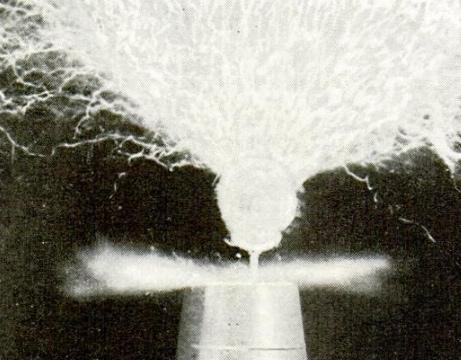
When an actor demurs at getting chummy with built-up amperages and high frequency current, and when trick photography cannot be used to achieve an effect, Strickfaden doubles for the timid actor.
"I have confidence in my knowledge and in my apparatus," he explained, "but there is always the possibility of an accident."
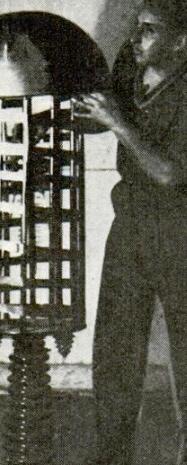
During the filming of "The Mask of Dr. Fu Manchu," Boris Karloff, playing the part of the Chinese scientist, was to transfer a six-foot 1,500,000-volt arc from the ball terminal of a piece of mysterious apparatus to a sword which was to be tested. He was to approach the roaring apparatus and calmly intercept the flame on his long Chinese fingernails and direct it to the sword which would or would not melt as its genuineness would determine. A brass sword and one made of gilded wax and magnesium powder were used.
In doubling for Karloff, Strickfaden used every precaution possible. A wire concealed under the clothing was run from the copper fingernails to the resonator apparatus ground through a safety gap. Everything was set for a take. The low hum of the apparatus swelled in volume as the arc developed from the electrode to the tips of the coppered fingernails. Just as the spark reached its full intensity and Strickfaden was about to transfer it to the sword, he did a spasmodic back flip with the fire still streaming from his fingernails. The power was cut off, the cameras stopped and the, dazed double was helped to his feet. The cause of the trouble was soon found. Smoke led to the cable carrying 70,000 volts from the transformer to the rotary gap. The cable had punctured and formed an arc across the flooring to a pipe underneath, completing the circuit up through Strickfaden's body along the wire on his arm to the safety horn gap which broke the circuit and prevented possible electrocution. Repairs were soon made, the cable moved and a subsequent take was made without further trouble. Strickfaden said the only sensation he felt was a strangely painless flash of light.
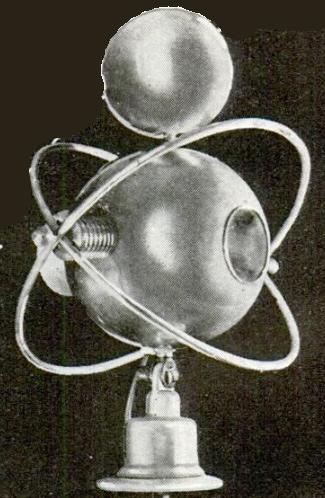
Between pictures he loads his movie props and high voltage apparatus on a special trailer of his own construction and goes on tour. Music over light beams, electric snow, artificial lightning, photo electric and gaseous tube effects are just a few of the features that make up his electrical circus.