Nikola Tesla Articles
The Home of Home Experiments
TO: Reader
FROM: Editor
The first Tuesday of every month, rain or shine, a chap turns up in the offices of Popular Science with a manuscript and some photographs in one hand and a can of salted peanuts in the other. Without comment, he deposits the peanuts on the desk of the Mechanics & Handicraft Editor. The editor proceeds as wordlessly to read the manuscript and look at the pictures. It is always a race to see whether the editor or his visitor will get the most of the peanuts.
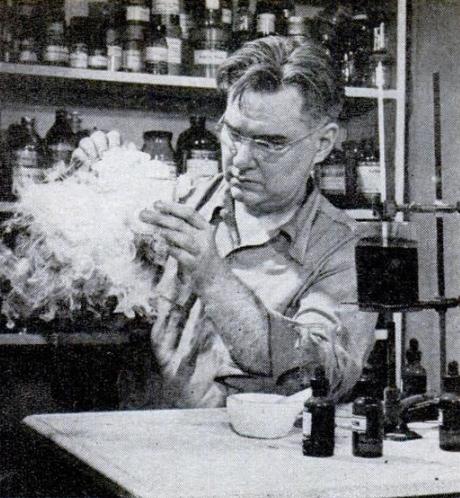
Conversation is needless, because the peanut vendor has been going through this routine for the last dozen years. He is Ken Swezey, author of scores of highly popular PS articles on home demonstrations of basic science. This month he wrote and illustrated "Focusing Your Interest" (p. 235). Last month he took apart a glass of milk. Next month he will tell about cold light.
Ken Swezey is a burly fellow who was born — and still lives — in Greenpoint, Brooklyn. He has been selling articles on science since his grammar-school days. His first, written when he was 11, told how to make a wet cell. It brought him $2.
As a youngster, one of his heroes was Nikola Tesla, the electrical genius. Swezey was 17 when he scraped up an acquaintance. Their close friendship lasted until Tesla's death a few years ago. Troubled by public indifference to Tesla in his later years, Swezey stage-managed a celebration of the inventor's 75th anniversary that snowballed into a world-wide affair. Not long ago the executor of Tesla's estate assigned Swezey the task of sifting the inventor's trunkfuls of notebooks for publication.
Swezey is the editor of a book in his own right — "After-Dinner Science," published recently by Whittlesey House. Albert Einstein wrote Swezey that he found it interesting, and added: ". . . I admired very much the experiment about Archimedes' principle; it was quite new to me." Much of the book is made up of material that first appeared in Popular Science. Many of the photographs (which Swezey shot himself) were recently featured in Life.
Publications in South America and Sweden regularly reprint Swezey's home experiments from PS. College professors incorporate his demonstrations in physics lectures. John Kieran, the radio wit and encyclopedist, Lenox Lohr of the Chicago Museum of Science and Industry, and Fred Whipple, the astronomer, have complimented Swezey on them. That his appeal is not only to longhairs, however, can be attested by PS editors. When the pressure for space in the magazine occasionally squeezes out "Home Experiments," a batch of short-tempered letters warns us not to let it happen again.
How does Swezey make science popular? His skill lies in translating an abstraction into a graphic image. He strips the mystery from a perplexing principle and dresses it in everyday garb by demonstrating it with common utensils. It's a neat trick if you can do it. Ken Swezey can.
- The Editors