Nikola Tesla Articles
Mr. Tesla and Wireless Telegraphy
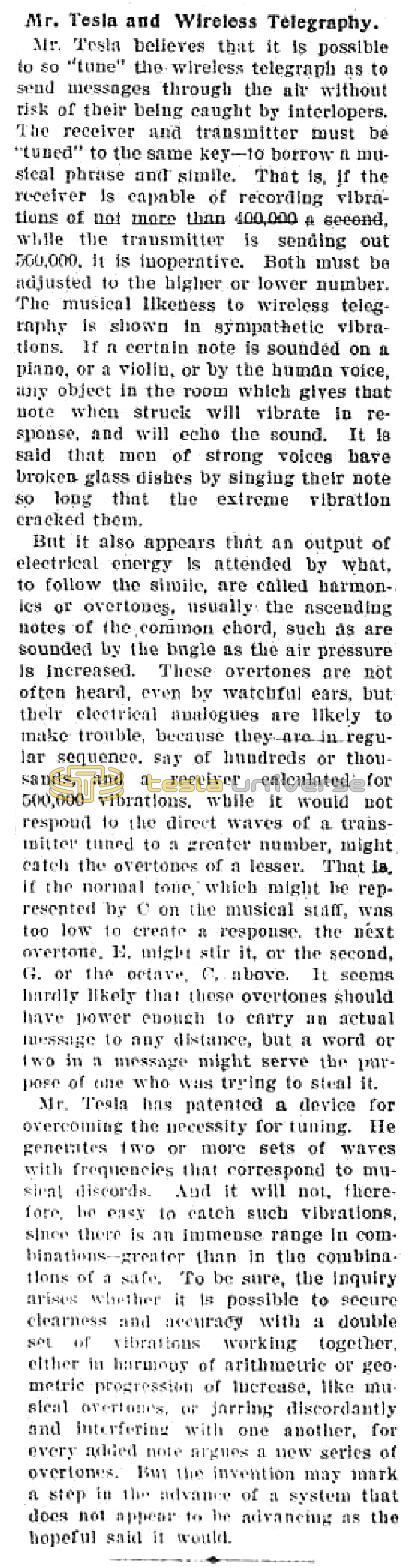
Mr. Tesla believes that it is possible to so "tune" the wireless telegraph as to send messages through the air without risk of their being caught by interlopers. The receiver and transmitter must be "tuned" to the same key — to borrow a musical phrase and simile. That is, if the receiver is capable of recording vibrations of not more than 400,000 a second, while the transmitter is sending out 500,000, it is inoperative. Both must be adjusted to the higher or lower number. The musical likeness to wireless telegraphy is shown in sympathetic vibrations. If a certain note is sounded on a piano, or a violin, or by the human voice, any object in the room which gives that note when struck will vibrate in response, and will echo the sound. It is said that men of strong voices have broken glass dishes by singing their note so long that the extreme vibration cracked them.
But it also appears that an output of electrical energy is attended by what, to follow the simile, are called harmonics or overtones, usually the ascending notes of the common chord, such as are sounded by the bugle as the air pressure is increased. These overtones are not often heard, even by watchful ears, but their electrical analogues are likely to make trouble, because they are in regular sequence, say of hundreds or thousands, and a receiver calculated for 500,000 vibrations, while it would not respoud to the direct waves of a transmitter tuned to a greater number, might catch the overtones of a lesser. That is, if the normal tone, which might be represented by C on the musical staff, was too low to create a response, the next overtone, E, might stir it, or the second, G, or the octave, C, above. It seems hardly likely that these overtones should have power enough to carry an actual message to any distance, but a word or two in a message might serve the purpose of one who was trying to steal it.
Mr. Tesla has patented a device for overcoming the necessity for tuning. He generates two or more sets of waves with frequencies that correspond to musical discords. And it will not, therefore, be easy to catch such vibrations, since there is an immense range in combinations — greater than in the combinations of a safe. To be sure, the inquiry arises whether it is possible to secure clearness and accuracy with a double set of vibrations working together, either in harmous of arithmetric or geometric progression of lucrease, like musical overtones, or jarring discordantly and interfering with one another, for every added note argues a new series of overtones. But the invention may mark a step in the advance of a system that does not appear to be advancing as the hopeful said it would.