Nikola Tesla Articles
Much Effort Expended to Save Adams Plant
By LANCE HUNT
Gazette Staff Writer
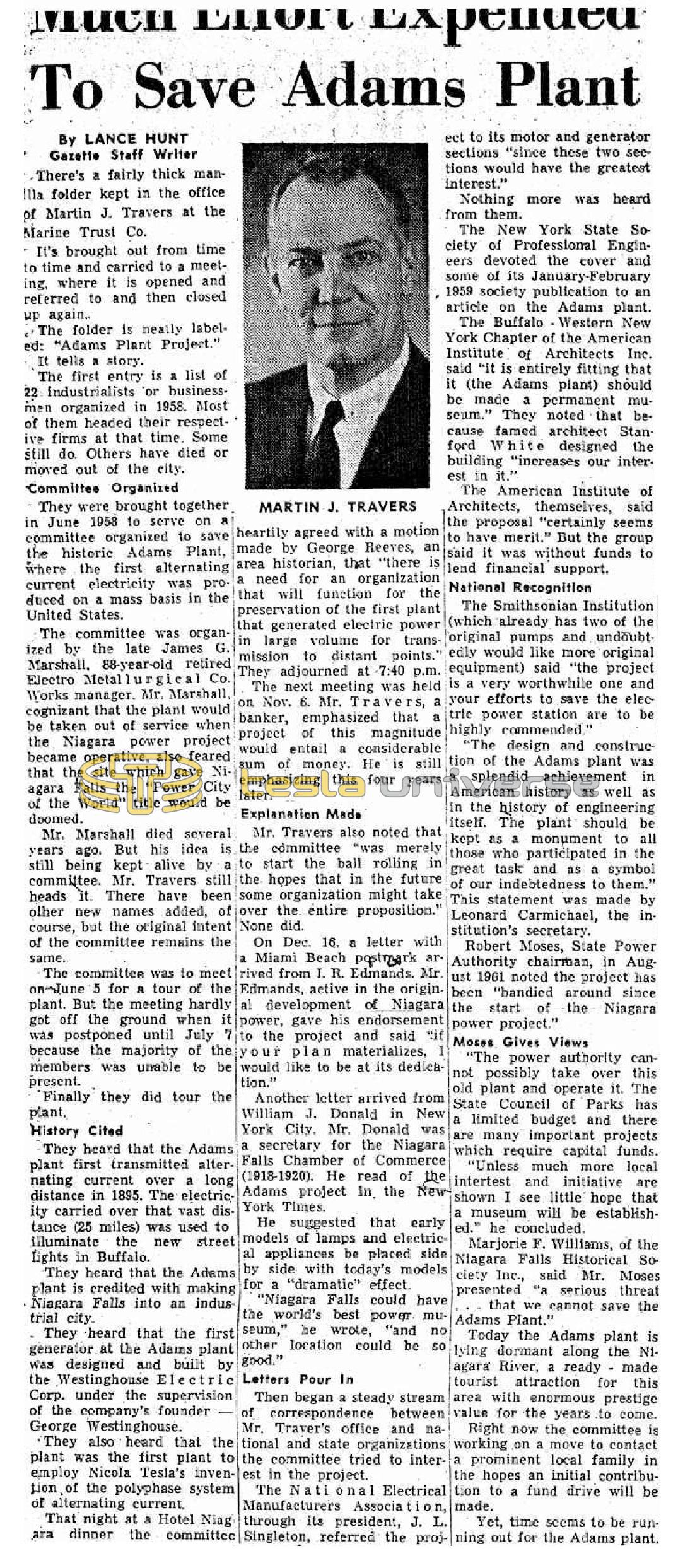
There’s a fairly thick manilla folder kept in the office of Martin J. Travers at the Marine Trust Co.
It’s brought out from time to time and carried to a meeting, where it is opened and referred to and then closed up again.
The folder is neatly labeled: “Adams Plant Project.”
It tells a story.
The first entry is a list of 22 industrialists or businessmen organized in 1958. Most of them headed their respective firms at that time. Some still do. Others have died or moved out of the city.
Committee Organized
They were brought together in June 1958 to serve on a committee organized to save the historic Adams Plant, where the first alternating current electricity was produced on a mass basis in the United States.
The committee was organized by the late James G. Marshall, 88-year-old retired Electro Metallurgical Co. Works manager. Mr. Marshall, cognizant that the plant would be taken out of service when the Niagara power project became operative, also feared that the site which gave Niagara Falls the “Power City of the World” title would be doomed.
Mr. Marshall died several years ago. But his idea is still being kept alive by a committee. Mr. Travers still heads it. There have been other new names added, of course, but the original intent of the committee remains the same.
The committee was to meet on June 5 for a tour of the plant. But the meeting hardly got off the ground when it was postponed until July 7 because the majority of the members was unable to be present.
Finally they did tour the plant.
History Cited
They heard that the Adams plant first transmitted alternating current over a long distance in 1895. The electricity carried over that vast distance (25 miles) was used to illuminate the new street lights in Buffalo.
They heard that the Adams plant is credited with making Niagara Falls into an industrial city.
They heard that the first generator at the Adams plant was designed and built by the Westinghouse Electric Corp. under the supervision of the company’s founder — George Westinghouse.
They also heard that the plant was the first plant to employ Nikola Tesla’s invention of the polyphase system of alternating current.
That night at a Hotel Niagara dinner the committee heartily agreed with a motion made by George Reeves, an area historian, that “there is a need for an organization that will function for the preservation of the first plant that generated electric power in large volume for transmission to distant points.”
They adjourned at 7:40 p.m.
The next meeting was held on Nov. 6. Mr. Travers, a banker, emphasized that a project of this magnitude would entail a considerable sum of money. He is still emphasizing this four years later.
Explanation Made
Mr. Travers also noted that the committee “was merely to start the ball rolling in the hopes that in the future some organization might take over the entire proposition.” None did.
On Dec. 16, a letter with a Miami Beach postmark arrived from I. R. Edmands. Mr. Edmands, active in the original development of Niagara power, gave his endorsement to the project and said “if your plan materializes, I would like to be at its dedication.”
Another letter arrived from William J. Donald in New York City. Mr. Donald was a secretary for the Niagara Falls Chamber of Commerce (1918-1920). He read of the Adams project in the New York Times.
He suggested that early models of lamps and electrical appliances be placed side by side with today’s models for a “dramatic” effect.
“Niagara Falls could have the world’s best power museum,” he wrote, “and no other location could be so good.”
Letters Pour In
Then began a steady stream of correspondence between Mr. Travers’ office and national and state organizations the committee tried to interest in the project.
The National Electrical Manufacturers Association, through its president, J. L. Singleton, referred the project to its motor and generator sections “since these two sections would have the greatest interest.”
Nothing more was heard from them.
The New York State Society of Professional Engineers devoted the cover and some of its January-February 1959 society publication to an article on the Adams plant.
The Buffalo - Western New York Chapter of the American Institute of Architects Inc. said “it is entirely fitting that it (the Adams plant) should be made a permanent museum.” They noted that because famed architect Stanford White designed the building “increases our interest in it.”
The American Institute of Architects, themselves, said the proposal “certainly seems to have merit.” But the group said it was without funds to lend financial support.
National Recognition
The Smithsonian Institution (which already has two of the original pumps and undoubtedly would like more original equipment) said “the project is a very worthwhile one and your efforts to save the electric power station are to be highly commended.”
“The design and construction of the Adams plant was a splendid achievement in American history as well as in the history of engineering itself. The plant should be kept as a monument to all those who participated in the great task and as a symbol of our indebtedness to them.” This statement was made by Leonard Carmichael, the institution’s secretary.
Robert Moses, State Power Authority chairman, in August 1961 noted the project has been “bandied around since the start of the Niagara power project.”
Moses Gives Views
“The power authority cannot possibly take over this old plant and operate it. The State Council of Parks has a limited budget and there are many important projects which require capital funds.
“Unless much more local interest and initiative are shown I see little hope that a museum will be established,” he concluded.
Marjorie F. Williams, of the Niagara Falls Historical Society Inc., said Mr. Moses presented “a serious threat . . . that we cannot save the Adams Plant.”
Today the Adams plant is lying dormant along the Niagara River, a ready-made tourist attraction for this area with enormous prestige value for the years to come.
Right now the committee is working on a move to contact a prominent local family in the hopes an initial contribution to a fund drive will be made.
Yet, time seems to be running out for the Adams plant.