Nikola Tesla Articles
Something About Serbia
A Description of the Manners and Customs of the Little Country Which Played Such An Important Part in the Recent Balkan Wars.
Away down in a corner of the Balkan States there is a fertile little country called Serbia. It is one of the pawns in the great game of chess now being played by the European powers, and just what the ultimate outcome of this game will be no one can predict with any degree of certainty.
The treaty at Bucharest changed the map of the Balkans and gave Serbia 1,200,000 more subjects, mostly Albanians. These people proved to be a set of scorpions, for less than two months after this treaty was signed they formed an army and commanded by Bulgarian and Austrian officers they succeeded in regaining a part of the territory and butchering several hundred Serbian soldiers. This forced the little country into a third war while thousands of her soldiers were lying wounded and her land was being ravaged by the cholera. When the first Balkan war occurred Serbia had money in her treasury and was able to furnish everything an army needed. This campaign was hard and long but the smaller countries won out against Turkey. Then came the division of the spoils, and the Serbians who had fought so valiantly were given the short end of the deal and they refused to submit to such injustice. Greece and Romania felt the same way in the matter, so before the demobilization of the army from the first war began little Serbia was plunged into one with Bulgaria which was even more horrible than the first. The treasury had been strained to the limit in the war with Turkey, yet Serbia went into the second war with a vim that surprised the world, and just as her victory was nearly won the powers intervened and forbade the further humiliation of the savage Bulgarians. At present Serbia is in the throes of trouble with Albania, and old men and boys are now doing military service, not against their wills, for they have come into the recruiting station begging to be taken. The writer, who has but recently returned from Serbia, has watched these people as they came into the barracks. They know the awful trials they will have to undergo, with many times only bread and water for food, yet they are eager and ready to suffer even unto death for the glory of Serbia.
The fortitude the Serbians have shown in battle is little short of marvelous, and their endurance, their patient suffering and their absolute fidelity to duty under all circumstances have placed the little country in a new light before the world. That they deserve to win out is unquestioned, but whether or not they will receive their just deserts is a matter of conjecture, for unfortunately some of the larger countries of Europe think little of crushing a smaller nation, especially if that nation has fertile land.
Early History.
No country on the face of the globe has had more trials and tribulations than this little land, and her history reads like a romance. At the beginning of the seventh century the race of Slavs known as Serbians were living on the northern slopes of the Carpathian Mountains and were divided into different States. During the tenth and eleventh centuries attempts were made to unite these provinces into one kingdom, but it was not until the last part of the twelfth century that this was accomplished. The family of Nemanya, the Great Zupan of the Province of Rashka, then became the reigning family and ruled from 1169 until 1371. Stephen Nemanya took for himself the title of king but was never crowned, but this honor came to his son Stephen, who was formally crowned as the first Serbian king in 1222. During the reign of the Nemanyich dynasty the little kingdom was constantly menaced by its neighbors and finally in 1389 it was subdued by the Turks when the flower of the Serbian aristocracy perished in the battle of Kossova in their final struggle against the enemy. The Sultan, however, did not finally take charge of the country until 1459, and from that time until 1867 it was ruled by the Turks. During these centuries of Mohammedan rule the Serbians were oppressed to such an extent that revolution and insurrections were almost yearly occurrences.
After the fortress at Belgrade had been regained from the Turks the Obrenovich dynasty came into power. Internal strife caused the assassination of Prince Michael in a park near Belgrade a year later and King Milan became the ruler. His reign was a troubled one on account of domestic infelicity, and after he divorced Queen Natalie he was forced to abdicate in favor of his son Alexander in 1889. This young man was pampered by the Serbian nobility and ruined by being allowed to do exactly as he pleased. He sowed his wild oats in an open fashion and finally outraged the decency of the people by marrying his mistress, Draga Mashin, and placing her on the Serbian throne. In 1903 King Alexander and Queen Draga were assassinated and their bodies thrown from the window of the old palace at Belgrade.
The present King Peter Karageorgevich was the next ruler. From that time until the first Balkan war, about eighteen months ago, Serbia lived in comparative peace except for the trivial troubles between the political parties which exist in every country. King Peter has several children, one of whom, Prince Alexander, will shortly be betrothed to one of the daughters of the Czar of Russia — another important move in the game of European chess.
Religion.
The Greek Church is the religion of Serbia, and while there is some superstition among the peasants the educated Serbian is singularly free from many of the beliefs of the Slav races.
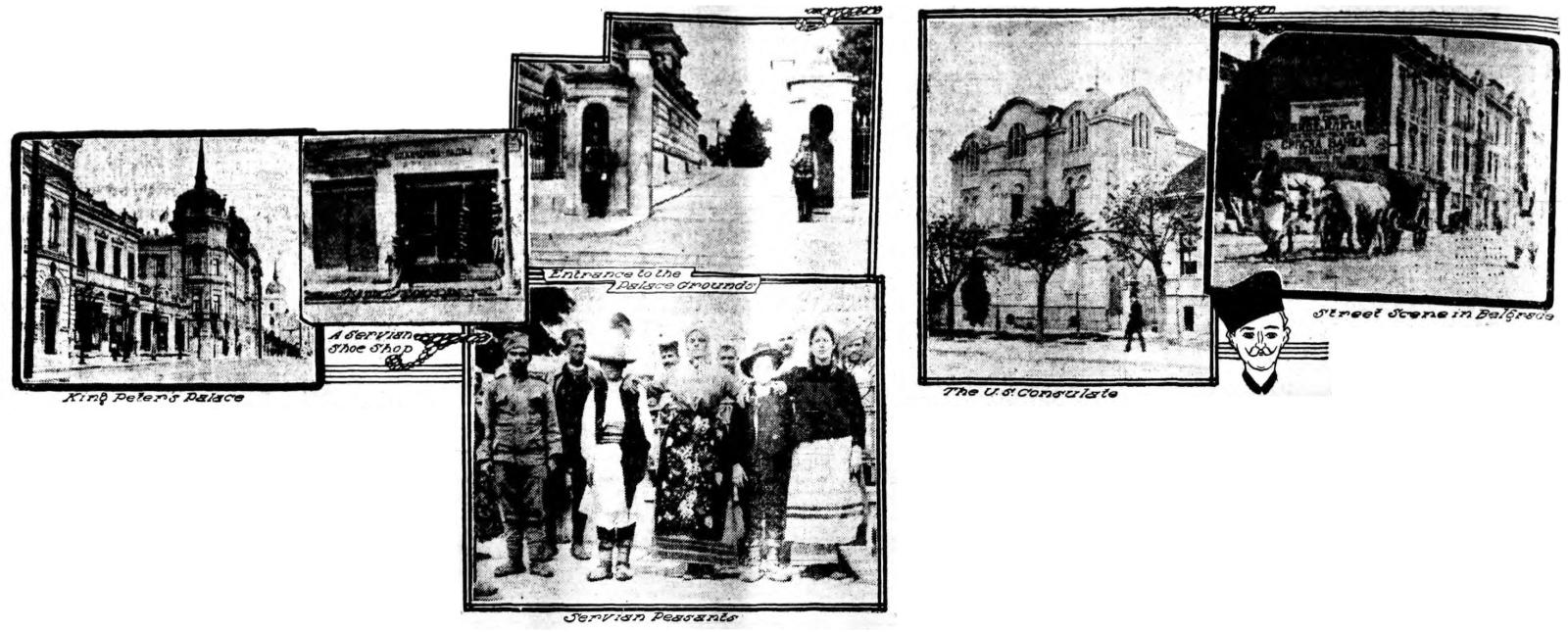
The women are rather pretty, and the peasant class is fond of bright colors, fancy embroidery and gaudy head dresses. Jewelry is popular especially, and they wear beads of every variety. Their shoes are rather curious, being made of plaited leather and turned up in front like the runner of a sleigh. No heels are used. Heavy stockings are worn, and when long walks are to be taken straps fastened to the shoes are bound about the leg almost to the knee. The people are hard-working and thrifty, for while their farms are not large and their agricultural implements of the crudest kind the crops compare favorably with those of the larger countries. This is all the more to their credit from the fact that their land does not lie together, but is generally composed of parcels which are very often wide apart and much of the farmer’s time is taken up in going from one plat to the other.
Laws Prevent Poverty.
No Serbian peasant will suffer from poverty if he will work, except at the present time, when the country is in a state of war. There are three peculiar institutions which guard against poverty. First, there is a law passed in 1878 by virtue of which a minimum of a peasant’s property cannot be sold for debt — five acres of land, a pair of oxen, plough and other agricultural tools; second, an old law by which every peasant having some land was bound to contribute after every harvest some corn or wheat to the Municipal Provident Magazine. This Magazine loans in time of need corn for consumption or sowing at a very moderate interest. The third is a custom known as “Moba” — the whole population of the village going to help a poor peasant, cut his harvest and store it away in good time. This useful custom is attended with picturesque scenes, for after the day’s work is done the peasants go to the home of the man whose harvest they have gathered, where, after a prayer, there is a meal — not always elaborate. This is followed by the young people spending the evening in singing and dancing.
The peasant’s house consists of a large kitchen, with a square opening for the chimney, and one or two adjoining rooms. The kitchen is the dining room and living room as well. Under the house there is a cellar where the wine, plum whiskey and winter store of vegetables are kept. This usually consists of cabbage, sauerkraut, potatoes, onions and paprika. The winter supply of meat, salted beef and pork, is kept hanging in the open chimney.
That Serbia is an agricultural country is evidenced from the fact that eighty-two per cent. of her entire population (nearly 3,000,000) are peasants.
Belgrade.
Belgrade, the capital, is the educational and social centre of the country. It is a pretty little city of seventy thousand, and is beautifully located at the junction of the Save and Danube Rivers. When war was declared against Turkey the Serbians were busy beautifying their capital; the streets were being paved with concrete, a new palace and a new parliament house were in course of erection — in fact, Belgrade was in the heights of what we Americans call a “Boom,” but the workmen had to be turned into soldiers and only the older men were left at the work. There is a fine university in the city, several good looking banks and a pretty opera house.
Music and Literature.
The Serbians love music, both vocal and instrumental. Their principal musical instruments are the gussel and tambura. The former is made of maple, the cavity being covered by a tightly stretched skin and the strings are formed from horsehair. The short but highly arched bow has also horsehair for its strings. The tambura is used to accompany singers and is not unlike a mandolin. Dancing is one of the principal amusements, the favorite one being not unlike a quadrille.
Serbia is rich in literature, both in science and poetry, but unfortunately very little of it has been translated into English except the works of Doctor Cviyish, whose geographical researches in the Balkan States have been translated into several languages. One of the great electrical men of the age, Nikola Tesla, now a citizen of the United States is a Serbian. Few Serbian women have been writers of any note. Zmay Zovar Vovanovich, who died in 1904, was successful as a writer of verse and translator, and one is surprised to find such poems as Enoch Arden in the Serbian language in Belgrade bookstores. During the last years of his life Vovanovich wrote poems of child life which are highly regarded by his countrymen. We owe some of our best known proverbs to Serbia, among them the following:
“It is better to serve a good man than to give orders to a bad man.”
“It is better to be poor and honest than rich and dishonest.”
“Who judges hastily will repent quickly.”
“The fools build the houses; the wise men buy them when they are ready.”
“Where the devil cannot cause a mischief there he sends an old woman and she does it.”