Nikola Tesla Articles
A New Safety Device
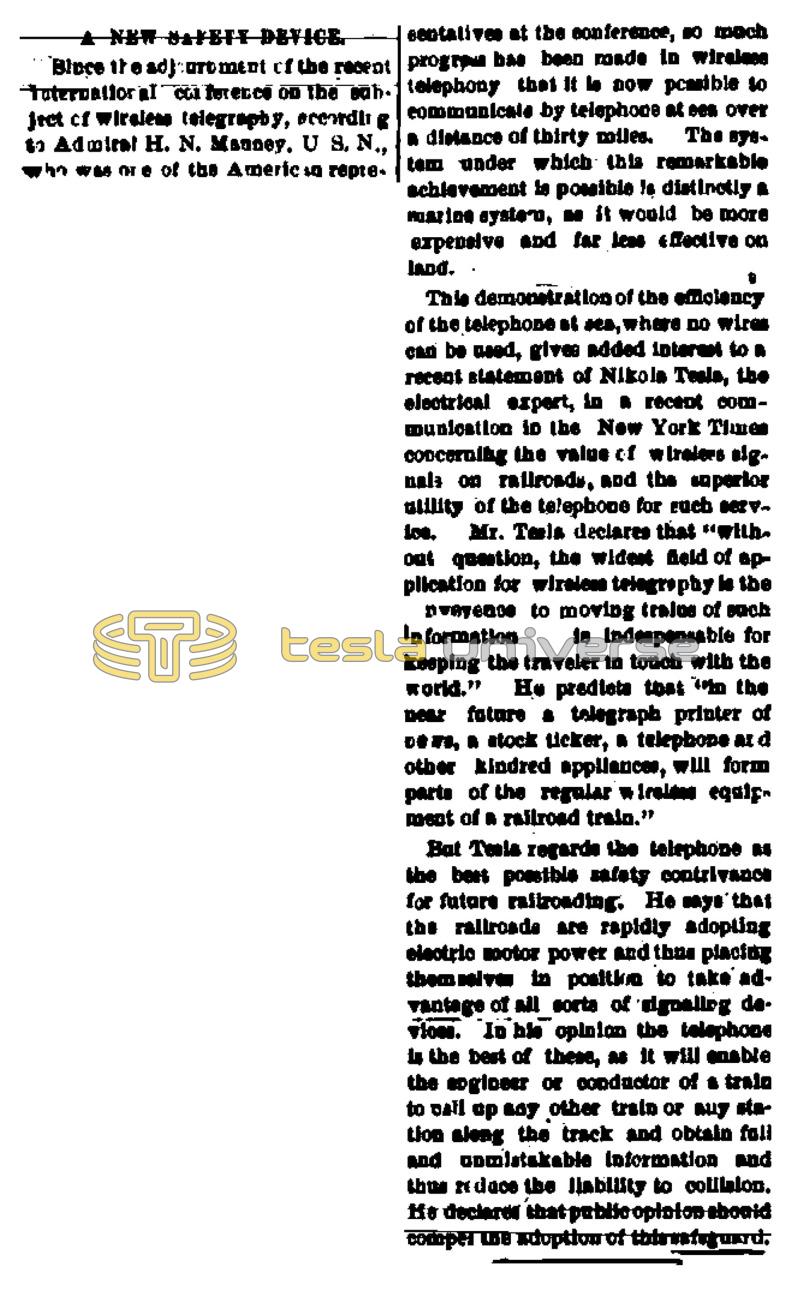
Since the adjournment of the recent International conference on the subject of wireless telegraphy, according to Admiral H. N. Manney, U. S. N., who was one of the American representatives at the conference, so much progress has been made in wireless telephony that it is now possible to communicate by telephone at sea over a distance of thirty miles. The system under which this remarkable achievement is possible is distinctly a marine system, as it would be more expensive and far less effective on land.
This demonstration of the efficiency of the telephone at sea, where no wires can be used, gives added interest to a recent statement of Nikola Tesla, the electrical expert, in a recent communication in the New York Times concerning the value of wireless signals on railroads, and the superior utility of the telephone for such service. Mr. Tesla declares that “without question, the widest field of application for wireless telegraphy is the conveyance to moving trains of such information as is indispensable for keeping the traveler in touch with the world.” He predicts that “in the near future a telegraph printer of news, a stock ticker, a telephone and other kindred appliances, will form parts of the regular wireless equipment of a railroad train.”
But Tesla regards the telephone as the best possible safety contrivance for future railroading. He says that the railroads are rapidly adopting electric motor power and thus placing themselves in position to take advantage of all sorts of signaling devices. In his opinion the telephone is the best of these, as it will enable the engineer or conductor of a train to call up any other train or any station along the track and obtain full and unmistakable information and thus reduce the liability to collision. He declares that public opinion should compel the adoption of this safeguard.