Nikola Tesla Articles
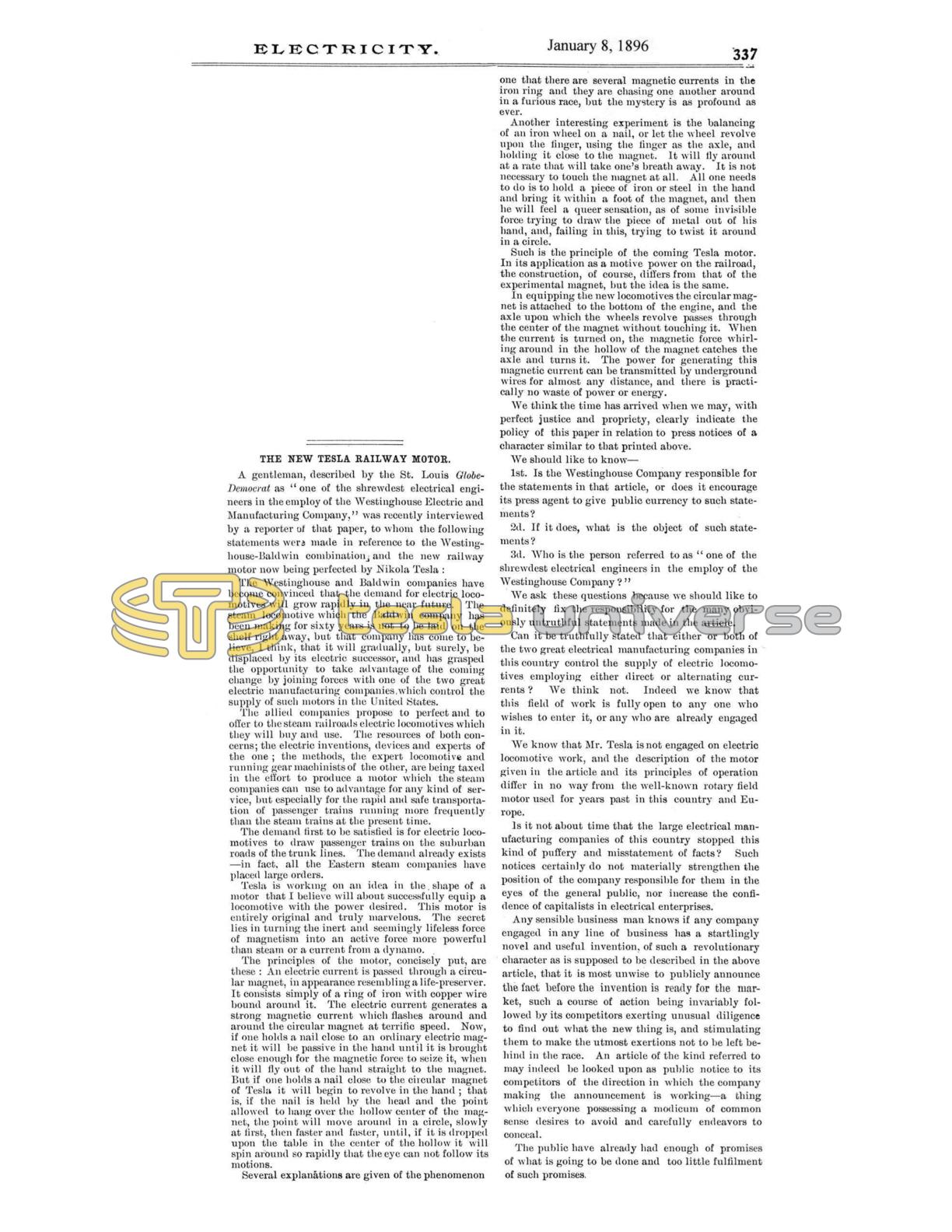
The New Tesla Railway Motor
A gentleman, described by the St. Louis Globe-Democrat as "one of the shrewdest electrical engineers in the employ of the Westinghouse Electric and Manufacturing Company," was recently interviewed by a reporter of that paper, to whom the following statements were made in reference to the Westinghouse-Baldwin combination, and the new railway motor now being perfected by Nikola Tesla:
The Westinghouse and Baldwin companies have become convinced that the demand for electric locomotives will grow rapidly in the near future. The steam locomotive which the Baldwin company has been making for sixty years is not to be laid on the shelf right away, but that company has come to believe, I think, that it will gradually, but surely, be displaced by its electric successor, and has grasped the opportunity to take advantage of the coming change by joining forces with one of the two great electric manufacturing companies, which control the supply of such motors in the United States.
The allied companies propose to perfect and to offer to the steam railroads electric locomotives which they will buy and use. The resources of both concerns; the electric inventions, devices and experts of the one; the methods, the expert locomotive and running gear machinists of the other, are being taxed in the effort to produce a motor which the steam companies can use to advantage for any kind of service, but especially for the rapid and safe transportation of passenger trains running more frequently than the steam trains at the present time.
The demand first to be satisfied is for electric locomotives to draw passenger trains on the suburban roads of the trunk lines. The demand already exists — in fact, all the Eastern steam companies have placed large orders.
Tesla is working on an idea in the shape of a motor that I believe will about successfully equip a locomotive with the power desired. This motor is entirely original and truly marvelous. The secret lies in turning the inert and seemingly lifeless force of magnetism into an active force more powerful than steam or a current from a dynamo.
The principles of the motor, concisely put, are these An electric current is passed through a circular magnet, in appearance resembling a life-preserver. It consists simply of a ring of iron with copper wire bound around it. The electric current generates a strong magnetic current which flashes around and around the circular magnet at terrific speed. Now, if one holds a nail close to an ordinary electric magnet it will be passive in the hand until it is brought close enough for the magnetic force to seize it, when it will fly out of the hand straight to the magnet. But if one holds a nail close to the circular magnet of Tesla it will begin to revolve in the hand; that is, if the nail is held by the head and the point allowed to hang over the hollow center of the magnet, the point will move around in a circle, slowly at first, then faster and faster, until, if it is dropped upon the table in the center of the hollow it will spin around so rapidly that the eye can not follow its motions.
Several explanations are given of the phenomenon one that there are several magnetic currents in the iron ring and they are chasing one another around in a furious race, but the mystery is as profound as ever.
Another interesting experiment is the balancing of an iron wheel on a nail, or let the wheel revolve upon the finger, using the finger as the axle, and holding it close to the magnet. It will fly around at a rate that will take one's breath away. It is not necessary to touch the magnet at all. All one needs to do is to hold a piece of iron or steel in the hand and bring it within a foot of the magnet, and then he will feel a queer sensation, as of some invisible force trying to draw the piece of metal out of his hand, and, failing in this, trying to twist it around in a circle.
Such is the principle of the coming Tesla motor. In its application as a motive power on the railroad, the construction, of course, differs from that of the experimental magnet, but the idea is the same.
In equipping the new locomotives the circular magnet is attached to the bottom of the engine, and the axle upon which the wheels revolve passes through the center of the magnet without touching it. When the current is turned on, the magnetic force whirling around in the hollow of the magnet catches the axle and turns it. The power for generating this magnetic current can be transmitted by underground wires for almost any distance, and there is practically no waste of power or energy.
We think the time has arrived when we may, with perfect justice and propriety, clearly indicate the policy of this paper in relation to press notices of a character similar to that printed above.
We should like to know —
1st. Is the Westinghouse Company responsible for the statements in that article, or does it encourage its press agent to give public currency to such statements?
2d. If it does, what is the object of such statements?
3d. Who is the person referred to as "one of the shrewdest electrical engineers in the employ of the Westinghouse Company?"
We ask these questions because we should like to definitely fix the responsibility for the many obviously untruthful statements made in the article.
Can it be truthfully stated that either or both of the two great electrical manufacturing companies in this country control the supply of electric locomotives employing either direct or alternating currents? We think not. Indeed we know that this field of work is fully open to any one who wishes to enter it, or any who are already engaged in it.
We know that Mr. Tesla is not engaged on electric locomotive work, and the description of the motor given in the article and its principles of operation differ in no way from the well-known rotary field motor used for years past in this country and Europe.
Is it not about time that the large electrical manufacturing companies of this country stopped this kind of puffery and misstatement of facts? Such notices certainly do not materially strengthen the position of the company responsible for them in the eyes of the general public, nor increase the confidence of capitalists in electrical enterprises.
Any sensible business man knows if any company engaged in any line of business has a startlingly novel and useful invention, of such a revolutionary character as is supposed to be described in the above article, that it is most unwise to publicly announce the fact before the invention is ready for the market, such a course of action being invariably followed by its competitors exerting unusual diligence to find out what the new thing is, and stimulating them to make the utmost exertions not to be left behind in the race. An article of the kind referred to may indeed be looked upon as public notice to its competitors of the direction in which the company making the announcement is working — a thing which everyone possessing a modicum of common sense desires to avoid and carefully endeavors to conceal.
The public have already had enough of promises of what is going to be done and too little fulfillment of such promises.