Nikola Tesla Articles
Nikola Tesla and the Electric Light of the Future Page 1
Outlook - March 9th, 1895
By WALTER T. STEPHENSON.
Exactly ten years ago Nikola Tesla, who, in June, 1894, received high honorary degrees from the colleges of Yale and Columbia, came to this country, poor and unknown, to enter an Edison shop in New York City. For two years previous he had served as engineer in one of the new electric lighting companies in Paris, and, having become an ardent and appreciative admirer of the splendid genius of Thomas A. Edison, whose fame in those days had only recently flashed throughout Europe, he was, naturally, eager to accept an opportunity of meeting the "wizard" face to face. Tesla had already patented several minor inventions of his own, but, what was of more importance, his brain was then literally teeming with great ideas, as yet, perhaps, chaotic, but which must some day evolve into definite shape for revelation, and of all countries he firmly believed the United States offered the best encouragement to the inventor who could show practical results. Since New York has continued to be Mr. Tesla's home, we may reasonably infer that he has not been disappointed in his early expectations.
The young Servian electrician derived a fresh stimulus and lasting benefit from his association with Thomas A. Edison. Nevertheless, he soon realized that it would be far wiser for him to continue his special investigations alone, unhampered by other work. Therefore, after a few months of delightful intimacy, the two men of genius separated with mutual expressions of good will.
Mr. Tesla now threw himself with redoubled ardor and energy into the study and analysis of alternating or polyphase currents, which had long been his chosen field of electrical investigation. In 1887 he exploited his wonderful invention of the rotating magnetic field for the economic transmission of power. This simple statement means that, after thirteen years of indomitable effort, embittered by sore disappointments and fierce controversies, a substantial success was at last assured, while scientists everywhere began now to await with keenest interest succeeding developments of the potentialities undoubtedly latent in these hitherto neglected alternating currents.
The majority of us probably are aware that the principal electricians of the world have long been struggling vainly toward the solution of a tremendous problem — the improvement of the electric light. When we are told, for one thing, that fully ninety-nine per cent. of energy is wasted every time such artificial illumination is produced under existing conditions, we begin to realize the crying need there is for a radical change in industrial methods. Now, the goal which some electricians declare to be already in sight means nothing less than the recovery of fully one-third of this wasted energy, thereby rendering possible an illumination many times brighter than at present and, at a notable reduction of expense. The question is, Which one of the few leaders in the race will outstrip the others and win an immortal name? Rumors have reached the public ear with increasing frequency of late that Nikola Tesla was working slowly but surely in his own way toward the accomplishment of some such magnificent end.
We know that in May, 1891, Mr. Tesla emerged from the seclusion of his laboratory to deliver an address before the American Institute of Electrical Engineers, at Columbia College, on polyphase currents as applied to artificial illumination. Having in this lecture created a marked impression by the lucid exposition of his peculiar theories, he was soon urged by some of the prominent scientists of Europe to favor them in like manner. So it was that in February, 1892, he crossed the ocean and lectured before numerous audiences in England and on the Continent. It is not too much to say that the name of Nikola Tesla now commanded universal attention in the world of science, but still the man himself was beginning to chafe sadly already under his prolonged absence from the distant laboratory. In the fall of 1892, therefore, he gladly returned to New York to resume his interrupted labors in behalf of science.
In view of all this, even the hardiest of interviewers would be apt to think twice before intruding upon such an individual in his privacy. It will be enough, perhaps, for me to say that the forbearance and kindliness of Nikola Tesla are by no means his least distinguishing traits. Not very far from Washington Square, in the heart of that picturesque neighborhood known as the French quarter, teeming with cheap restaurants, wine shops, and weather-beaten tenements, the observant passer-by will notice a huge yellowish brick building of some half-dozen stories apparently devoted to manufacturing purposes.
If such a one should undertake to explore the murky interior of this uninviting looking pile, say to the extent of climbing three or four flights of stairs, and warily threading a signless path through successive mazes of vociferous machinery, his perseverance might be rewarded, as in my own case, by discovering the retreat of a modern wizard. While awaiting my opportunity in an anteroom, I caught glimpses through the adjoining office and library of the mystic laboratory itself, which, as I ascertained later, opened into an immense machine room.
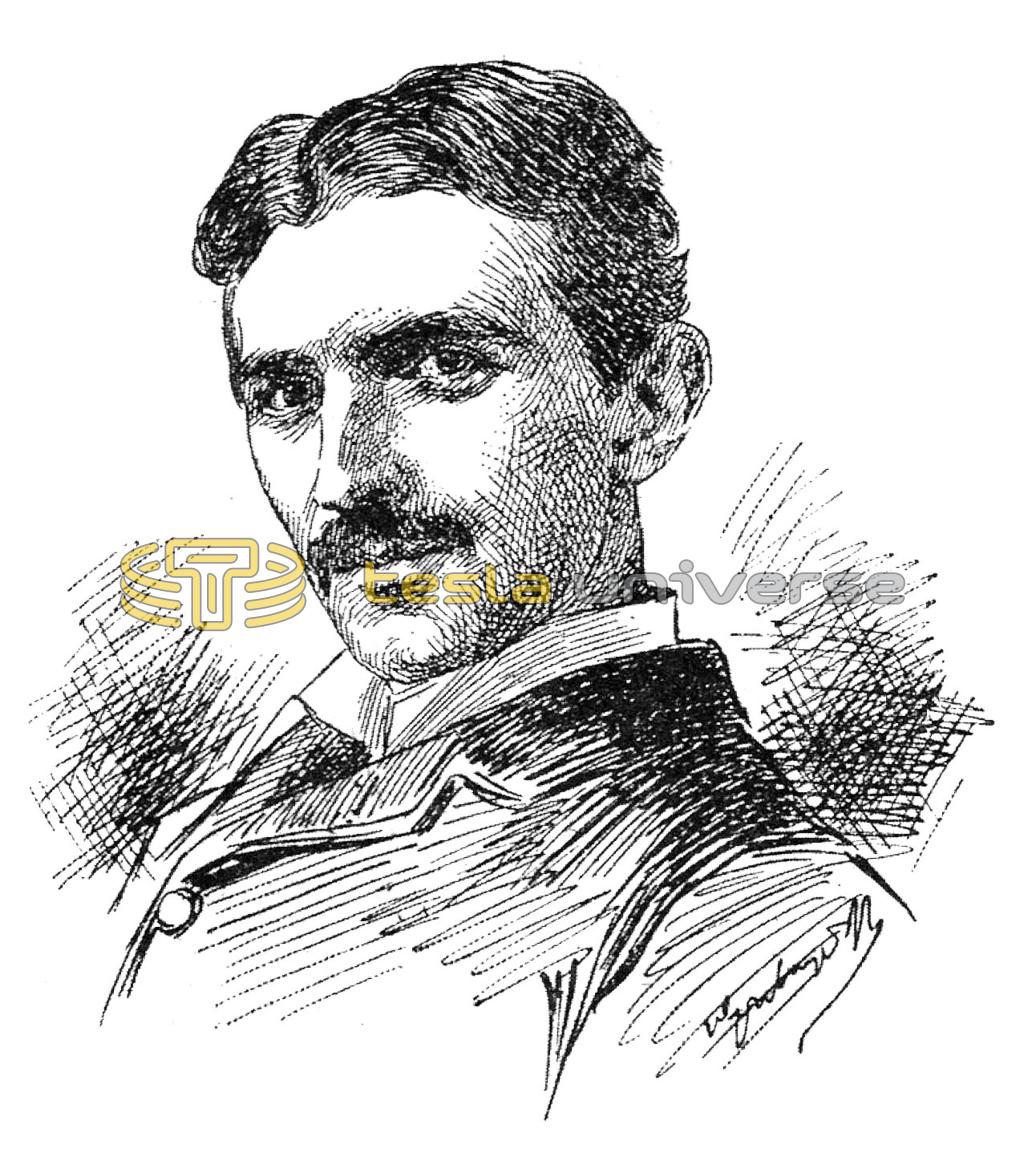
I may candidly state that I was a trifle shocked the first time I saw Nikola Tesla as he suddenly appeared before me in the library and sank into a chair seemingly in a state of utter dejection. Tall, straight, gaunt, and sinewy of frame like a true Slav, with clear. blue eyes and small, mobile mouth fringed with a boyish mustache, he looked younger than his thirty-seven years. But what arrested my attention chiefly at the moment was the pallid, drawn and haggard appearance of the face. While scanning it closely I plainly read a tale of overwork and of tremendous mental strain that must soon reach the limits of human endurance.
"I would like to talk with you, my dear sir," he said, "but I feel far from well to-day. I am completely worn out, in fact, and yet I cannot stop my work. These experiments of mine are so important, so beautiful, so fascinating, that I can hardly tear myself away from them to eat, and when I try to sleep I think about them constantly. I expect I shall go on until I break down altogether. So you would really like to see some of my experiments in electric lighting," he added. "I shall endeavor to accommodate you, my friend, if you will come with me into the laboratory. Be prepared, though, for a surprise or two."
Mr. Tesla then ushered me into a room some twenty-five feet square, lighted on one side by two broad windows, partially covered by heavy black curtains. Directly opposite was an open door leading into the machine room, which seemed to be fairly alive with grimy figures flitting to and fro. The whole scene, to my unaccustomed eyes, suggested a veritable magician's den.
The laboratory was literally filled with curious mechanical appliances of every description. Wires innumerable, from the smallest size to cables three-quarters of an inch
