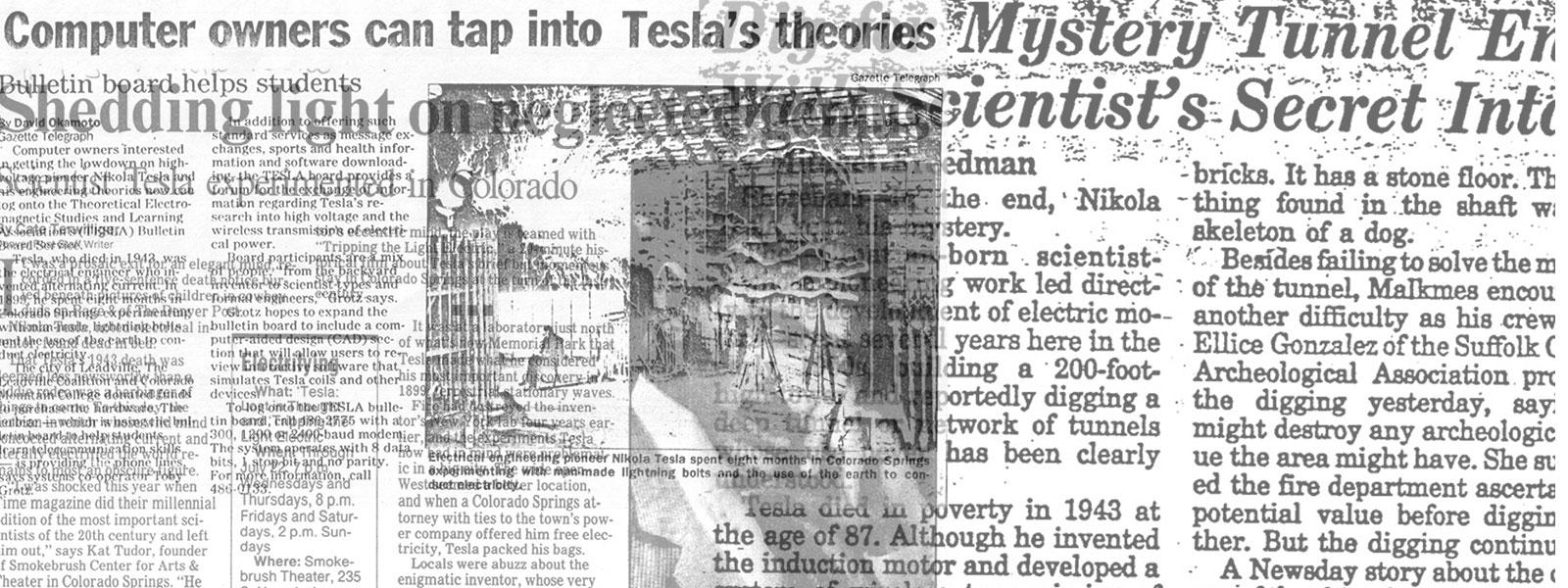
Nikola Tesla Articles
Nikola Tesla and the Electric Light of the Future Page 2
Outlook - March 9th, 1895
thick, ran along the walls, ceiling, and even the floor. In the center was what appeared to be a large circular table covered with thick strips of black woolen cloth; snakelike cables running up underneath were connected at the other end with an adjacent dynamo, thereby establishing a possible center of electro-dynamic vibration. Between the table and the windows two large brownish globes, eighteen inches in diameter, depended from the ceiling by cords. These balls were composed of brass, coated with two inches of wax to render them non-injurious, and served the purpose of spreading the electrostatic field.
So much for my surroundings, as I glanced about in some bewilderment after hearing Mr. Tesla say that he had a surprise in store for me. Promptly suiting the action to the word, he called in several employes from the workshop and issued a succession of hurried orders which I followed but vaguely. Presently, however, the doors were shut and the curtains closely drawn until every chink or crevice for the admission of light was concealed and the laboratory bathed in absolutely impenetrable gloom. I awaited developments with intense interest.
The next minute exquisitely beautiful luminous signs and devices of mystic origin began to flash about me with startling frequency. Sometimes they seemed iridescent, while again a dazzling white light prevailed.
"Take hold," said a voice, and I felt a sort of handle thrust into my hand. Then I was gently led forward and told to wave it. On complying, I spelled the word "Welcome" flaming before my eyes. Unfortunately, I was totally unable at the time to appreciate the kindly sentiment implied.
A hand approached mine ere I had quite recovered, and I felt the tips of my fingers lightly brushed. Fancy my dire dismay when I immediately experienced an acute tingling sensation, accompanied by a brief pyrotechnic display that was surprising, to say the least. When the daylight, as well as my equanimity, was in a measure restored, I learned something of the meaning of these wondrous experiments, which may be said to foreshadow in a way the electric light of the future. What impressed me most of all, perhaps, was the simple but cheerful fact that I remained unscathed while electrical bombardments were taking place on every side. Curiously enough, the polyphase currents of high frequency and high potential, of say 200,000 volts, have, as Mr. Tesla has demonstrated repeatedly on the platform, no harmful effect whatever on the human body, although a like energy exerted in indirect currents would prove instantaneously fatal.
Over two and a half years ago Mr Tesla made this striking observation in one of his lectures: "The ideal way of lighting a hall or room would, however, be to produce such a condition in it that an illuminating device could be moved and put anywhere, and that it should be lighted no matter where it is put, and without being electrically connected to anything."
To return to my own experience in the darkened laboratory, it seems that the entire room was actually filled with electric vibrations through the agency of these same currents, styled alternating (that is, with direction perpetually changing). The strange devices I had seen were nothing more than nearly exhausted glass tubes bent into various shapes and analogous to lamps, excepting that they were devoid of filament or button.
These tubes being carried into the area where the electrical agitation was strongest, the remaining molecules of ether or air within all the while pressing against the crystal confines, a molecular bombardment followed, produced by the collision of two forces, and the bulbs simultaneously became luminous. Those which were made to glow with the colors of the rainbow were coated on the inside with phosphorescent substances.
I have attempted nothing more than a very imperfect outline of Mr. Tesla's novel and interesting scheme, which is to be regarded as still in a state of embryo. It cannot be denied too, that there are many scientists to-day who shake their heads dubiously at the bril liant Servian's unequivocal attitude toward the electric light.
Meanwhile Mr. Tesla makes no boasts, but is willing to abide his time. Throughout the interview I was constantly impressed with the man's loftiness of purpose, innate modesty and utter indifference to public applause. "I should much prefer not to be written about at all," he remarked; "but if it must be done, I trust you will take due pains to quote me correctly."
Speaking of the scientific status of the United States. as compared with that of older nations, he said: "English scientists are the greatest in theory, perhaps, although, as far as practical results go, America may well claim to lead the world. That is why I like to stay here."
Mr. Tesla speaks our language with the idiomatic range and choice diction of a native who is also a scholar and a trained speaker, the guttural accent of the Slav, of course, being slightly noticeable. He told me that he felt equally at home in six languages, not to mention the same number of dialects. is
Though simple, self-contained and undemonstrative in manner, when he is especially pleased or absorbed in enthusiastic description of electrical wonders, the intellectual animation of his frank blue eyes, combined with a rarely winning smile, exercises a charm that irresistible. I have noticed the same unconscious quality of personal magnetism in Mr. Edison, though in almost every other respect these two remarkable individuals are totally dissimilar.
Edison may be more truly the man of genius. He works out his intricate problems by intuition. He peers into the future like a seer of old, and receives, as it were, lightning flashes of inspiration to guide him to the goal. In a word, the illiterate train boy of thirty-odd years ago has come to be regarded as little less than a wizard; and yet, assuredly, he is neither a thinker nor a student in the true sense.
Now, how is it with the Servian, who has acquired fame much less rapidly? What was his life before he came among us? Let me say, at the outset, that eighteen years of exhaustive, patient study were accomplished before Nikola Tesla deemed himself adequately prepared to embark upon the career which he had planned from childhood.
Born in 1857 at Smiljan Lika, a remote village in Austro-Hungary, he is the descendant of a sturdy line of Servian patriots, who for centuries had taken a prominent part in the protracted struggle against the domineering Turk. It
The young Nikola commenced his studies in the public school of Gospich when five years of age. Not long afterward the marvels of electricity and magnetism began to dawn upon the boy's receptive soul. Fascinated and stirred until he scarcely thought of anything else, he resolved thenceforth to devote his life to research and investigation in this noble field of knowledge. In 1873, against the wishes of his father, who, being a clergyman in the Greek Church, had hoped that his son would discover a theological bent, Nikola entered the Polytechnic School at Gratz. was at this institution, while puzzling over the complexities of a direct current Gramme machine, that his alert mind was led to conceive of a rotating magnetic field, which discovery was destined to deal the deathblow to those troublous contrivances the commutator and brushes. After completing the technical course at Gratz, Mr. Tesla removed to Vienna, where for several years he attended philosophical lectures, read omnivorously on many subjects, continued his special studies, and incidentally found time to master five or six languages. Verily, an intellectual training of this sort, in the face, too, of untold trials and difficulties, to would have far exceeded the scope of any ordinary student.
Before I bade a regretful farewell to this kindly wizard of Washington Square he confided to me that he was engaged on several secret experiments of most abundant promise, but their nature cannot be hinted at here. However, I have Mr. Tesla's permission say that some day he proposes to transmit electric vibrations through the earth; in other words, that it will be possible to send a message from an ocean steamer to a city, however distant, without the use of any wire.
To those who would gain a complete technical knowledge of the Servian's manifold labors since he came to the United
