Nikola Tesla Articles
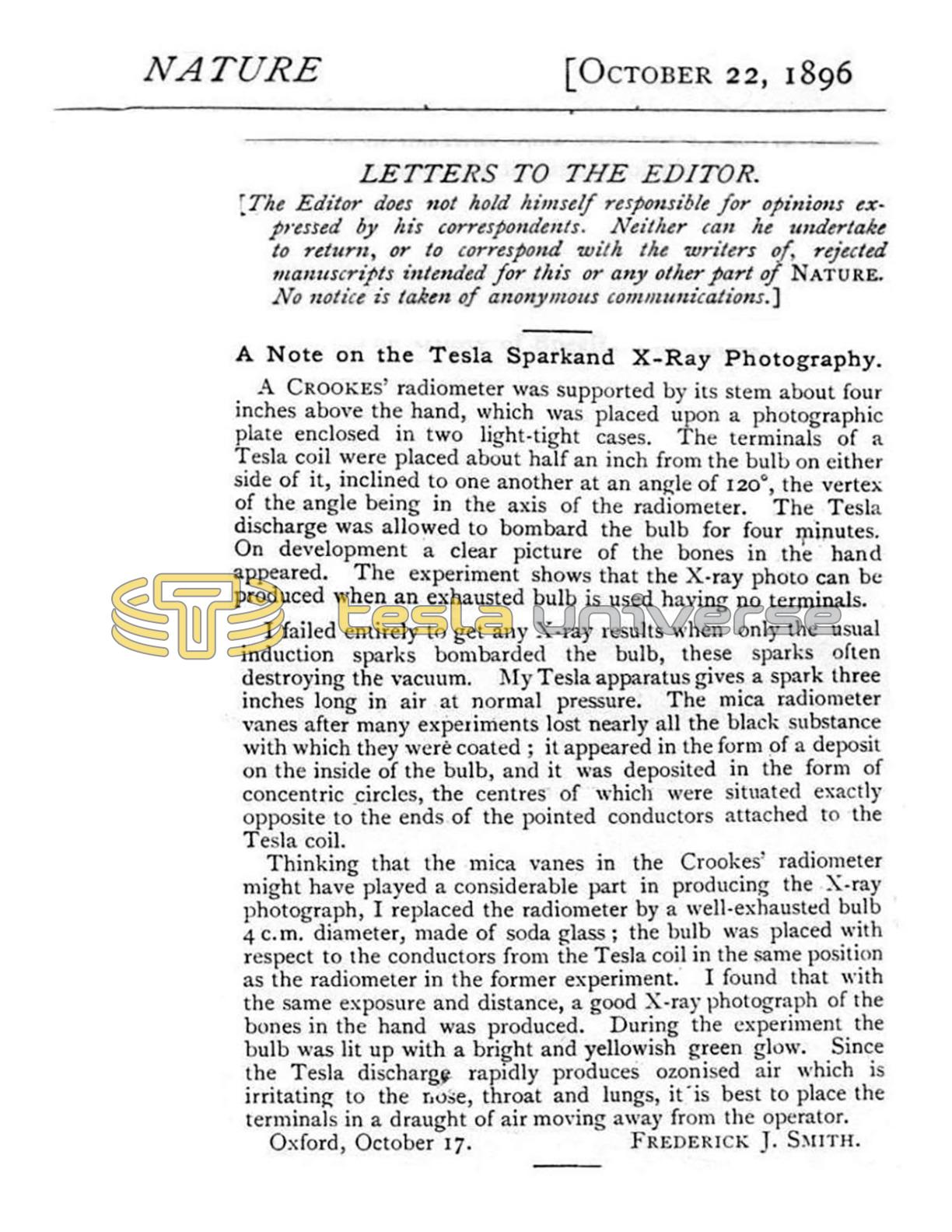
A Note on the Tesla Spark and X-Ray Photography
A Crookes' radiometer was supported by its stem about four inches above the hand, which was placed upon a photographic plate enclosed in two light-tight cases. The terminals of a Tesla coil were placed about half an inch from the bulb on either side of it, inclined to one another at an angle of 120°, the vertex of the angle being in the axis of the radiometer. The Tesla discharge was allowed to bombard the bulb for four minutes. On development a clear picture of the bones in the hand appeared. The experiment shows that the X-ray photo can be produced when an exhausted bulb is used having no terminals.
I failed entirely to get any X-ray results when only the usual induction sparks bombarded the bulb, these sparks often destroying the vacuum. My Tesla apparatus gives a spark three inches long in air at normal pressure. The mica radiometer vanes after many experiments lost nearly all the black substance with which they were coated; it appeared in the form of a deposit on the inside of the bulb, and it was deposited in the form of concentric circles, the centres of which were situated exactly opposite to the ends of the pointed conductors attached to the Tesla coil.
Thinking that the mica vanes in the Crookes' radiometer might have played a considerable part in producing the X-ray photograph, I replaced the radiometer by a well-exhausted bulb 4 c.m. diameter, made of soda glass; the bulb was placed with respect to the conductors from the Tesla coil in the same position as the radiometer in the former experiment. I found that with the same exposure and distance, a good X-ray photograph of the bones in the hand was produced. During the experiment the bulb was lit up with a bright and yellowish green glow. Since the Tesla discharge rapidly produces ozonised air which is irritating to the nose, throat and lungs, it is best to place the terminals in a draught of air moving away from the operator.
Oxford, October 17.
FREDERICK J. SMITH.