Nikola Tesla Articles
The Performance of the Tesla Motor
Supplementary to Mr. Perry's article on the new Westinghouse Electrical Works at East Pittsburg, which appeared in our issues for April 10th and 17th, we give the following curves of performance made especially for this purpose but completed too late for insertion with the rest of the matter. The motor under test was one of those referred to in the article rated at 50 H. P. It is running on the regular shop two-phase currents, 220 volts-3,000 alternations, 750 revolutions per minute. The switch for throwing in and out the starting resistances was of the ring or most recent type, and was illustrated in Fig. 4 on page 176.
The curves will sufficiently explain themselves, but it seems worth while to draw particular attention to several points in the performance of the motor.
The maximum starting torque of which the motor is capable is a little over 2 times the full load running torque, but as in ordinary practice such a starting torque is not required, the starting resistance in the secondary of the motor is given such value that the torque at starting is about 14 times the full load running torque. This is done to avoid the excessive current which is necessarily required by any motor, whether for direct or alternating currents, for the development of an abnormal torque. With such a resistance the current taken by the motor at the instant of starting is about 50 per cent. in excess of that taken at full load. When the motor has nearly attained full speed the starting resistance is short-circuited.
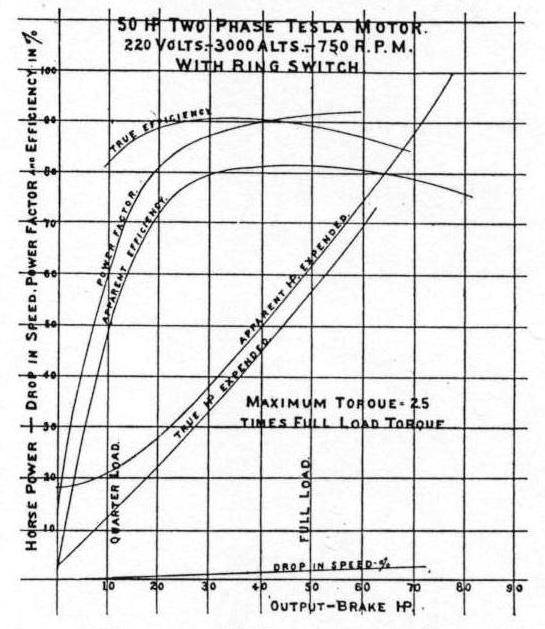
The motor when running unloaded takes only 18 apparent H. P., or 36 per cent. of the full load output.
The falling off of speed from no load to full load is less than 2 per cent.
The apparent and true efficiencies rise very rapidly as the load increases. At one quarter load the apparent efficiency is 57 per cent. and true efficiency 84 per cent. At full load the apparent efficiency is 81.5 per cent. and the true 89.5 per cent. The full load efficiency is better than is ordinarily attained by direct current machines of the same output, and the light load efficiencies are much better. Such a motor as this will have, therefore, a much higher all-day efficiency than a direct current motor of the same output in places where the power required is variable. It is claimed for this type of motor that, in addition to its electrical superiority, the simplicity and durability of construction and the consequent freedom from breakdowns, its ability to carry severe overloads without any harm resulting, and the ease with which it can be controlled both as to speed and as to direction of rotation, make such a machine as this much superior to any direct current motor for all ordinary purposes for which an electric motor can be used.