Nikola Tesla Articles
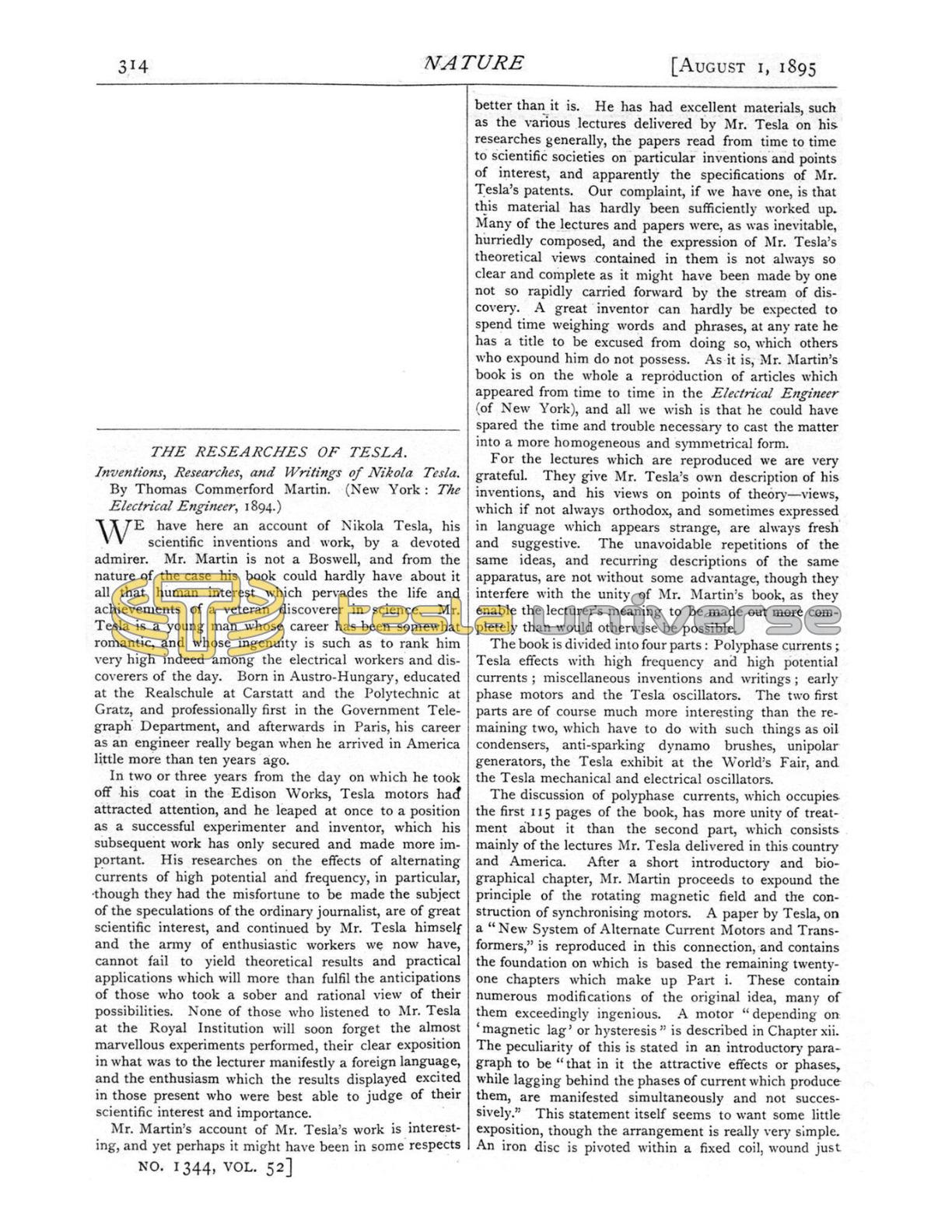
The Researches of Tesla
Inventions, Researches, and Writings of Nikola Tesla. By Thomas Commerford Martin. (New York: The Electrical Engineer, 1894.)
We have here an account of Nikola Tesla, his scientific inventions and work, by a devoted admirer. Mr. Martin is not a Boswell, and from the nature of the case his book could hardly have about it all that human interest which pervades the life and achievements of a veteran discoverer in science. Mr. Tesla is a young man whose career has been somewhat romantic, and whose ingenuity is such as to rank him very high indeed among the electrical workers and discoverers of the day. Born in Austro-Hungary, educated at the Realschule at Carstatt and the Polytechnic at Gratz, and professionally first in the Government Telegraph Department, and afterwards in Paris, his career as an engineer really began when he arrived in America little more than ten years ago.
In two or three years from the day on which he took off his coat in the Edison Works, Tesla motors had attracted attention, and he leaped at once to a position as a successful experimenter and inventor, which his subsequent work has only secured and made more important. His researches on the effects of alternating currents of high potential and frequency, in particular, though they had the misfortune to be made the subject of the speculations of the ordinary journalist, are of great scientific interest, and continued by Mr. Tesla himself and the army of enthusiastic workers we now have, cannot fail to yield theoretical results and practical applications which will more than fulfil the anticipations of those who took a sober and rational view of their possibilities. None of those who listened to Mr. Tesla at the Royal Institution will soon forget the almost marvellous experiments performed, their clear exposition in what was to the lecturer manifestly a foreign language, and the enthusiasm which the results displayed excited in those present who were best able to judge of their scientific interest and importance.
Mr. Martin's account of Mr. Tesla's work is interesting, and yet perhaps it might have been in some respects better than it is. He has had excellent materials, such as the various lectures delivered by Mr. Tesla on his researches generally, the papers read from time to time to scientific societies on particular inventions and points of interest, and apparently the specifications of Mr. Tesla's patents. Our complaint, if we have one, is that this material has hardly been sufficiently worked up. Many of the lectures and papers were, as was inevitable, hurriedly composed, and the expression of Mr. Tesla's theoretical views contained in them is not always so clear and complete as it might have been made by one not so rapidly carried forward by the stream of discovery. A great inventor can hardly be expected to spend time weighing words and phrases, at any rate he has a title to be excused from doing so, which others who expound him do not possess. As it is, Mr. Martin's book is on the whole a reproduction of articles which appeared from time to time in the Electrical Engineer (of New York), and all we wish is that he could have spared the time and trouble necessary to cast the matter into a more homogeneous and symmetrical form.
For the lectures which are reproduced we are very grateful. They give Mr. Tesla's own description of his inventions, and his views on points of theory — views, which if not always orthodox, and sometimes expressed in language which appears strange, are always fresh and suggestive. The unavoidable repetitions of the same ideas, and recurring descriptions of the same apparatus, are not without some advantage, though they interfere with the unity of Mr. Martin's book, as they enable the lecturer's meaning to be made out more completely than would otherwise be possible.
The book is divided into four parts: Polyphase currents; Tesla effects with high frequency and high potential currents; miscellaneous inventions and writings; early phase motors and the Tesla oscillators. The two first parts are of course much more interesting than the remaining two, which have to do with such things as oil condensers, anti-sparking dynamo brushes, unipolar generators, the Tesla exhibit at the World's Fair, and the Tesla mechanical and electrical oscillators.
The discussion of polyphase currents, which occupies the first 115 pages of the book, has more unity of treatment about it than the second part, which consists mainly of the lectures Mr. Tesla delivered in this country and America. After a short introductory and biographical chapter, Mr. Martin proceeds to expound the principle of the rotating magnetic field and the construction of synchronising motors. A paper by Tesla, on a "New System of Alternate Current Motors and Transformers," is reproduced in this connection, and contains the foundation on which is based the remaining twenty-one chapters which make up Part i. These contain numerous modifications of the original idea, many of them exceedingly ingenious. A motor "depending on 'magnetic lag' or hysteresis" is described in Chapter xii. The peculiarity of this is stated in an introductory paragraph to be "that in it the attractive effects or phases, while lagging behind the phases of current which produce them, are manifested simultaneously and not successively." This statement itself seems to want some little exposition, though the arrangement is really very simple. An iron disc is pivoted within a fixed coil, wound just large enough to admit the diameter of the disc one way, and a little more than its thickness the other. The coil carries two pole-pieces, one at each end, which project from opposite sides a little way round the disc. Thus opposite poles are stretched out as it were from the coil round the disc in the same direction. An alternating current passed round the coil magnetises both these pole-pieces and the disc, and the repulsion between the adjacent similar polarities of the disc and pole-pieces produces the rotation, the polarities of both being of course reversed with the current. The disc is wound with closed coils, so that the induced currents augment the turning couple developed. This arrangement is further developed into a "multipolar motor"; but in neither case is there any clear statement of how the action depends on hysteresis.
In connection with these and similar devices it would have been interesting to have had some estimate of efficiency, but generally speaking, in no part of the book is there any discussion of this most important question. Indeed, when the word energy is used it seems to bear a somewhat peculiar sense. For example, at p. 81 we have a statement as to the "energies" of the field and the armature, and the importance of these being equal if for a given sum the motor is to have the greatest efficiency. This passage is a little difficult of interpretation, if the word energy is to be taken as it ought to be in its technical sense throughout, though it is not very hard to make out the idea intended.
By far the most interesting portion of the book to a student of electricity generally is Part ii. The alternator of high frequency which Mr. Tesla used is fully described, and the arrangements for using it explained in the first of the lectures already referred to. The phenomena produced are set forth in the remaining chapters with numerous illustrations which render the descriptions very easy to follow. The whole subject of high frequency phenomena is very intimately connected with the researches of Hertz on the one hand, and the work of Mr. Crookes on the other, and forms a most inviting field of research for experimentalists who possess the necessary equipment. Whether always the theoretical view taken by Mr. Tesla is correct, is matter for legitimate difference of opinion. For one thing, we do not think that there is any difference at all between electric force produced by what is properly called electro-static action and that produced by electro-magnetic action. The distinction is only mathematical — the former force can be derived from a potential function, the latter cannot — and in a sense only expresses our ignorance of the mode of production of the force. But perhaps we are mistaken in supposing that Mr. Tesla regards the electric forces in these two cases as different in nature.
To every physical inquirer the perusal of these lectures cannot but be of the greatest benefit. It will again remind him that the field of research is unlimited, and quicken his scientific enthusiasm, if not to taking part in the work of this particular part of it, to at least prosecuting with renewed vigour the inquiry, whatever it is, which lies ready to his hand.
It was reported a few weeks ago that all the apparatus and machinery belonging to Mr. Tesla had been destroyed by fire. Every reader of his researches must sincerely sympathise with Mr. Tesla in his loss of valuable appliances and still more valuable time. That he at once set himself to repair the loss is only what was to be expected from his character; let us hope that it may result in such improvements of his means of experimenting as may, in some measure at least, make up for his disappointment, if it is not, what is perhaps too much to suppose, turned into a blessing.
A. GRAY.