Nikola Tesla Articles
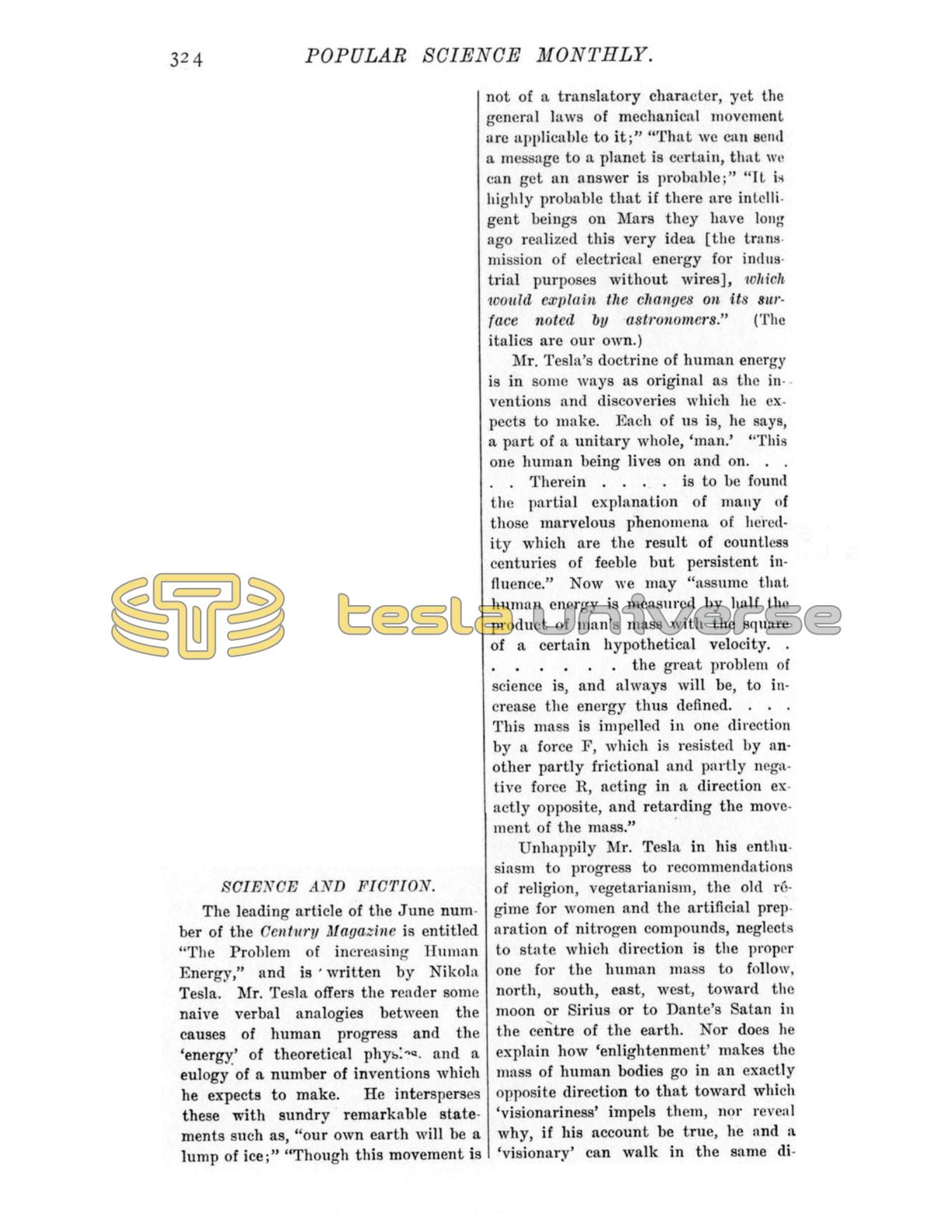
Science and Fiction
The leading article of the June number of the Century Magazine is entitled "The Problem of increasing Human Energy," and is written by Nikola Tesla. Mr. Tesla offers the reader some naive verbal analogies between the causes of human progress and the 'energy' of theoretical physis, and a eulogy of a number of inventions which he expects to make. He intersperses these with sundry remarkable statements such as, "our own earth will be a lump of ice;" "Though this movement is not of a translatory character, yet the general laws of mechanical movement are applicable to it;" "That we can send a message to a planet is certain, that we can get an answer is probable;" "It is highly probable that if there are intelligent beings on Mars they have long ago realized this very idea [the transmission of electrical energy for industrial purposes without wires], which would explain the changes on its surface noted by astronomers." (The italics are our own.)
Mr. Tesla's doctrine of human energy is in some ways as original as the inventions and discoveries which he expects to make. Each of us is, he says, a part of a unitary whole, 'man.' "This one human being lives on and on. Therein is to be found the partial explanation of many of those marvelous phenomena of heredity which are the result of countless centuries of feeble but persistent influence." Now we may "assume that human energy is measured by half the product of man's mass with the square of a certain hypothetical velocity. . the great problem of science is, and always will be, to increase the energy thus defined. This mass is impelled in one direction by a force F, which is resisted by another partly frictional and partly negative force R, acting in a direction exactly opposite, and retarding the movement of the mass."
Unhappily Mr. Tesla in his enthusiasm to progress to recommendations of religion, vegetarianism, the old régime for women and the artificial preparation of nitrogen compounds, neglects to state which direction is the proper one for the human mass to follow, north, south, east, west, toward the moon or Sirius or to Dante's Satan in the centre of the earth. Nor does he explain how 'enlightenment' makes the mass of human bodies go in an exactly opposite direction to that toward which 'visionariness' impels them, nor reveal why, if his account be true, he and a 'visionary' can walk in the same direction. Of course the whole notion that the 'velocity' of the human 'mass,' i.c. the space it traverses in a given time, has any connection with human progress or is of any value to anybody or anything, is absurd.
Mr. Tesla has enjoyed considerable, excellent repute as a gifted student of certain electrical phenomena and one expects a good deal from his "electrical experiments, now first published." Mr. Tesla, too, expects a good deal from them. It would take too long to even note here all the important scientific discoveries which Mr. Tesla expects to make or all the benefits which he expects to thereby confer upon mankind in general and in particular upon those who exploit his inventions. Some samples may be given. War will be rendered harmless by being reduced to a sort of game between 'telautaumata,' machines which behave "just like a blind-folded person obeying instructions received through the ear," any one of which is "enabled to move and to perform all its operations with reason and intelligence."
Says Mr. Tesla: "I purpose to show that, however impossible it may now seem, an automaton may be contrived which will have its 'own mind,' and by this I mean that it will be able, independent of any operator, left entirely to itself, to perform, in response to external influences affecting its sensitive organs, a great variety of acts and operations as if it had intelligence. It will be able to follow a course laid out or to obey orders given far in advance; it will be capable of distinguishing between what it ought and what it ought. not to do, and of making experiences or, otherwise stated, of recording impressions which will definitely affect its subsequent actions. In fact, I have already conceived such a plan."
Inasmuch as the interest in this telautomatic warfare is to be purely aesthetic, it would seem as if international bull-fights or kite-flying or spelling matches or potato-races might do as well, and have the added advantage of leaving Mr. Tesla's expectations free to wander among the following prospective discoveries.
New sources of energy, Mr. Tesla thinks, may be opened up, such as a wheel which shall perform work without any further effort on our part than that of constructing it. "Imagine a disc of some homogeneous material turned perfectly true and arranged to turn in frictionless bearings on a horizontal shaft above the ground. This disk, being under the above conditions perfectly balanced, would rest in any position. Now, it is possible that we may learn how to make such a disk rotate continuously and perform work by the force of gravity without any further effort on our part. To make the disk rotate by the force of gravity we have only to invent a screen against this force. By such a screen we could prevent this force from acting on one half of the disk, and the rotation of the latter would follow."
Into further particulars concerning the nature of such a screen Mr. Tesla does not enter, though it would seem a matter well fitted to engage his peculiar gifts. The 'screen against gravity' idea has already entered into a popular story, but scientific men have probably not given it much consideration.
By producing a 'sink' or reservoir of a low temperature, thereby inducing the heat of the ambient medium to transform itself in part into other forms of energy (e.g. electrical), Mr. Tesla hopes to "get any amount of energy without further effort" beyond the amount needed to create the 'sink.' We should thus employ "an ideal way of obtaining motor power," and incidentally rebuke the narrow-minded physics of Carnot and Lord Kelvin.
By means of his electrical oscillator Mr. Tesla has satisfied himself that he can transmit electrical energy in large quantities without wires. He expects that this can be done to great economic advantage. Then would come the golden age. "Men could settle down everywhere, fertilize and irrigate the soil with little effort, and convert barren deserts into gardens, and thus the entire globe could be transformed and made a fitter abode for mankind."
The golden age figures largely in Mr. Tesla's article; he offers us all that is entrancing and wonderful. He is generous. We ask for the bread of definite facts of science and intelligible evidence, but he gives us the amethyst and topaz and diamonds of an ambient medium doing all our work and the atmosphere transporting all our motive power and the tyrant gravity held powerless by a screen, and Mr. Tesla correcting Lord Kelvin's errors. Still amethyst and topaz and diamonds are only stones. They may dazzle magazine reader, but they do not nourish the student of science.
The editorial department of the Century Magazine perhaps felt that these the jewels were a bit too bright. We read there that "much that must seem speculative to the layman can take its proper place only in the purview of the scientist." Some conservative scientists will feel like growling, "And much that must seem bosh to the man of science can take its proper place only in the purview of the editorial departments of popular magazines." Leaving aside the present case, it is a fact that the same care which is exercised by editors to secure in their contributions excellence of style and syntax, a proper moral tone and freedom from advertisement of business ventures, is not exercised to secure accuracy in statements of fact or decent credibility in matters of theory. The editors apparently impute to their readers a desire to be entertained at all costs. They descend to a footing with the Sunday newspaper instead of trying to rise to the level of such scientific literature as Huxley or Tyndall gave us. They evidently often do not know science from rubbish and apparently seldom make any effort to find out the difference. They should at least submit their scientific literature to competent men for criticism and revision.
The general public is helpless before any supposedly scientific statement. It may judge vaguely by the standing of the paper or magazine or book containing it, by the name of the writer or by the general tone in which the article is written. But it cannot judge definitely by comparison with relevant facts or by critically examining the logic of the deductions, for the general public lacks both knowledge of the relevant facts and training in logical criticism. a man should invent a microscope which will enable one to see objects a million That times as small as can be seen with the naked eye seems no more questionable to the general public than that a man should cause unfertilized eggs to develop. Yet the first would be impossible while the second has been possible, probable, and still more lately proved. Guidance in scientific matters should be welcome if only for the protection thus given against fraudulent medicines, bogus inventions and nonsensical enterprises.
PHYSICIST.