
Nikola Tesla Articles
Tesla (by Bud Spurgeon)
He wasn't from Venus, merely Yugoslavia, but his vision of broadcast pointed in a direction few have traveled. Thirty-five years after his death, the work begins anew...
by Bud Spurgeon
We depend upon a system of generating and distributing electrical power which is both ubiquitous and completely taken for granted, a fact brought home sharply to anyone who has lived through a power blackout.
This system of electrical power, whose essential elements are the same worldwide, is mostly the invention of an extraordinary scientist named Nikola Tesla. Tesla, a Serbo-Croatian immigrant to the United States, discovered the principle of the rotating magnetic field in a single flash of creative vision, and his application of that vision in the alternating current (AC) induction motor and the polyphase system of AC generation and distribution forms the foundation of technological civilization. Tesla's patents of 1888 were so complete that no basic changes have been made for over eighty years.
Tesla also is responsible for the first tuned radio circuits, for discoveries in gaseous and fluorescent lighting, for the use of high frequencies in medicine, for the first demonstration of robotics, and much more. Yet the name of this prolific inventor, who lived and worked in New York City around the turn of the century, is virtually unknown.
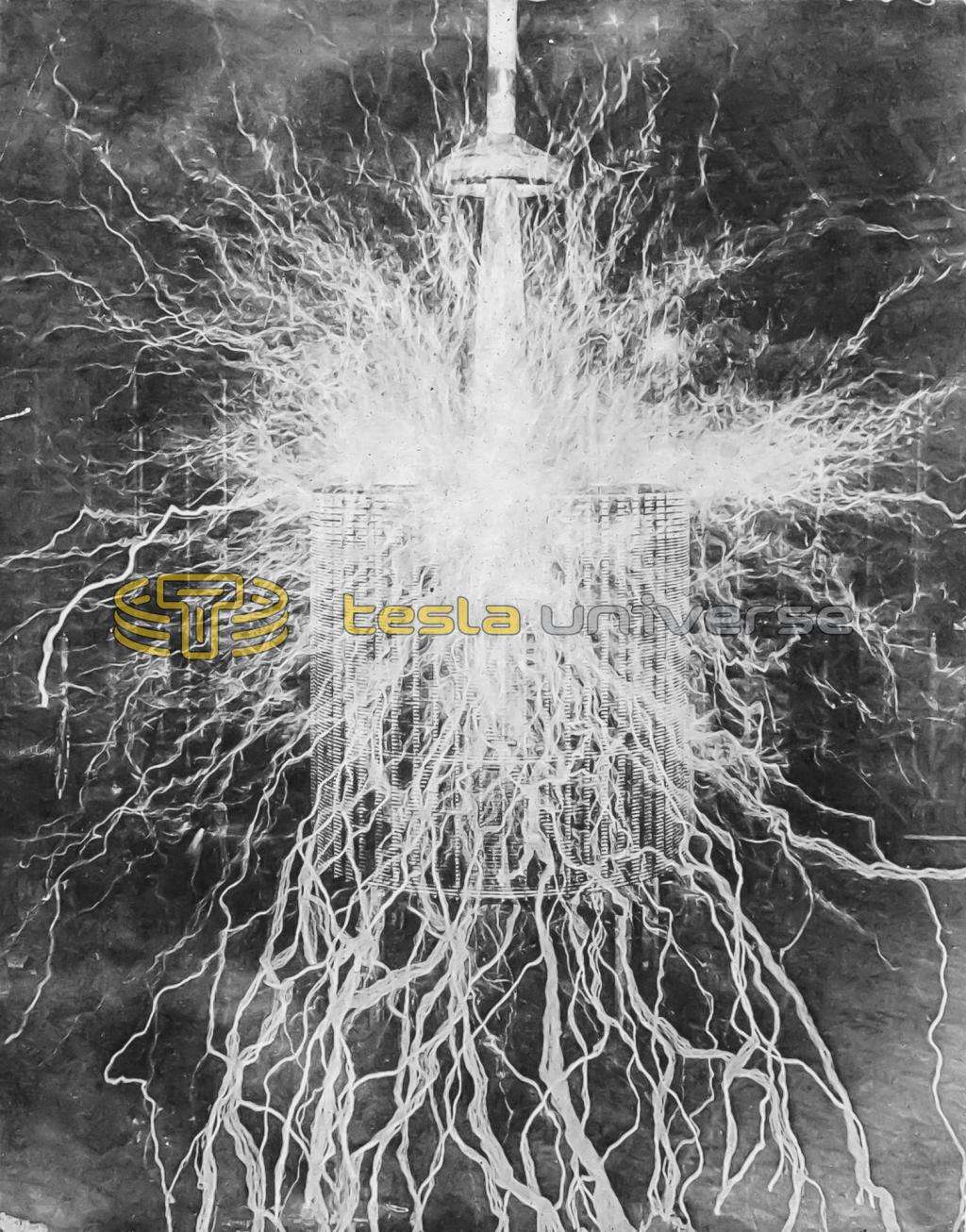
Many of his discoveries were so basic and so far ahead of his time that even today, scientists comb his sketchy notebooks looking for new ideas. For example, in 1976 a huge Tesla coil (a high frequency current transformer) was constructed in an Air Force hanger in Wendover, Utah. The last time that such a large coil had been built was by Tesla himself in Colorado Springs in 1899. Operating at the unheard of power of 12 million volts and up, he accidentally had produced ball lightning during experiments aimed at something quite different. Today Robert K. Golka has become the second man in history to generate such high voltages and his coil is an exact copy of the one used by Tesla nearly 80 years ago. Golka, who is working under a federal grant, has instituted Project Tesla and intends to study the ball lightning generated by Tesla's coil.
We don't know much about ball lightning, but most theories agree that it is a plasma held together somehow by surface tension. Exactly how this surface tension manages to contain the plasma is a matter of great interest to researchers in fusion power. Tesla's coil turns out to be the only known way to produce artificially the phenomenon of ball lightning, whose very existence was denied by scientists until recently. For such an old experiment to become so immediately useful in science is a rare occurrence - but then, Tesla was a rare individual.
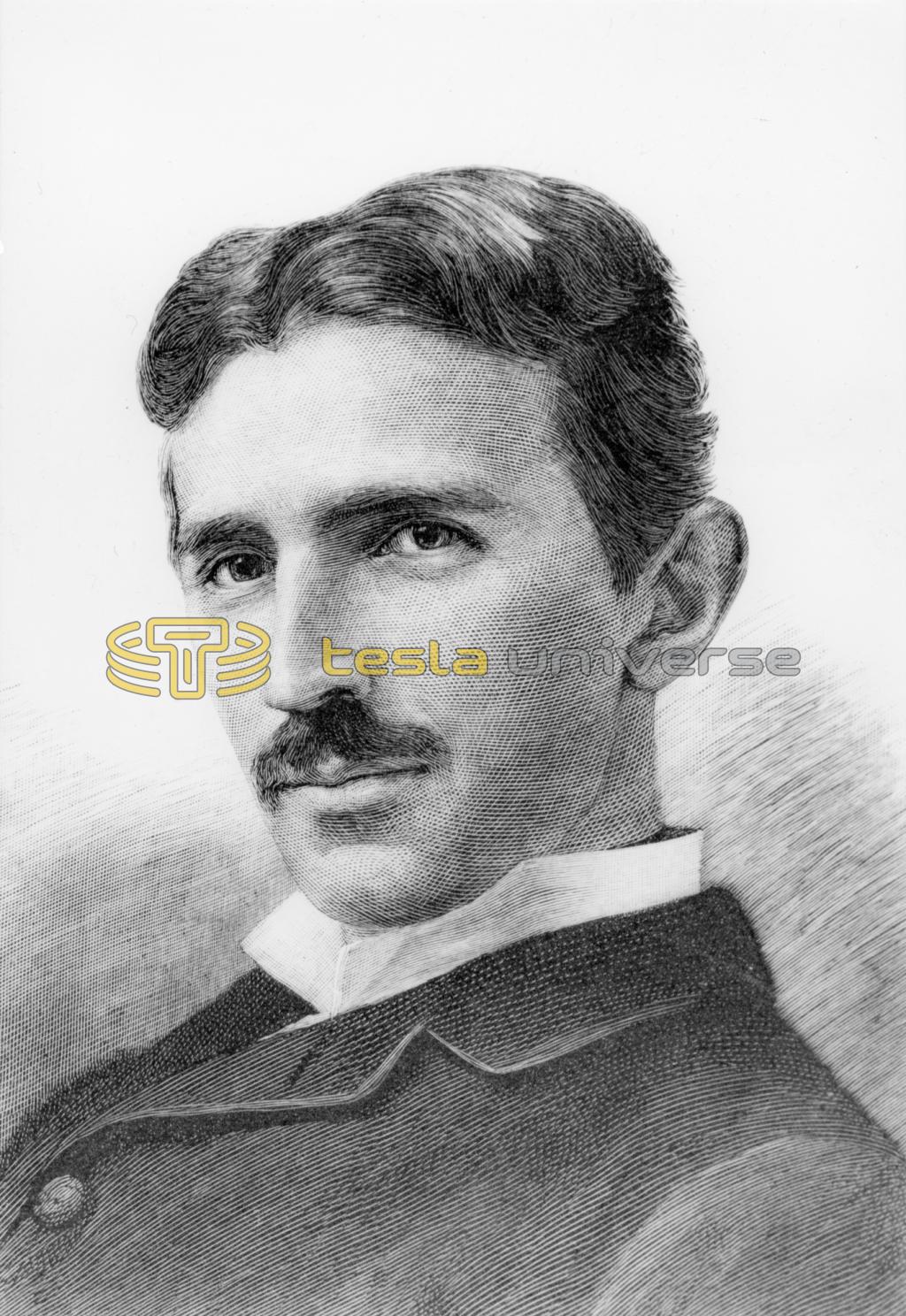
He was born in 1856 in the village of Smiljan, in what is now Yugoslavia. His father was the pastor of the local Serbian Orthodox church. His mother was illiterate, but she was well known in the village for her ability to invent labor-saving household devices.
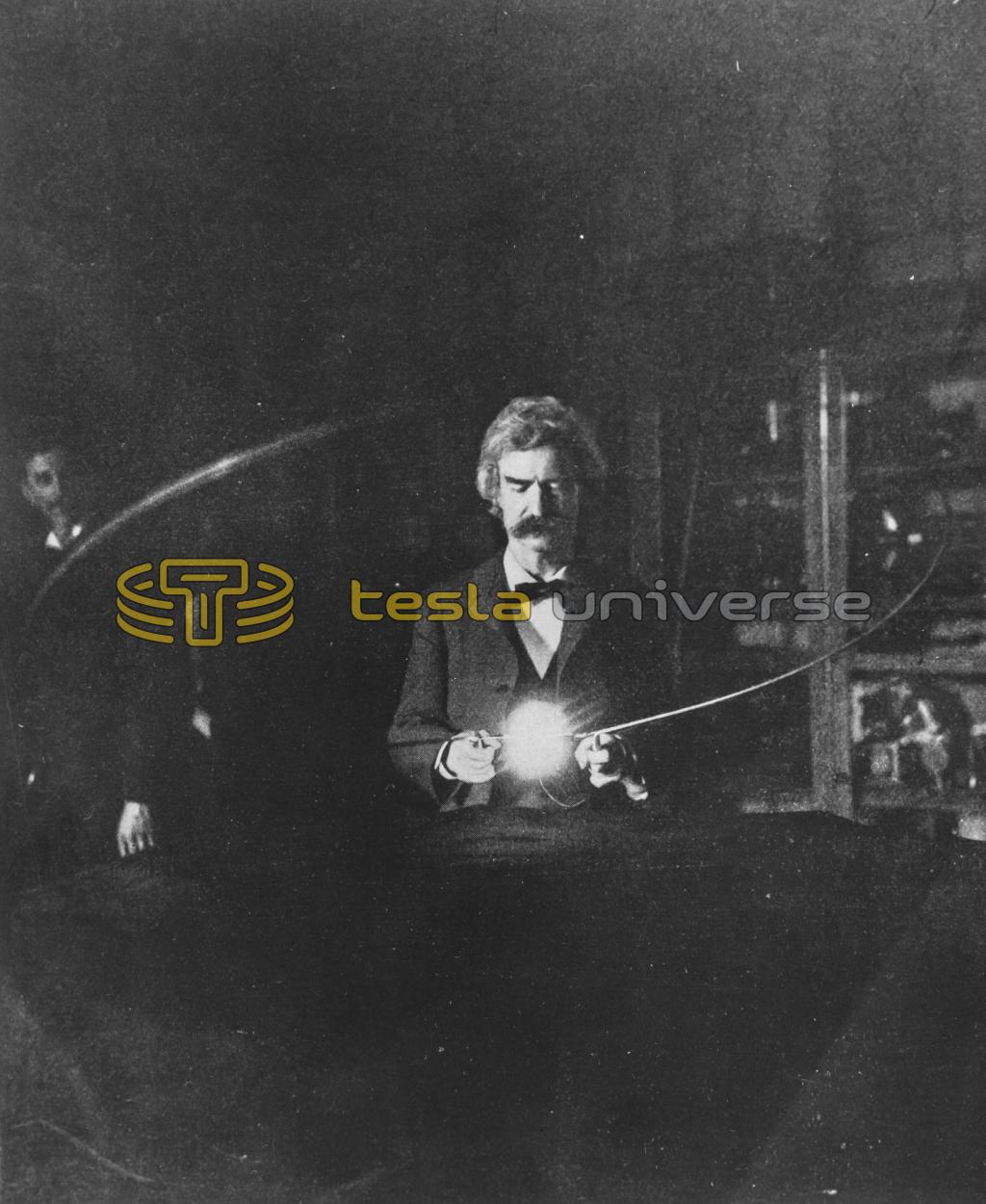
By the age of fourteen, Tesla had become a voracious reader in four languages. He also could solve mathematical problems in his head almost instantly. By now, Tesla's family was living in the city of Gospic. Tesla had been asked to catalog the local library, and while he was working on this task he was stricken by a long illness. He fell into a deep depression and the town's doctors gave up hope for his recovery. To help pass the time Tesla asked that books be brought from the library to his home and while reading one of them, he suddenly recovered his will to live. The book that cheered him up was by Mark Twain, and he later credited it with saving his life. Much later, when Tesla met Twain in New York, they became close friends.
Tesla first became aware of the problem which would lead him to the discovery of the rotating magnetic field in 1877. Then 22 years old, he was in engineering training at the Polytechnic School in Graz, Austria. There, his physics teacher, Professor Poeschl, demonstrated a newly acquired direct current (DC) motor called a Gramme machine. The motor would generate DC electricity if turned by some force, and also would act as an electrical motor if DC power was applied to it. The design included a commutator and brushes which sparked a great deal, and Tesla believed that the sparking could somehow be eliminated. Poeschl devoted an entire class to a scathing lecture demonstrating the "fallacy" of Tesla's idea, but Tesla was unmoved.
The answer came to him five years later in one of the stranger examples of scientific inspiration ever recorded. In 1882 Tesla was working as the chief electrician for the new telephone company in Budapest. On an evening in Feburary he was walking through the city park with a friend named Szigeti. They had stopped to admire the sunset and Tesla, drawing upon his prodigious memory, began reciting some of his favorite lines from Faust:
"The glow retreats, done is the day of toil;
It yonder hastes, new fields of life exploring;
Ah, that no wing can lift me from the soil,
Upon its track to follow, follow soaring...."
And then, as Tesla tells it,
"As I spoke the last words, plunged in thought and marveling at the power of the poet, the idea came like a lighting flash. In an instant I saw it all, and I drew with a stick in the sand the diagrams which were illustrated in my fundamental patents of May, 1888, and which Szigeti understood perfectly."1
The diagrams Tesla drew for Szigeti, while containing the solution to the problems of the electric motor, were also the essence of a system of electrical power which would change the world. Tesla had the ability to visualize the products of his imagination with such intensity that as a child he often had confused his visions and the real world. Later this ability made it possible for him to imagine a motor, for instance, and then mentally to build the motor from scratch, run it, and then inspect it for wear. Using this talent, Tesla was able in just two months after his vision in the park to design mentally all of the elements of the electrical power system he later would patent.
Since he was unable to interest anyone in Budapest, or later Paris, in backing his new system, Tesla decided to emigrate to America. He landed in New York with four cents, some poems he had written, and a plan for a flying machine. He also had a letter of introduction to Thomas Edison, and he immediately began working at the Edison lab in New York. Edison and Tesla were completely. different in temperament and method, and a split-up was inevitable. Tesla had an excellent European education, was a fine mathematician, and could speak and read several languages. Edison had very little formal education and had been known to make statements such as, "I can hire mathematicians, but they can't hire me."
Tesla walked out a year later, after Edison reneged on a promised bonus. Tesla then went to work on a new arc-lamp street lighting system for backers who had promised him great rewards, but who delivered only a nearly worthless stock certificate when the work was done. Tesla had reached the low point of his career, and he was forced to spend the next year as a day laborer digging ditches, until a chance acquaintance led to new backers who set up the Tesla Electric Company and funded a lab.
Finally in control of his own lab, Tesla exploded into creativity and began building models of all the machines he had been mentally refining for years. All of his models worked the first time, and in 1888 he was granted patents to generators, transformers, and motors making up an entire system of polyphase AC power.
George Westinghouse was the first to recognize the significance of Tesla's system, and during a meeting with the inventor in his lab, Westinghouse reportedly offered him one million dollars for his patent rights and a dollar-per-horsepower royalty on all the generators. This royalty has been estimated to have been worth 12 million dollars during Tesla's lifetime, but Tesla later waived it to help prevent Westinghouse from going bankrupt. Another report has it that Westinghouse offered only $200,000 for the patent rights, but by any account, it was the bargain of the century.
In any event, Tesla was delighted by the sale. After paying off his backers he still had money left to spend as he wished. It seems that Tesla had only one desire, to explore the strange world of electricity. He had dedicated his whole life to that end, never marrying, saying that an involvement with a woman would take too much away from his work. He had few close friends and he made it a habit never to confide in any of his laboratory assistants. No one but Tesla knew what research he was considering or what new inventions he very was working on. He preferred it that way, declaring that unlike other experimenters he could name, all of his work was his own. Since he had such a fine memory he wrote down only the scantiest of notes and much of what he did or planned to do is lost forever because of this habit.
After selling his patent rights, Tesla went to Pittsburgh to help Westinghouse build his polyphase system and his motors. Apparently Tesla disliked working with other engineers and he left Pittsburgh after only a year, despite the offer of a huge salary and a lab. After this experience, Tesla refused to work under anyone again. He maintained that he could get his work done only if everything was under his personal control. Also, Tesla appeared constrained by association with experimenters who were, in his eyes, groping their way into the study of electricity.
By contrast, Tesla had been thinking deeply about this mysterious force for years. His vision in Budapest not only revealed the basis for a new motor, but also the profound nature of alternating currents. Years of thought had convinced Tesla that the vibratory nature of these currents contained great powers. He saw all of nature as a vibratory phenomenon and he also saw parallels between the resonant circuits he would go on to develop and the acoustical resonance which is a property of all matter. Tesla concentrated his thinking on electrical and mechanical vibration and resonance, and it was this concentration on fundamental principles of nature which probably helped put him far ahead of all the other experimenters of the time. To work with mere thinkers was anathema. He had bigger fish to fry.
With his fine training in mathematics and his strange ability to visualize, Tesla was able to produce whole streams of inventions, often working in several areas simultaneously. This is what occurred when he returned to his New York lab in 1889. He immediately began to expand the frontiers of electrical science with studies of higher frequencies in alternating currents. Work in Pittsburgh had shown that 60-cycle alternating power was slow enough to turn a motor with force, yet high enough to prevent the perception of a flicker in electric lights. Now Tesla was wondering about the world above 60 cycles.
He began experiments for which he built mechanical generators and resonating coils to produce high frequency power. One of these was an elegant reciprocal generator whose output was so stable that Tesla built and ran a clock from it, and this became the first demonstration of electronic timekeeping. His generator would run on steam or compressed air, and through the interaction of its mechanical and electrical parts it was able to maintain a stable rate of vibrations. It had no valves or other moving parts except the shaft to which the main cylinder was attached.2
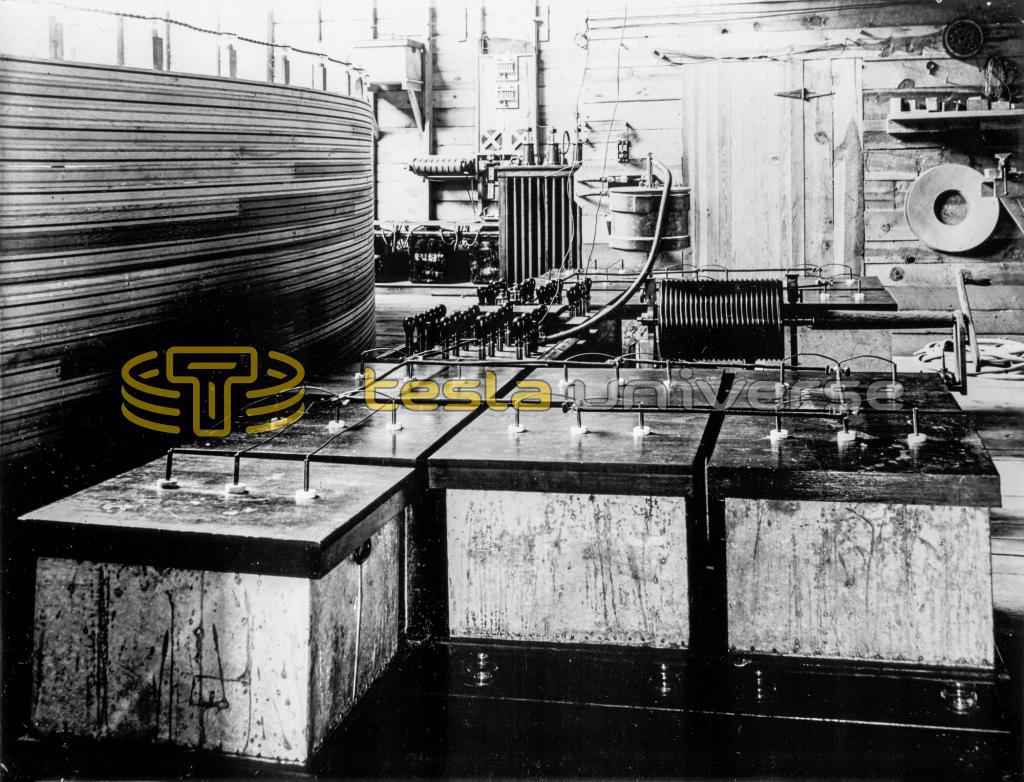
Tesla had spent quite some time perfecting the mechanical portion of the generator and he used just this portion for experiments in mechanical resonance. One of these experiments consisted of a platform to which he had attached the cylinder, the platform insulated from the floor with cork. Anyone who stood on the platform would experience a very pleasant massage, but the oscillations were so "pure" that other effects could, and did, occur. One story about these other effects is told in John J. O'Neill's biography of Tesla, Prodigal Genius. O'Neill tells of the time Mark Twain stopped by to see what Tesla was up to. Twain decided to try out the vibrating platform and found it much to his liking, so much so that he refused to get off despite Tesla's warnings. Twain suddenly discovered the reason for Tesla's concern and left the platform rapidly, heading for the bathroom. (The device had a powerful laxative effect.)
"...[he could] imagine a motor, then mentally build it from scratch, run it, and then inspect it for wear, all in his head."
In another experiment Tesla bolted the cylinder to an I-beam in his lab. The vibrations, carried through the beam into the foundations of the building, spread throughout the neighborhood and caused a small earthquake, breaking windows and pipes and exciting the neighbors. When the vibrations eventually centered on his own lab and threatened to destroy the building, Tesla managed to stop the machine with a blow from a sledgehammer.
In his efforts to increase the frequencies of his electrical experiments Tesla was forced to invent new methods of insulating wires and new forms of capacitors. He hit upon the method of immersing capacitors and other components in oil, a revolutionary technique for the times, but one still in use today. He went to these extremes because high frequency power is difficult to contain and would just as easily travel through the air as through copper wire.
At this time Tesla began building the series of air core conical transformers which have become known as "Tesla coils". The action of the coil depends on the resonant electrical vibrations produced by the interaction of the coil with a capacitor, and very high voltages were possible. The mechanical analog of this sort of resonance can be seen in the wooden bridge which collapses because soldiers march over it in unison each vibration is timed to reinforce the preceding one and enormous forces are built up. Since Tesla's coils operated on electricity, these forces were built up instantly and were limited only by the size of the coil. One only needs to build larger coils, as Tesla did in Colorado Springs or as Golka has done recently in Utah, in order to generate huge voltages.
Since these coils resonated at a known frequency, and since the energy they developed was of a type that would travel easily through air, it became a simple matter for Tesla to provide another coil tuned to resonate at the same frequency which would pick up some of the energy radiated by the first coil. He refined the method by tuning the coils to respond to quarter wavelengths, which are nodal points of zero movement in an oscillating system. By tuning his coils to respond to quarter wavelengths Tesla had discovered a method whereby the controlling end of his coils would have no electrical movement while the other end would shoot off high voltage sparks. This elegant system is the basis of our tuned radio circuits today. Tesla knew the secret of tuned circuits several years before Marconi sent a Morse code "S" crackling across the Atlantic in his primitive demonstration of wireless telegraphy.
Tesla began using his system to broadcast electricity across his lab, running motors and lighting lights with just one wire connected to the power source, and sometimes without any connecting wires. He also was developing new light sources at this time, one of them a bulb with a single wire going to a carborundum button which became incandescent when connected to high frequency power. Other lamps were sealed glass tubes which would glow under electrical bombardment. He lit these by running a wire around the ceiling of his lab and connecting it to one of his coils. The tubes would glow without any connecting wires, and this became his favorite method of lighting his lab. If he needed more light, he simply picked up one of the tubes and hung it next to the work at hand. Pictures taken at this time show that he had had the tubes bent into shapes such as stars and even words the first demonstrations of neon lighting, an invention which many might agree would have been better left undone.
It was around this time that Tesla published his observations of the effect of high-frequency currents on the human body - a heating effect. He suggested that medicine might find a use for it, and this is what happened some years later under the name Diathermy. Among other things, the treatment was used for the relief of arthritis symptoms.
Somehow or other Tesla also found time to develop thermomagnetic motors, little devices which took advantage of the sudden loss of magnetism that occurs when a magnet is heated to a certain temperature. He succeeded in producing small reciprocating motors using only magnets and a small flame for their power. The motors never produced very much power, and even Tesla couldn't figure out what to do with them. He designed, but never built, a large AC generator based on this effect. It had one moving part.
In 1891 Tesla began giving public lectures on his work. At the first, in New York, he revealed his new coils and lamps. He went on to London and Paris in 1892. He had the satisfaction of having risen from unknown ditch-digger to world-famous scientist in only four years.
Part of the reason he had so much to demonstrate was the pace he set himself. He slept only five hours a night, or less, and worked every day of the week. However, now that he had money and had become famous, he allowed himself to relax a bit and began giving social demonstrations in his lab. Such an evening began with a gourmet meal at his reserved table at Delmonico's, and then Tesla and his guests trooped to his lab where he generated huge sparks and photographed his guests holding bulbs that glowed while unconnected to anything else. He had a fine sense of the dramatic, and seemed to enjoy posing as the high wizard of electricity.
Tesla gave demonstrations at the Chicago World's Fair of 1893, and the fair was lighted and powered by an AC system installed by Westinghouse. It was the first large scale practical demonstration of alternating current. Late that same year, the final confirmation of Tesla's system came with the announcement that the Westinghouse plan had been chosen to generate power from Niagara Falls.
"The vibrations, carried through the beam into the foundations of the building, spread throughout the neighborhood and caused a small earthquake..."
Up until then Thomas Edison had been fighting the introduction of Tesla's system, which Edison correctly feared would run his direct current generating system out of business. Edison had launched a publicity campaign in which he claimed that AC power would instantly kill anyone who ran afoul of it. Since there was no love lost between Edison and Westinghouse, the campaign got ugly. Edison paid children around his lab 25¢ per head to round up stray dogs and cats for him. He electrocuted these unfortunate animals in front of reporters in a gruesome demonstration of the "dangers" of AC power.
A former Edison lab assistant who called himself "Professor" H. P. Brown electrocuted dogs on stage as an example of the "humane" executions which the use of AC power offered. New York State became the first to adopt Brown's "humane" method of execution and hired Brown to install a system using three Westinghouse generators supplying power to the first electric chair. The first person to be electrocuted, a condemned murderer named William Kemmler, had to be zapped several times since Brown had miscalculated and the power was too low to kill him outright. Nevertheless, the electric chair caught on, and its use to the present day stems from Edison's campaign to discredit alternating current.
Once Tesla's system became accepted as the only practical means to harness the power of Niagara Falls, Edison had to admit defeat. All of the generating plants Edison had built were converted to the much more powerful and flexible system which was Nikola Tesla's greatest contribution to the world.
Tesla, meanwhile, decided to return to work in his lab to the exclusion of all else. His mother had died while he was in Europe and he had fallen ill after her funeral. While recuperating he took stock of his efforts up to then and decided that he had been spending too much time frivolously giving dinner parties, demonstrations, lectures, and the like.
All of his efforts were now directed toward the development of his system of electrical broadcasting which, he felt, would supplant AC line transmission and bring wealth beyond his needs.
His idea was to broadcast power impressed onto the electrical field of the earth itself. Once the system was put into action, one would need only stick an antenna into the air and a ground stake into the earth in order to draw off electricity for use in lights and motors anywhere on the planet. In 1894 he gave an interview in which he described the idea and mentioned sending messages worldwide by the same method.
However, in March of 1895, while Tesla was adding the finishing touches to a prototype of his system, his laboratory burned to the ground. His matchless equipment was destroyed and his records and papers were lost. Worse yet, the lab was not insured, and Tesla had run out of the money from the Westinghouse sale.
Trading on his fame, Tesla managed to secure new backers. It took him over a year to rebuild the equipment that had been lost in the fire. Finally, in 1897, he tested his system by sending signals from his lab to a boat on the Hudson, 25 miles away. His first public demonstration of the broadcasting system was combined with the first demonstration of an electronic robot. Tesla's robot was a radio-controlled boat. The demonstration was held in Madison Square Garden in 1898 and it was a huge success. A large tank had been built in the hall for the boat to float in. The boat itself was several feet long, made of iron with a sealed top, and looked like a peculiarly modified Victorian bathtub.
Due to patent considerations, Tesla did not reveal that he also had a method for building a loop antenna into the hull of the boat and for making much more sophisticated systems of tuned circuits. The boat he demonstrated had an antenna sticking up from the top and only simple circuits inside to flash lights, steer the rudder, and so on. Crowds jammed the hall to watch the boat, shouting directions. Tesla would manipulate the switches so that the boat would respond, and to the people there it seemed like magic. To Tesla it was "... the first of a race of robots, mechanical men who will do the work of the human race."
More than fifteen years later Tesla wrote about his discoveries in robotics, which he called "Teleautomatics," in an unpublished article quoted in Prodigal Genius. There he discusses his boat and then goes on to talk about his plan for a new kind of flying machine. He says:
"As stated on a previous occasion, when I was a student at college I conceived a flying machine quite unlike the present ones. The underlying principle was sound but could not be carried into practice for want of a prime mover of sufficiently great activity. In recent years I have successfully solved the problem and am now planning aerial machines devoid of sustaining planes, ailerons, propellers and other external attachments, which will be capable of immense speeds and are very likely to furnish powerful arguments for peace in the near future. Such a machine, sustained and propelled entirely by reaction, can be controlled either mechanically or by wireless energy. By installing proper plants it will be practicable to project a missile of this kind into the air and drop it almost on the very spot designated which may be thousands of miles away. But we are not going to stop at this.
Here we have, in an article written around 1915, a clear description of guided missiles and the first intimation of electronic computers.
After his successful demonstration in Madison Square Garden, Tesla continued work on the broadcasting system, but now two problems presented themselves. First, Tesla had reached the limits of his laboratory to contain the large coils he was building. Bolts of electricity and sheets of "electric flame" were hitting the walls and ceiling; he obviously needed a bigger lab. Second, Tesla was out of money again. After his lab burned in 1895, he had refused a deal that required taking on the son of one of his backers as a silent partner.
Tesla's public attitude was aloofness, which, combined with his towering height and elegant clothes, served to intimidate. While his behavior would not have been exceptional in European circles, in America Tesla was considered by many to be "putting on airs”. His personality made it difficult for him to attract new money, merely enough to allow him to continue his work on the broadcasting system.
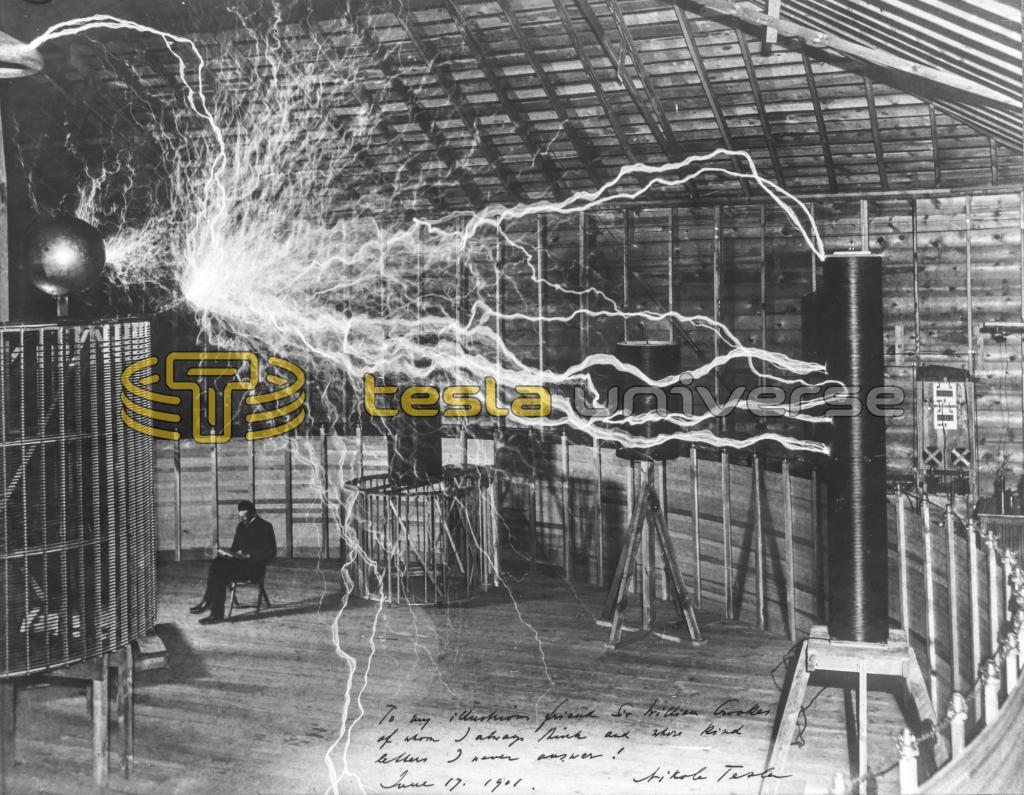
Following invitations from his patent attorney and the Colorado Springs Power Company, Tesla left for Colorado Springs to continue his experiments. There. he built a large wooden lab building and equipped it with a monstrous coil. In 1899 Tesla succeeded in verifying to his satisfaction that his system was feasible. It was also here that he became the first person to artificially produce ball lightning, and, finally, here that Tesla received what he believed were signals from another planet.
In one recent account of Tesla's life it was suggested that the announcement Tesla made of this discovery was the first sign of mental instability on his part, perhaps due to the death of his mother. While there is no doubt that Tesla was deeply affected by his mother's death, the announcement, which was printed in Collier's in 1901, is quite a document and reads very lucidly.
Tesla begins by speculating on the possibility of life on other planets and notes that it need not be organized along chemical processes familiar to us. He then describes the equipment he was using at the time he received the signals and says:
"One of the most interesting results, and one of great practical importance, was the development of certain contrivances for indicating at a distance of many hundred miles an approaching storm, its direction, speed and distance traveled. These appliances are likely to be valuable in future meteorological observations and surveying, and will lend themselves particularly to many naval uses."
This device sounds like a description of some sort of radar, but, typically, no written details of the device seem to exist. Descriptions like this one crop up all through the material on Tesla and can be pretty frustrating. Tesla then describes the moment of discovery:
"My first observations positively terrified me, as there was present in them something mysterious, not to say supernatural, and I was alone in my laboratory at night; but at that time the idea of these disturbances being intelligently controlled did not yet present itself to me. The changes I noted were taking place periodically, and with such a clear suggestion of number and order that they were not traceable to any cause then known to me. I was familiar, of course, with such electrical disturbances as are produced by the sun, Aurora Borealis and earth currents, and I was as sure as I could be of any fact that these variations were due to none of these . A purpose was behind these signals; and it was with this conviction that I announced to the Red Cross Society, when it asked me to indicate one of the great causes. ... possible achievements of the next hundred years, that it would probably be the confirmation and interpretation of this planetary challenge to us."
He then goes on to become the first person; to my knowledge, to propose that extraterrestrial communication be based upon mathematical principles, and says:
"Absolute certitude as to the receipt and interchange of messages would be reached as soon as we could respond with the number 'four,' say, in reply to the signal 'one, two, three.' ... the inhabitants of whatever planet had signalled to us would understand at once that we had caught their message across a gulf of space and had sent back a response."
Tesla never had the opportunity to repeat his experiment and to determine just where the signals were coming from. But even if we assume that the signals were terrestrial in origin, Tesla still displays an understanding of the possibilities of extraterrestrial communication and an insistence on scientific principles that would do credit to a modern day astronomer working on the same subject.
The strange signals were just one part of Tesla's work at Colorado Springs. The citizens of the town became reluctant observers of the huge bolts of man-made lightning and the loud thunderclaps that occurred while the coil was operating. During the experiments the surrounding atmosphere would become ionized to the extent that butterflies in the area flew around in confused circles, a blue glow covering their wings. To draw a glass of water in town meant getting a static shock from the faucet. In order to keep people away from his lab and possible harm, Tesla announced that he was working on a new weapon that could kill 300,000 people at one time. The ruse worked, but
it also started all manner of rumors about the "true" nature of Tesla's work while in Colorado Springs. Tesla conducted his most important experiments dressed in coat and tails as usual, with his height increased by three-inch rubber soles he had added to his shoes to prevent getting shocked.
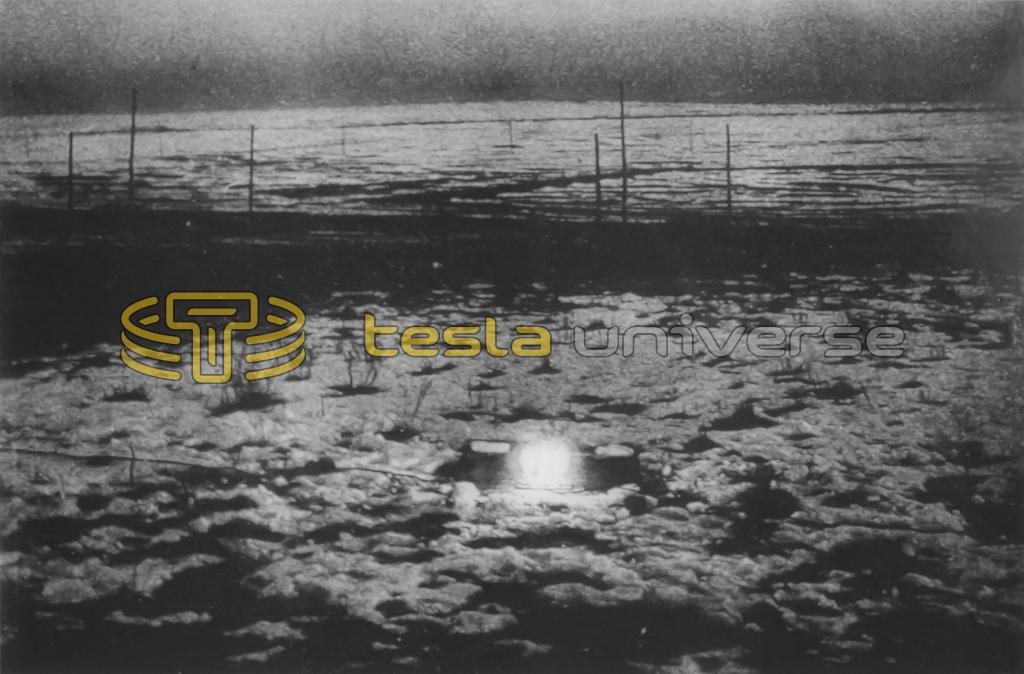
During his experiments, Tesla succeeded in lighting lamps at a distance of 26 miles from the main coil. He declared that his experiment was a success and that he had managed to build up the natural electrical oscillations of the earth into regular waves carrying large amounts of power. Now he proposed to build a suitably sized power station and give a practical demonstration of his world-wide system of broadcasting "power and intelligence" through the entire planet. The only problem was one Tesla had been fighting since 1895 and one he would suffer from the rest of his long life - he was broke again.
When Tesla returned to New York late in 1899, a close friend named Robert Underwood, one of the editors of Century magazine, invited him to submit an article about his latest work for inclusion in their special turn-of-the-century issue. "The Problem of Increasing Human Energy," subtitled "With Special Reference to Harnessing the Sun's Energy," reveals Tesla as a technological visionary of the first order.
He begins by postulating that the mass of humanity must respond to classical calculations of force and acceleration. The concept is totally mechanistic, and reveals the Newtonian thinking that was the basis for Tesla's ideas. The theories of Einstein and Heisenberg were still in the future and so Tesla proceeded from the best available understanding of the world at the time. Even though that understanding was composed of a clockwork concept of the universe, he still manages to reach some startling conclusions.
For one, he demonstrates in the article that burning fossil fuels to produce electricity is "barbarous" and thoroughly wrong. He then recommends that only water power be used for generating electricity and says:
"Evidently all electrical energy obtained from a waterfall, saving so much fuel, is a net gain to mankind, which is all the more effective as it is secured with little expenditure of human effort, and as the most perfect of all known methods of deriving energy from the sun contributes in many ways to the advancement of civilization."
He goes on to say that his broadcasting system began with the discovery that he could send power through the air and was complete when he realized that he could cause resonant oscillations to occur in the earth's electrical field. His plan, then, was for all of the power needed on the planet to be supplied by hydroelectric generators stationed next to rivers all around the world. By using his broadcast system everyone's needs would be supplied by a power system based renewable energy and, upon he declared, this was the best way of harnessing the sun's energy.
In another part of the article Tesla discusses forces which impede human progress, and concludes that the greatest of these is organized warfare. In what must be one of the earliest descriptions of an arms race Tesla says:
"It has been argued that the perfection of guns of great destructive power will stop warfare. So I myself thought for a long time, but now I believe this to be a profound mistake. Such developments will greatly modify, but not arrest it. On the contrary, I think that every new arm that is invented, every new departure that is made in this direction, merely invites new talent and skill, engages new effort, offers a new incentive, and so only gives a fresh impetus to further development. . . . Nor do I believe that warfare can ever be arrested by any scientific or ideal development, so long as similar conditions to those now prevailing exist, because war has itself become a science, and because war involves some of the most sacred sentiments of which man is capable. In fact, it is doubtful whether men who would not be ready to fight for a high principle would be good for anything at all. It is not the mind which makes man, nor is it the body. Our virtues and our failings are inseparable, like force and matter. When they separate, man is no more."
He recommends mutual arms reductions as "...the first rational step to take toward diminishing [this] force retarding human movement," and he predicts that his Teleautomata would finally evolve into war machines which would fight against other war machines and render war bloodless. In an age when "smart" bombs have been used against civilians, we all know better - but it was a nice thought.
The upshot of the article is that Tesla, once having realized that the energy for our society must come from renewable resources, set out over eighty years ago to perfect a system capable of realizing that goal. His work on the broadcasting system was entirely motivated by this desire to build an electrical energy system based on renewable resources. He was working on this years before anyone realized that a society could even require such large amounts of electrical power. Electricity at that time was used only for very limited lighting systems. The idea that society could become dependent upon this power had occurred to no one but Tesla.
The article attracted a great deal of attention. One of those interested was the millionaire J. P. Morgan, who invited Tesla to his home to explain his system in detail. Morgan agreed to underwrite part of the first phase of Tesla's project, a gigantic radio broadcasting system on Long Island. The money Morgan advanced was not nearly enough to complete a project of the size that Tesla envisioned, but it was a start. Tesla planned to locate a huge tower in Suffolk County on Long Island under an agreement with a local developer, who in turn hoped to sell houses to the thousands of people who would eventually work at the project. The development was to be called Wardenclyffe.
It is hard to convey the scope of the project Tesla had in mind. To the man who thought he could vibrate the entire planet at will, nothing less than a worldwide broadcasting system would do. He planned to establish a monopoly on all forms of broadcasting and a list of the services he intended to provide was printed in a brochure he published at the outset of work on Long Island. [See box.]
This was 1901, in an era of feeble spark-gap radios, and years before anyone else had even thought of a radio broadcasting system.
The Wardenclyffe Vision
The first World System' power plant can be put into operation in nine months. With this power plant it will be practical to attain electrical activities up to ten million horsepower and it is designed to serve for as many technical achievements as are possible without undue expense. Among these may be mentioned:
1. Interconnection of the existing telegraph exchanges of offices all over the world;
2. Establishment of a secret and non-interferable government telegraph service;
3. Interconnection of all the present telephone exchanges or offices all over the Globe;
4. Universal distribution of general news, by telegraph or telephone, in connection with the Press;
5. Establishment of a World System of intelligence transmission for exclusive private use;
6. Interconnection and operation of all stock tickers of the world;
7. Establishment of a world system of musical distribution, etc;
8. Universal registration of time by cheap clocks indicating the time with astronomical precision and requiring no attention whatever;
9. Facsimile transmission of typed or handwritten characters, letters, checks, etc.;
10. Establishment of a universal marine service enabling navigation of all ships to steer perfectly without compass, to determine the exact location, hour and speed, to prevent collisions and disasters, etc.;
11. Inauguration of a system of world printing on land and sea;
12. Reproduction anywhere in the world of photographic pictures and all kinds of drawings or records.
The first description of the concept of a radio broadcasting system is usually dated from 1916 when David Sarnoff wrote his "Music Box Memo", detailing an idea of having radios broadcasting music to homes in the United States. This was considered a breathtaking idea, but contrast the simple concept of a "music box" with the enormous system Tesla had planned to implement sixteen years before.
The actual operation of his radio system was a science known only to Tesla. He had planned also to build a similar system which would broadcast pure electrical power from Niagara Falls, but this never got off the ground. The Wardenclyffe project went as far as the construction of the power building and a dome-topped wooden tower about 150 feet high. At this point Morgan apparently lost interest and refused to advance the money needed to complete the project, despite Tesla's pleadings. Once it was known that J. P. Morgan had pulled out of the project, no one else would advance money, and Tesla's World System collapsed. With just a few more months and more money the prototype might have been completed, but it was not to be. The equipment of the partially finished station was repossessed, spelling an end to Tesla's attempt at worldwide broadcasting.
Would the system have worked? Did Tesla seriously intend to deliver all of the services he listed? Could he have done it? The answer to all of these questions is, no one knows. It is generally considered impossible to transmit power by the method Tesla outlined, due to the resistance of the Earth's crust. The power should be converted into heat by the resistance of non-conducting rock. Tesla must have known this. Did he have a method which would get around this problem? Our knowledge of electricity would seem to indicate that his system was impossible, and further, he never practically demonstrated his idea. We have only his word and some very sketchy notebooks to say that he was capable of accomplishing this feat. And there the matter stands.
But not quite...
It should be noted that electricity is still a theory. The electric force which has become so commonplace today is still a mysterious force. No one I have questioned who is familiar with the science is willing to totally condemn Tesla's idea, simply because our understanding of both Tesla's idea and electricity is not total.
Interestingly enough, while researching this article, I discovered that Tesla believed he was manipulating electricity in a manner fundamentally different from all other experimenters. All of the articles and books I have read either assume that Tesla was using electricity in the usual way or gloss over the difference by maintaining that he was just using different language to describe standard effects in his work. Yet Tesla says that he was not using electricity in the standard way. The distinction he makes is a subtle one, but he insists that it was central to his work. The full story has yet to be told. Tesla's "madman" status in the history of electricity has so far kept many from taking his ideas seriously. Tesla has even been the subject of books claiming that he was from Venus and that he landed here in a flying saucer.
The man deserves better than this. Tesla spent his life working in the physical sciences and he demanded proofs of his experiments as rigorously as any other scientist. His lectures show that he was well aware of other experimenters' work at the time and that he felt he knew exactly what he was up to. The problem hinges on the lack of records detailing his experiments and their results. A close reading of his published lectures of 1891, '92 and '93 reveals that he was adamant about the fundamental difference between the effects he observed and those observed by others. Those who ignore these protests do him a disservice and, quite possibly, may have missed the entire point of his later work.
The collapse of the Wardenclyffe project spelled the end to Tesla's major electrical investigations. He would never again have enough money to start a lab, and due to his refusal to develop other patents of his into money making projects, he had no significant income. He had gambled all or nothing, and lost.
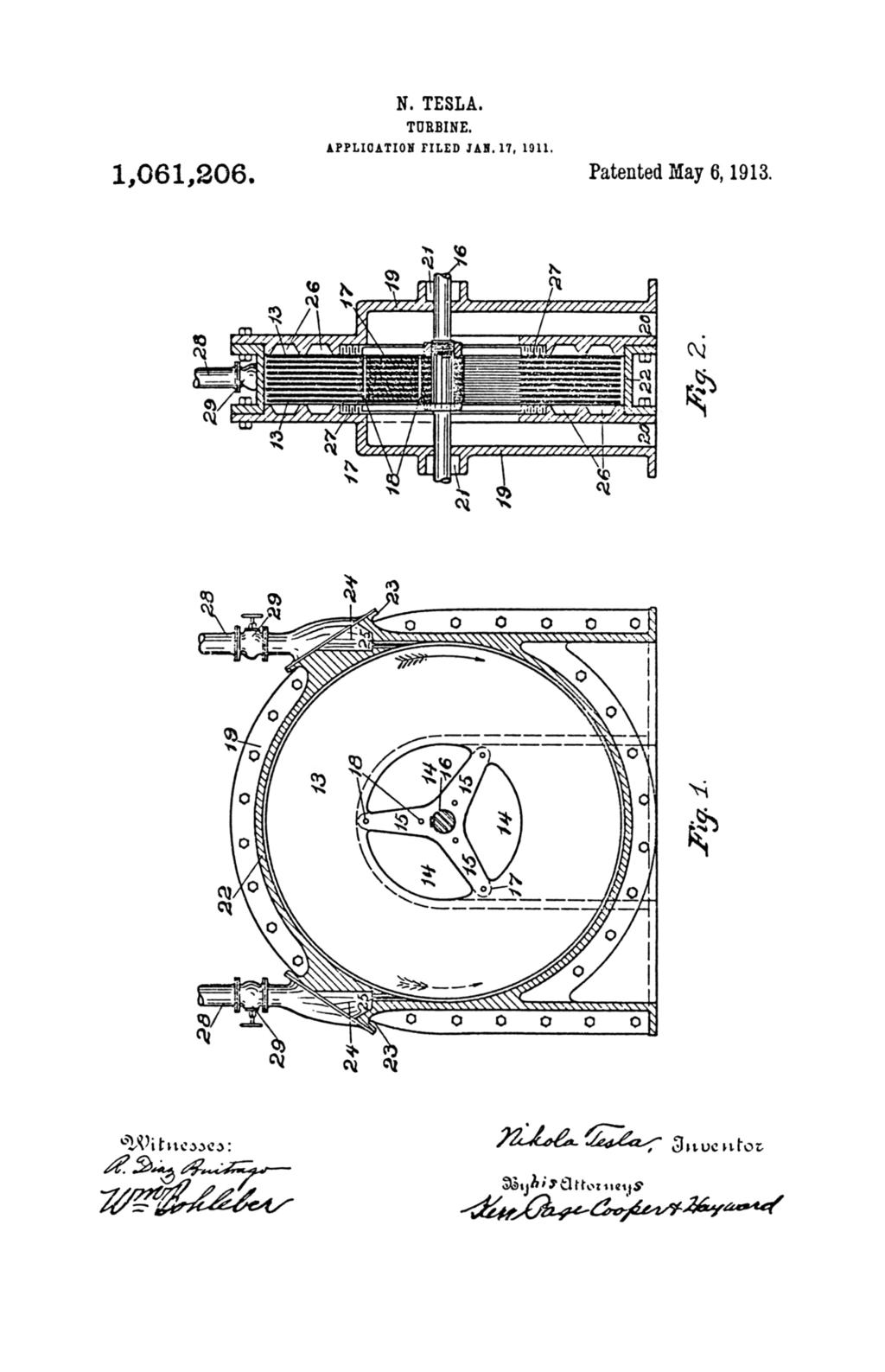
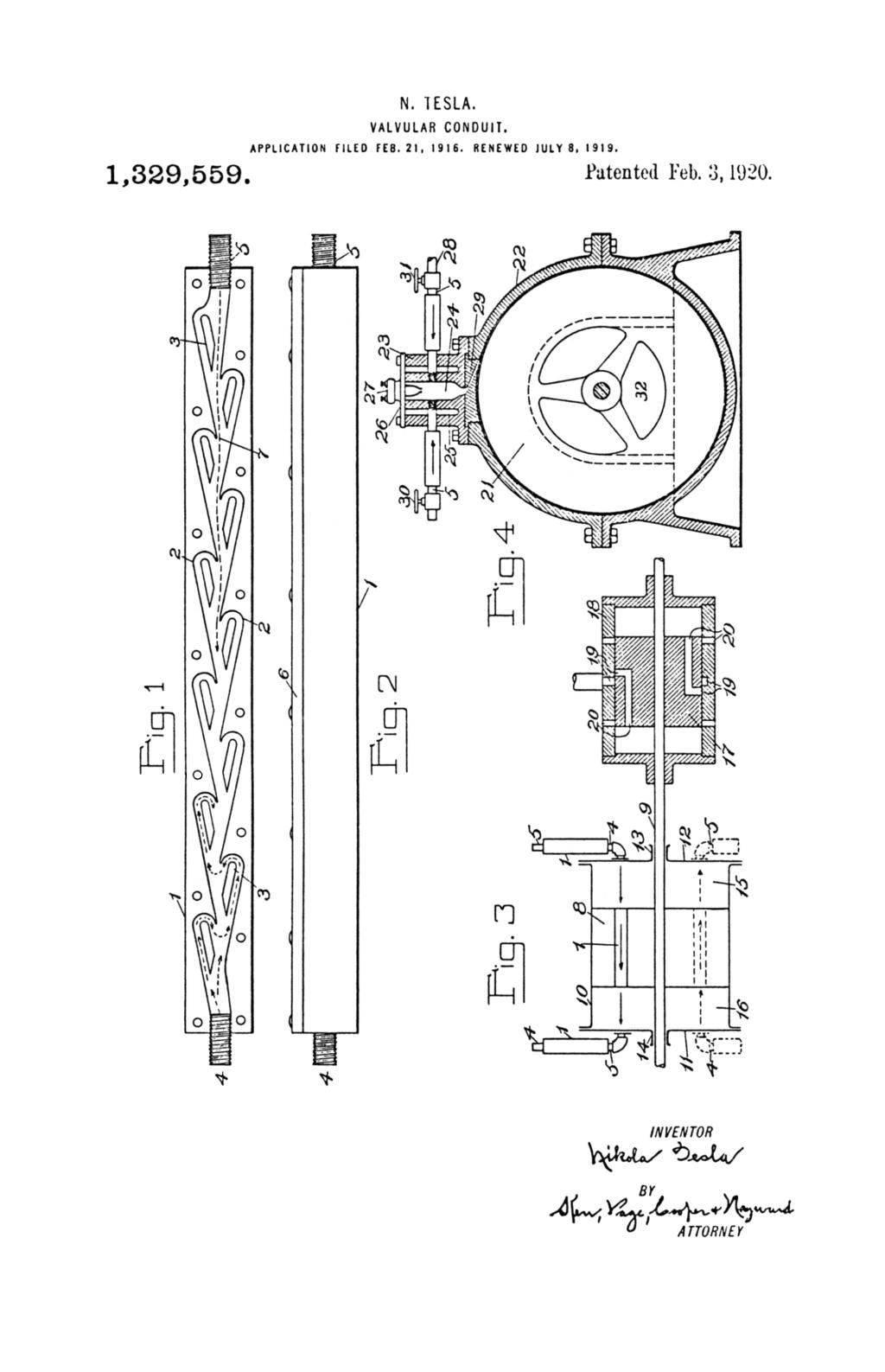
The last major project Tesla worked on was an idea for a new kind of turbine engine. He had developed an elegant device consisting of several discs spaced apart from one another along a common shaft. Holes were drilled into the discs near the point where the shaft went through them. Discs and shaft were encased in a chamber and steam, compressed air, or an exploded air/fuel mixture was directed against the edges of the discs, and would then travel between them to the center and exhaust out the holes drilled there. In this way the steam, or whatever, would spiral down from the edge to the center of each disc, turning them all with terrific force despite the fact that they carried no "buckets" or other protrusions. The first model, built in 1906, was six inches in its largest dimension, and reportedly developed thirty horsepower. Tesla hoped to develop his disc turbine into a money-making proposition, but for once he was too late. Turbine engines had been in development for years, and most of the problems with standard cup-and-vane turbines were either solved or on their way to solution. Tesla's turbine had no such history, and no one was interested in putting up with his authoritarian personality long enough to work out the problems. The main hurdle was that his turbine would spin so fast that the discs were damaged by the stresses at such speeds. Metallurgy has advanced in leaps and bounds since those days, but the incentive for an entirely new turbine still does not seem to exist.
Tesla also had invented a "valvular conduit" to feed air/fuel mixtures into his machines at the high speeds required for their operation. As a matter of fact, the faster the explosions of the air/fuel mixture occurred, the better his "valvular conduit", which had no moving parts, would work. Tesla took out patents on the turbine and conduit and he also took out patents for pumps and speedometers based on this principle.
"Tesla has even been the subject of books claiming that he was from Venus and that he landed here in a flying saucer."
Here the record of Tesla's work ends. His work on the turbine was an on-again, off-again affair until about 1912 when he walked out of the Allis Chalmers Company labs because "They would not build the turbines as I wished." Incredibly, for the next thirty years Tesla would continue his mental experiments but would never have enough money to build models of his ideas. Without the models he could not patent the devices, and without patent protection he refused to disclose details of his ideas to anyone. Nor does any written record seem to remain to reveal what he was working on. All we have are sensational newspaper reports based on Tesla's periodic announcements to the press about some new generator or method of power distribution. Tesla never revealed any details to the press, either, and while reporters loved the copy his "wild" ideas provided, no one could be certain that anything he announced was even possible. This is still true today.
During this long time Tesla drifted from hotel to hotel as past bills accumulated. Whenever he was given any money, he would use it to pay off back debts from the Wardenclyffe project, or back wages to old laboratory assistants. The famous electrical engineer B.A. Behrend was a close friend of Tesla's and Behrend settled Tesla's back hotel bills several times while Tesla drifted from place to place, finally ending up at the Hotel New Yorker. Tesla never admitted any disappointment with his life, always hoping that someday he would have enough money to begin work again. Until that time came, he would patiently wait and continue his routine of taking long walks in the city and feeding huge flocks of pigeons in nearby parks. When he was seventy-five a special birthday celebration was given, at which he was presented with a book of letters. from scientists and engineers all over the world, praising his work. A fund was started in Yugoslavia which provided a stipend of $7,200 per year for the rest of Tesla's life. A museum and institute were established in Belgrade, in which the notebooks and some of the equipment Tesla used are housed. In 1937, while out walking, Tesla was struck by a cab, but he refused to get treatment for his injury. He lay in his room for several months recuperating and when he finally recovered he resumed his walks, though less frequently. On January 8, 1943, a chambermaid found him dead in his room. Tesla had died alone at 85, virtually unknown, surrounded by a city whose life-blood of electricity flowed through the system he had created.
Tesla left no one to carry on his work. He had planned to write a definitive autobiography which was to give the full story of his work, but there is no indication that he ever began it. After his death his letters and papers were seized by the Custodian of Alien Property. The government in this case was probably looking for details of a "death ray" device - an idea for beamed which Tesla had announced to the press DC power - a few years previously. His personal papers were turned over to his nephew in Yugoslavia. The disposition of his other papers is not clear, although his Colorado Springs notebooks seem to have ended up in Belgrade also. There was a war on, and a very busy country soon forgot this lonely old man. As a result, one of America's greatest, and strangest, scientists became an obscure figure about whom odd tales are told.
Before he died, Tesla admitted that he may have been trying to act too soon in his attempts to establish his worldwide system of broadcasting "information and power". But, he noted, "Just as soon as the need arises. . . I have the system ready to be used with complete success.' "We need it now. If we can rediscover the methods Tesla employed, and if those methods prove useful, it just might happen.
Bibliography and Access
1. There are two major biographies about Tesla. The most accessible is:
John J. O'Neill, Prodigal Genius, 1944, David McKay Co., New York, N. Y., $3.45.
O'Neill was the Pulitzer Prize winning Science Editor of the Herald Tribune and he knew Tesla personally. This article is based upon his book, which I have found to be generally accurate, with a few exceptions. This is the best general biography including much material on Tesla's personal life and also on his inventions, but there is no bibliography or footnote material.
2. The most recent biography, but now out of print is: Inez Hunt and Wanetta W. Draper, Lightning in His Hand: The Life Story of Nikola Tesla, 1964, Sage Books, Denver, Colorado.
Hunt and Draper have written several books about the West and this book is a major change for them. They have produced a good general popularization about Tesla. The book clarifies some points made by O'Neill and disputes others. It is well researched with a very good bibliography and should be read to round out the subject.
3. Thomas Cummerford Martin, The Inventions, Researches, and Writings of Nikola Tesla, 1894, The Electrical Engineer, a journal Martin edited. Out of print. Republished once in 1952 by the Lee Engineering Co., Milwaukee, Wisconsin, so that there should be copies in electrical engineering libraries. Includes Tesla's major lectures and many technical descriptions of Tesla's AC devices.
4. Tesla's lectures may also be found in: Nikola Tesla - Lectures, Patents, Articles, the Nikola Tesla Museum, Belgrade, Yugoslavia, 1956. The only source for this which I have found is Health Research, an outfit which reprints hundreds of books and articles on the subjects of the occult, astrology, flying saucers, etc. They reprint by offset on cheap paper and the photos are ruined. Also many of the line drawings are hard to decipher, but the words are all there. About 1,065 pages. Includes all of Tesla's major patents and many articles, including, "The Problem of Increasing Human Energy." $30.00. Health Research also lists the Martin book for $10.00. Write to: Health Research, P.O. Box 70, Mokelumne Hill, California, 95245, for a price list and ordering in formation.
