Nikola Tesla Articles
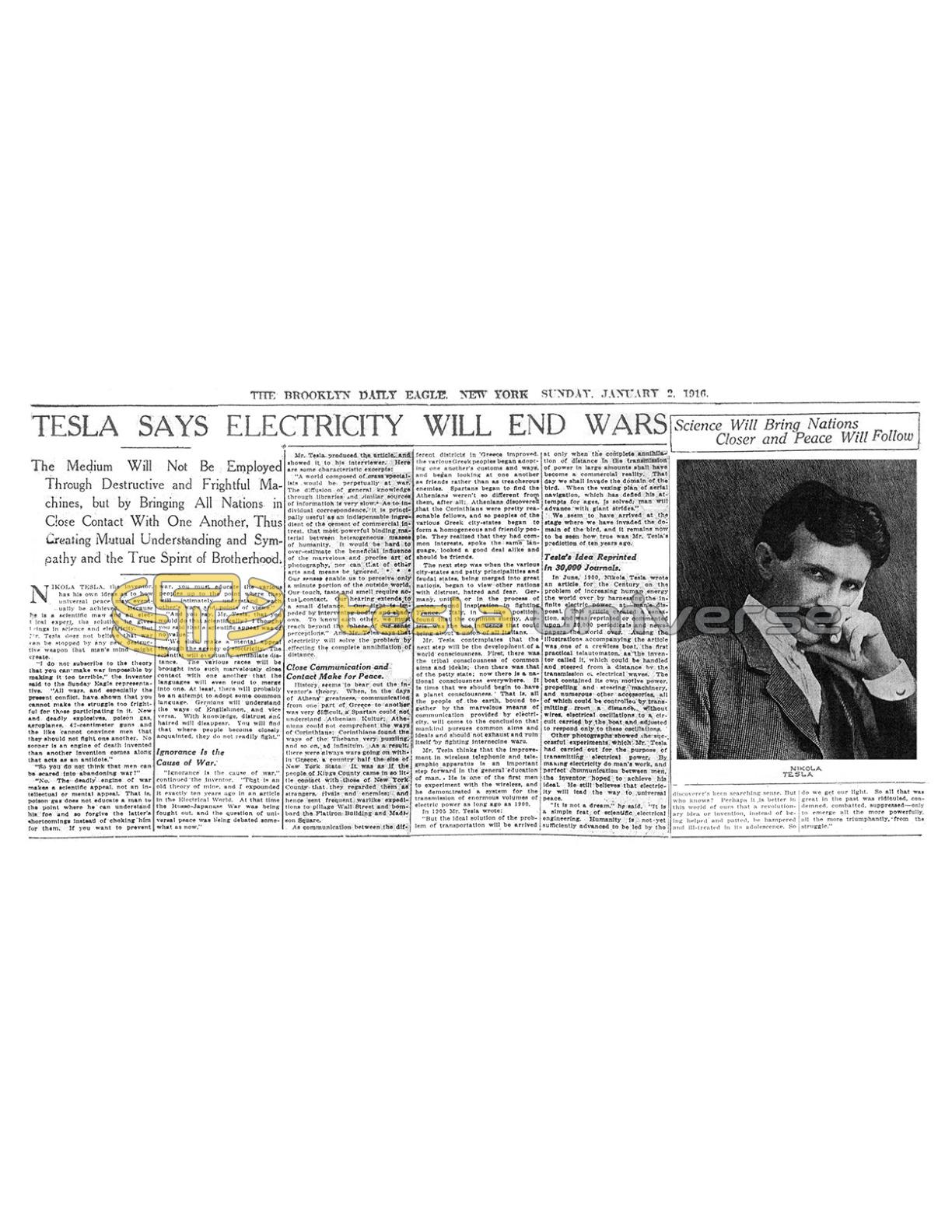
Tesla Says Electricity Will End Wars
Science Will Bring Nations Closer and Peace Will Follow
The Medium Will Not Be Employed Through Destructive and Frightful Machines, but by Bringing All Nations in Close Contact With One Another, Thus Creating Mutual Understanding and Sympathy and the True Spirit of Brotherhood.
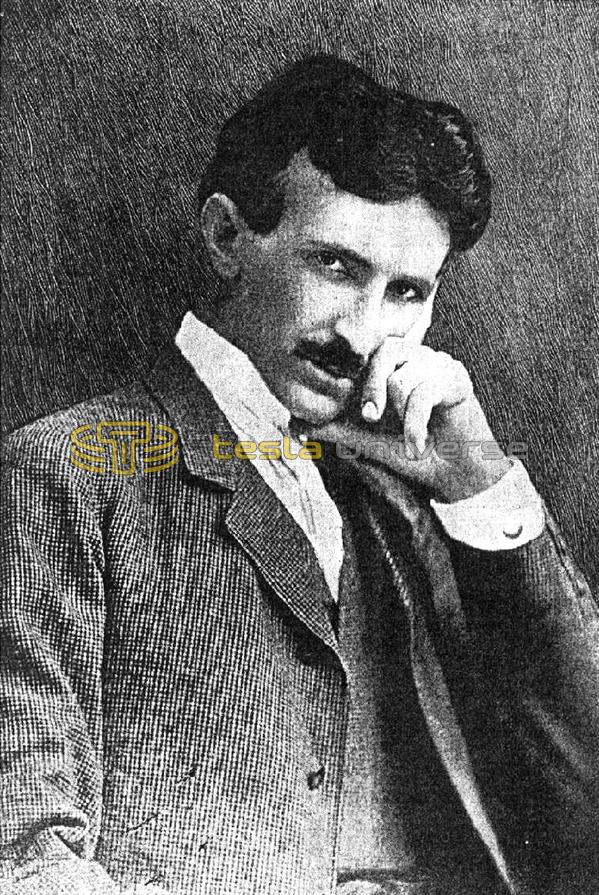
Nikola Tesla, the inventor, has his own ideas as to how universal peace may eventually be achieved. Because he is a scientific man and an electrical expert, the solution he gives brings in science and electricity. But Dr. Tesla does not believe that war can be stopped by any new destructive weapon that man's mind might create.
"I do not subscribe to the theory that you can make war impossible by making it too terrible," the inventor said to the Sunday Eagle representative. "All wars, and especially the present conflict, have shown that you cannot make the struggle too frightful for those participating in it. New and deadly explosives, poison gas, aeroplanes, 42-centimeter guns and the like cannot convince men that they should not fight one another. No sooner is an engine of death invented than another invention comes along that acts as an antidote."
"So you do not think that men can be scared into abandoning war?"
"No. The deadly engine of war makes a scientific appeal, not an intellectual or mental appeal. That is, poison gas does not educate a man to the point where he can understand his foe and so forgive the latter's shortcomings instead of choking him for them. If you want to prevent war, you must educate the various peoples up to the point where they will intimately understand each other's ways and points of views."
"And you say, Mr. Tesla, that you would do that scientifically? I thought you said that a scientific appeal was of no value."
"We shall make a mental appeal through the agency of electricity. The scientist will eventually annihilate distance. The various races will be brought into such marvelously close contact with one another that the languages will even tend to merge into one. At least, there will probably be an attempt to adopt some common language. Germans will understand the ways of Englishmen, and vice versa. With knowledge, distrust and hatred will disappear. You will find that where people become closely acquainted, they do not readily fight."
Ignorance Is the Cause of War.
"Ignorance is the cause of war," continued the inventor. "That is an old theory of mine, and I expounded it exactly ten years ago in an article in the Electrical World. At that time the Russo-Japanase War was being fought out, and the question of universal peace was being debated somewhat as now."
Mr. Tesla produced the article, and showed it to his interviewer. Here are some characteristic excerpts:
"A world composed of crass specialists would be perpetually at war. The diffusion of general knowledge through libraries and similar sources, of information is very slow. As to individual correspondence, it is principally useful as an indispensable ingredient of the cement of commercial interest, that most powerful binding material between heterogeneous masses of humanity. It would be hard to over-estimate the beneficial Influence of the marvelous and precise art of photography, nor can that of other arts and means be ignored.
Our senses enable us to perceive only a minute portion of the outside world, Our touch, taste and smell require actual contact. Our hearing extends to a small distance. Our sight is impeded by Intervening bodies and shadows. To know each other, we must reach beyond the sphere of our sense perceptions." And Mr. Tesla says that electricity will solve the problem by effecting the complete annihilation of distance.
Close Communication and Contact Make for Peace.
History, seems to bear out the inventor's theory. When, in the days, of Athens greatness, communication from one part of Greece to another was very difficult, a Spartan could not understand Athenian culture; Atheniens could not comprehend the ways of Corinthians: Corinthians found the ways of the Thebans very puzzling, and so on, ad infinitum. As a result, there were always wars going on within Greece, a country half the size of New York State. It was as if the people of Kings County came in so little contact with those of New York County that they regarded them as strangers, rivals and enemies; and hence sent frequent warlike expeditions to pillage Wall Street and bombard the Flatiron Building and Madison Square.
As communication between the different districts in Greece improved. the various Greek peoples began adopting one another's customs and ways, and began looking at one another as friends rather than as treacherous enemies. Spartans began to find the Athenians weren't so different from them, after all: Athenians discovered that the Corinthians were pretty reasonable fellows, and so peoples of the various Greek city-states began to form a homogeneous and friendly people. They realized that they had common interests, spoke the same language, looked a good deal alike and should be friends.
The next step was when the various city-states and petty principalities and feudal states, being merged into great nations, began to view other nations with distrust, hatred and fear. Germany, united or in the process of union, found inspiration in fighting France. Italy, in a like position, found that the common enemy, Austria, was the one influence that could bring about a union of all Italians.
Mr. Tesla contemplates that the next step will be the development of a world consciousness. First, there was the tribal consciousness of common aims and ideals; then there was that of the petty state; now there is a national consciousness everywhere. It is time that we should begin to have a planet consciousness. That is, all the people of the earth, bound together by the marvelous means of communication provided by electricity, will come to the conclusion that mankind pursues common aims and ideals and should not exhaust and ruin Itself by fighting internecine wars.
Mr. Tesla thinks that the improvement in wireless telephonic and telegraphic apparatus is an important step forward in the general education of man.. He is one of the first men to experiment with the wireless, and he demonstrated a system for the transmission of enormous volumes of electric power as long ago as 1900.
In 1905 Mr. Tesla wrote:
"But the ideal solution of the problem of transportation will be arrived at only when the complete annihilation of distance in the transmission of power in large amounts shall have become a commercial reality. That day we shall invade the domain of the bird. When the vexing plan of aerial navigation, which has defied his attempts for ages, is solved; man will advance with giant strides."
We seem to have arrived at the stage where we have invaded the domain of the bird, and it remains now to be seen how true was Mr. Tesla's prediction of ten years ago.
Tesla's Idea In 30,000 Journals.
Reprinted In June, 1900, Nikola Tesla wrote an article for the Century on the problem of increasing human energy the world over by harnessing the infinite electric power at man's disposal. This article created a sensation, and was reprinted or commented upon in 30,000 periodicals and newspapers the world over. Among the illustrations accompanying the article was one of a crewless boat, the first practical telautomaton, as the inventor called it, which could be handled and steered from a distance by the transmission of electrical waves. The boat contained its own motive power, propelling and steering machinery, and numerous other accessories, all of which could be controlled by transmitting from a distance, without wires, electrical oscillations to a circuit carried by the boat and adjusted to respond only to these oscillations.
Other photographs showed the successful experiments, which Mr. Tesla had carried out for the purpose of transmitting electrical power. By making electricity do man's work, and perfect communication between men, the inventor hoped to achieve his ideal. He still believes that electricity will lead the way to universal peace.
"It is not a dream," he said. "It is a simple feat of scientific electrical engineering. Humanity is not-yet sufficiently advanced to be led by the discoverer's keen searching sense. But who knows? Perhaps it is better in this world of ours that a revolutionary idea or invention, instead of being helped and patted, be hampered and ill-treated in its adolescence. So do we get our light. So all that was great in the past was ridiculed, condemned, combatted, suppressed — only to emerge all the more powerfully, all the more triumphantly, from the struggle."