Nikola Tesla Articles
Tesla's High-potential Work
Professor A. Slaby recently delivered a lecture on "The Latest Progress in Spark Telegraphy" before the general meeting of the Verein Deutscher Ingenieure at Kiel, Germany. He spoke of the latest systems of wireless-telegraph apparatus made by the Allegemeine Elektricitäts Gesellschaft and of the possibilities to be expected from space telegraphy in a practical way. At the conclusion of his lecture Professor Slaby showed that the future of spark telegraphy rests essentially in the possibility of producing high electrical pressures.
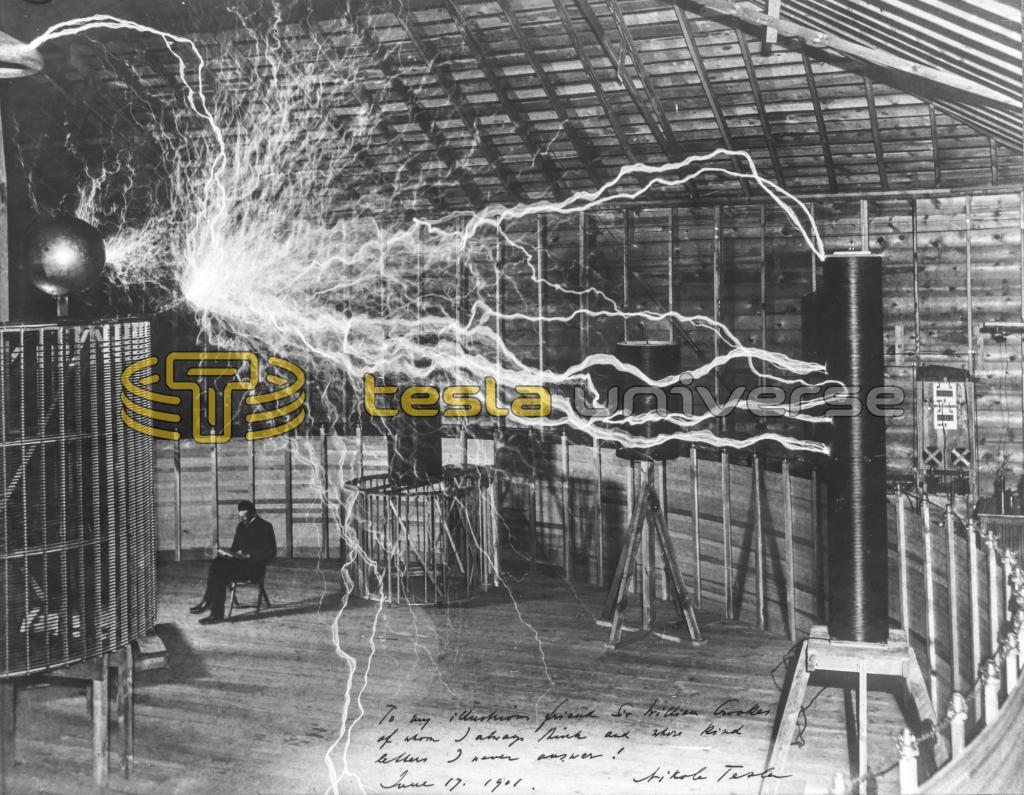
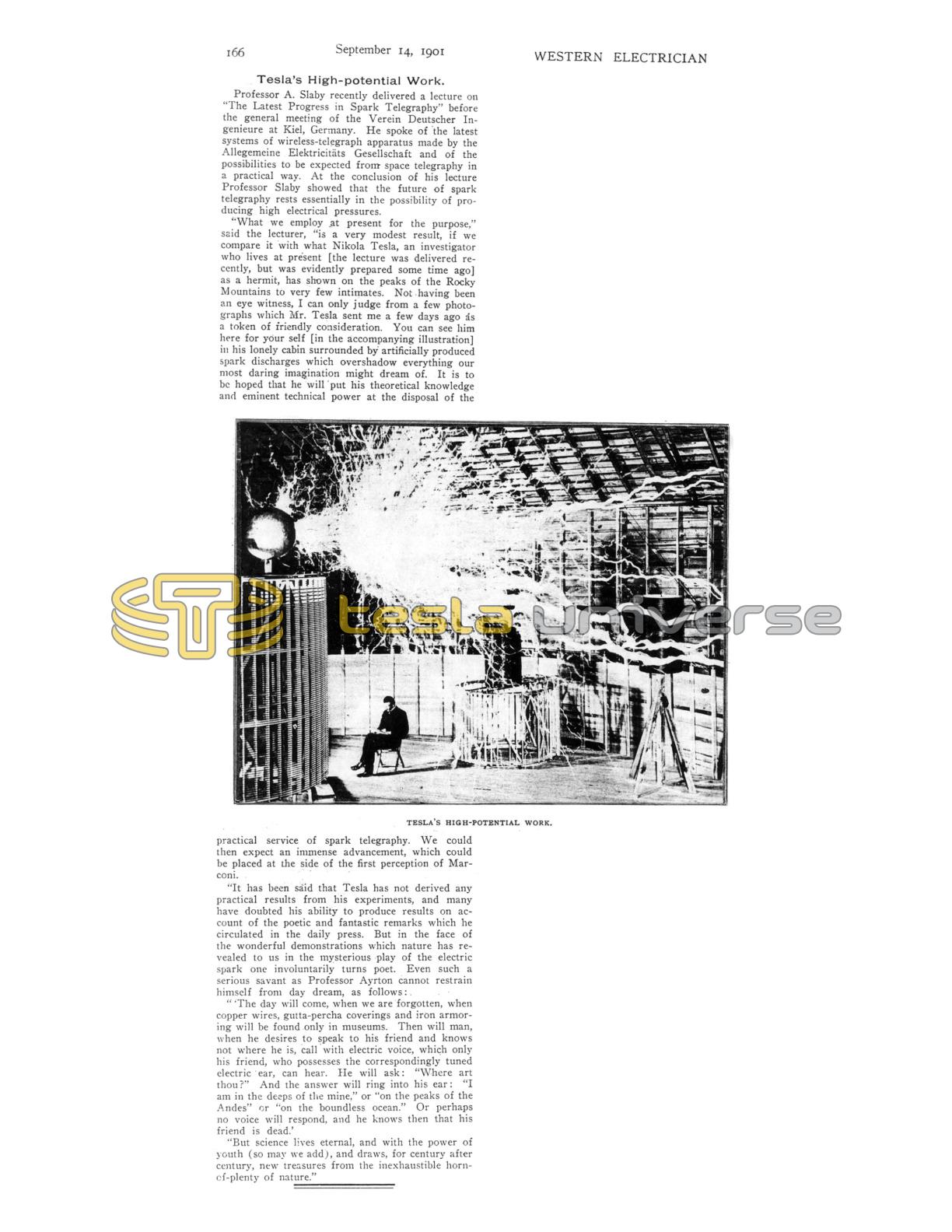
"What we employ at present for the purpose," said the lecturer, "is a very modest result, if we compare it with what Nikola Tesla, an investigator who lives at present [the lecture was delivered recently, but was evidently prepared some time ago] as a hermit, has shown on the peaks of the Rocky Mountains to very few intimates. Not having been an eye witness, I can only judge from a few photographs which Mr. Tesla sent me a few days ago as a token of friendly consideration. You can see him here for your self [in the accompanying illustration] in his lonely cabin surrounded by artificially produced spark discharges which overshadow everything our most daring imagination might dream of. It is to be hoped that he will put his theoretical knowledge and eminent technical power at the disposal of the practical service of spark telegraphy. We could then expect an immense advancement, which could be placed at the side of the first perception of Marconi.
"It has been said that Tesla has not derived any practical results from his experiments, and many have doubted his ability to produce results on account of the poetic and fantastic remarks which he circulated in the daily press. But in the face of the wonderful demonstrations which nature has revealed to us in the mysterious play of the electric spark one involuntarily turns poet. Even such a serious savant as Professor Ayrton cannot restrain himself from day dream, as follows:
"'The day will come, when we are forgotten, when copper wires, gutta-percha coverings and iron armoring will be found only in museums. Then will man, when he desires to speak to his friend and knows not where he is, call with electric voice, which only his friend, who possesses the correspondingly tuned electric ear, can hear. He will ask: "Where art thou?" And the answer will ring into his ear: "I am in the deeps of the mine," or "on the peaks of the Andes" or "on the boundless ocean." Or perhaps no voice will respond, and he knows then that his friend is dead.'
"But science lives eternal, and with the power of youth (so may we add), and draws, for century after century, new treasures from the inexhaustible horn-of-plenty of nature."