Nikola Tesla Articles
The Use of Tesla Coils for X-ray Work
TO THE EDITOR OF The Model Engineer.
DEAR SIR, — Mr. Howgrave-Graham's criticism of my article of November 17th loses much of its point by reason of the fact that he omitted to first read up my previous article of May 28th, 1903. Indeed, I, or anyone fully acquainted with the facts of the case, might be excused if on reading in "X-rays Simply Explained" a reference to the article just referred to, I came to the conclusion that even then Mr. Graham had not read it, and consequently had not seen the photographic illustration which accompanied it. The criticism thus becomes purely academic. I quite agree with Mr. Howgrave Graham on one point — viz., that an iron core would be worse than useless in such a coil. Mr. Graham refers to the matter in one of his articles dated June 4th, 1903, Model Engineer, page 533, and for my part I should find it difficult to say who first suggested the use of an iron core for high frequency transformer or self-induction coils. Certainly, unless I am greatly mistaken, Tesla makes no reference to it in his article of April, 1892, Journal of the Institute of Electrical Engineers.
Early in the history of Röntgen ray work a more or less simple form of Tesla coil was introduced for the purpose of supplementing or augmenting the power of existing induction coils in the production of the X-rays. More than one list of "X-ray apparatus and accessories" contains estimate for this; £6 IOS. appears to have been the usual figure, and, presumably, making every and liberal allowance for profits, there was a nicely made and more or less efficient piece of apparatus for the money. The only objection raised to the method was, so far as my memory serves, that the life of the tube was considerably shortened from the fact probably that the apparatus and tube were used frequently without sufficient discrimination,
That a simple form of Tesla (and I refer to apparatus on a small scale) was used, and found efficient, is indisputable. Personally, I never purchased such a coil, but simple forms were described from time to time in Electricity and, I believe, the English Mechanic. My first was made several years ago, and was used by me mainly for demonstration purposes, as I found that for a long continued run, or when it was desired to show the X-rays through a cryptoscope, there was much less risk of damage to one's coil (less current being required), while the deterioration of the tube was thought to be somewhat exaggerated. At all events, I was more disposed to risk a focus-tube than my coil!
Theoretically, I suppose, the Tesla discharges being oscillatory, by this arrangement X-ray should not be so completely harnessed for purposes of visual examination by means of a screen, as they undoubtedly are. Photographically, also, starting from similar premises, the absence of absolute sharpness — and this might be disputed — over a wider area is balanced by their greater power of penetration, and the consequent increase in the number of subjects available for purposes of delineation.
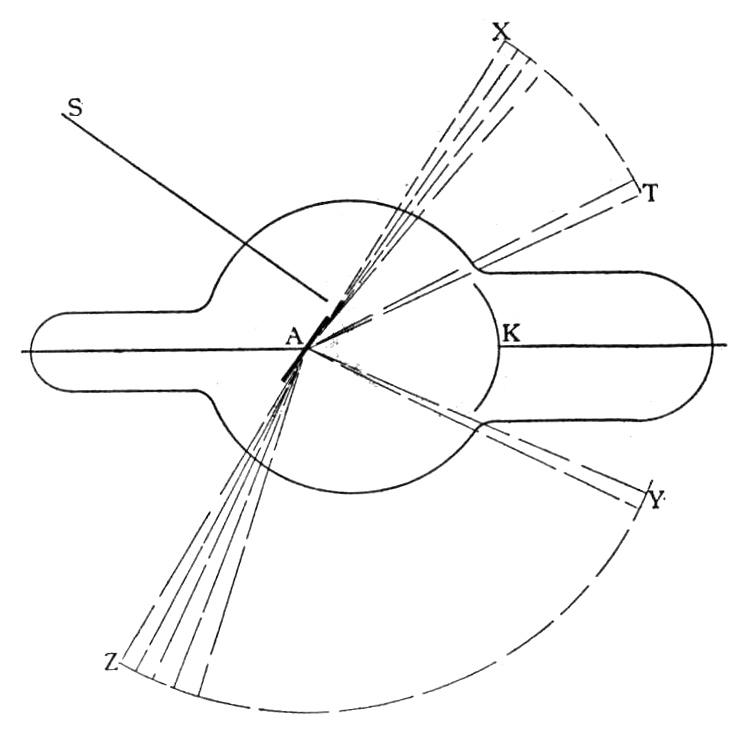
An inspection of the tube while working shows that (referring to Fig. 1) there is the usual line of demarcation from Z to X, not perhaps so strongly marked as when using induction coil only, but still perfectly definite; between S and X there is also fluorescence, and in greater volume than between X and T. Examining the tube also per cryptoscope, slowly revolving same, faint glimmers of rays are visible here and there, but nothing in comparison with the volume of X-rays which illumine the screen from Z to Y; and the conclusion arrived at must be that although A and K are constantly alternating, it is always to the advantage of the illuminated space between Y and Z. It would appear that every other half-wave or reversal does not decrease the efficiency of working, but results photographically, in not a loss of definition exactly, but rather a diffusion of focus, which is not unpleasing.
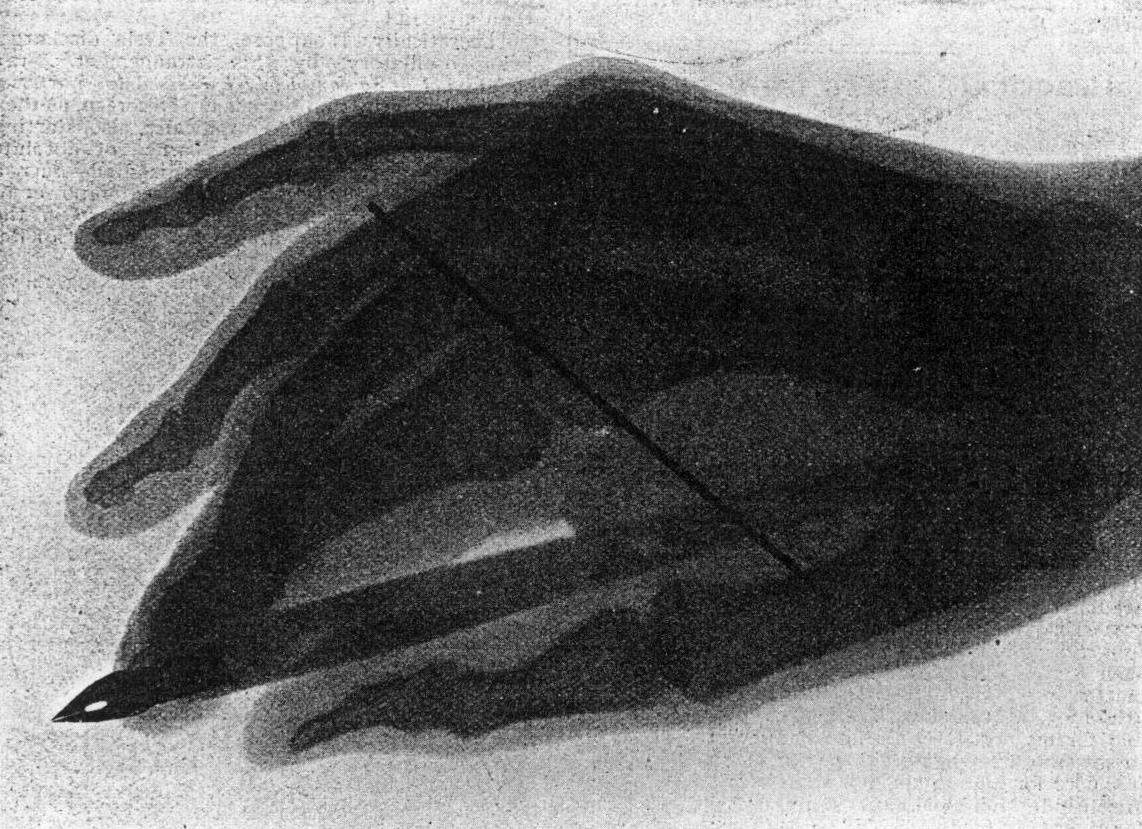
The accompanying radiograph, which was taken for the purpose of this letter, is one more proof of the efficiency of the apparatus. Here the hand is arched, the apex of the figure being 3 ins. above. the base — a distinct handicap from the photographic point of view, as, for uniform sharpness in the usual way, the bones should be co-planar. The radiograph may, I think, be left to tell its own tale,
— Yours truly,
J. PIKE.
Nottingham.