
Nikola Tesla Articles
Vilhelm Bjerknes on the Dissipation of Electrical Energy in the Hertz Resonator
In introducing conducting wires on different metals into his resonator Hertz asserted that neither the resistance nor the magnetic properties of the metal involved a sensible change in the length of the secondary spark.† We should, therefore, be tempted to conclude that the oscillations are completely independent of the nature of the metal. This independence is, however, only apparent. In my researches I employed a circular resonator having a diameter of 0.40 m., and a complete period (double) of 14 × 10⁻⁸ second. The poles took the shape of vertical parallel discs 0.008 m. apart, and 0.03 m. in diameter. In the field constituted by the gap between these discs a piece of aluminium foil, forming an angle of 45 deg. with the azimuth of the discs, was suspended by a quartz thread as an electrometer needle. Instead of the secondary spark the deflection of this needle was observed.
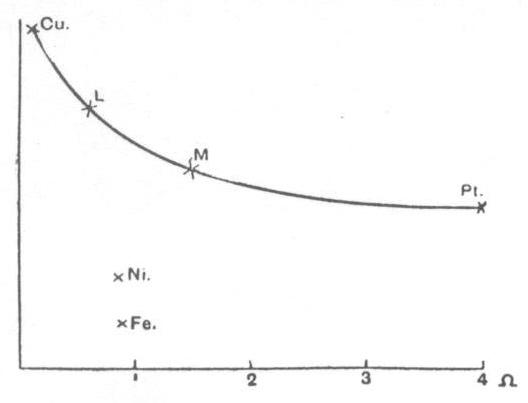
In this resonator I employed in succession geometrically identical conducting wires of different metals, and I obtained very different deflections. In the annexed diagram I give the results obtained with six wires, all of 0·5 mm. diameter, but made of copper (Cu), brass (L), nickel (Ni), iron (Fe), German silver (M), and platinum (Pt) respectively. The resistances of the wires are marked as abscissæ, and the ordinates show the deflections of the electrometer needle.
The results given in this figure appear at first glance singularly opposed to those obtained by Hertz. I think, however, that this divergence is only due to the difference of the methods. The oscillations of the resonator commence at zero and rapidly tend to a maximum, and gradually decrease afterwards. By the spark we evidently measure the height of this maximum; by the electrometer we measure the sum of all the oscillations. Owing to damping, this sum may have very different values without materially altering the height of the maximum. Consequently, the observations of Hertz show that the resonator always receives the same amount of electrical energy; the electro-magnetic measurements show that this energy is dissipated more or less quickly, according to the nature of the metal.
The capital point is thus the dissipation. The laws which govern it are represented indirectly by the diagram; a small ordinate corresponding to a rapid dissipation. It will be seen that the four non-magnetic metals ranged themselves on a curve having uniformly decreasing ordinates. On the other hand, the two magnetic metals, that is to say iron and nickel, are quite outside the curve, and the most magnetic metal is that which is the furthest from the curve. I have, therefore, come to the following conclusion: — The rapidity with which the electrical energy of the resonator is dissipated is increased by the resistance and the magnetism of the conducting wire. This dissipation may take place in two different ways, by radiation across the dielectric medium or by transformation into heat in the conducting wire. The considerable influence possessed by the physical constants of the metals seems to indicate that the transformation into heat is the principal cause. This transformation takes place in the thin superficial layer along which the electric currents flow. I endeavoured to determine the thickness of this layer with a view of getting to the bottom of the question.
To ascertain this, I covered the iron wire with thicker and thicker electrolytic layers of copper, and I found that the deflections of the electrometer increased, approaching asymptotically to the value of the deflections which took place in the case of the solid copper wire; the difference between the wires disappeared when the layer had a thickness of 0.01 mm. I next covered the copper wire with electrolytic layers of iron; even a layer 0.0002 mm. thick had an appreciable effect. The deflections very quickly approached the value which they had in the case of the solid iron wire, and all difference disappeared at the moment when the layer exceeded 0.003 mm. in thickness. I conclude, therefore, that the currents penetrate less deeply into the magnetic metals than into the non-magnetic metals.
This result explains the part played by magnetism in the dissipation of electrical energy. The currents being confined to a thin layer, these would encounter a greater resistance, and consequently there would be a greater generation of heat. This explanation agrees with the theory already put forward by Lord Rayleigh and Herr Stefan. I may remark in conclusion that the penetration of alternating currents into the metals is a phenomenon of the same nature as the penetration of light into them. The results which I have obtained are sufficient to prove that metals are more transparent to luminous undulations, which agrees perfectly with theory.
* From the Comptes Rendus, Vol. CXV., No. 19.
† Hertz Ausbreitung der Elektrischen Kraft, p. 50.
Reprints
- Vilhelm Bjerknes on the Dissipation of Electrical Energy in the Hertz Resonator (reprint)Electrical Engineer — December 14th, 1892