Nikola Tesla Articles
“We'll Harness Nature to the Electric Flash”
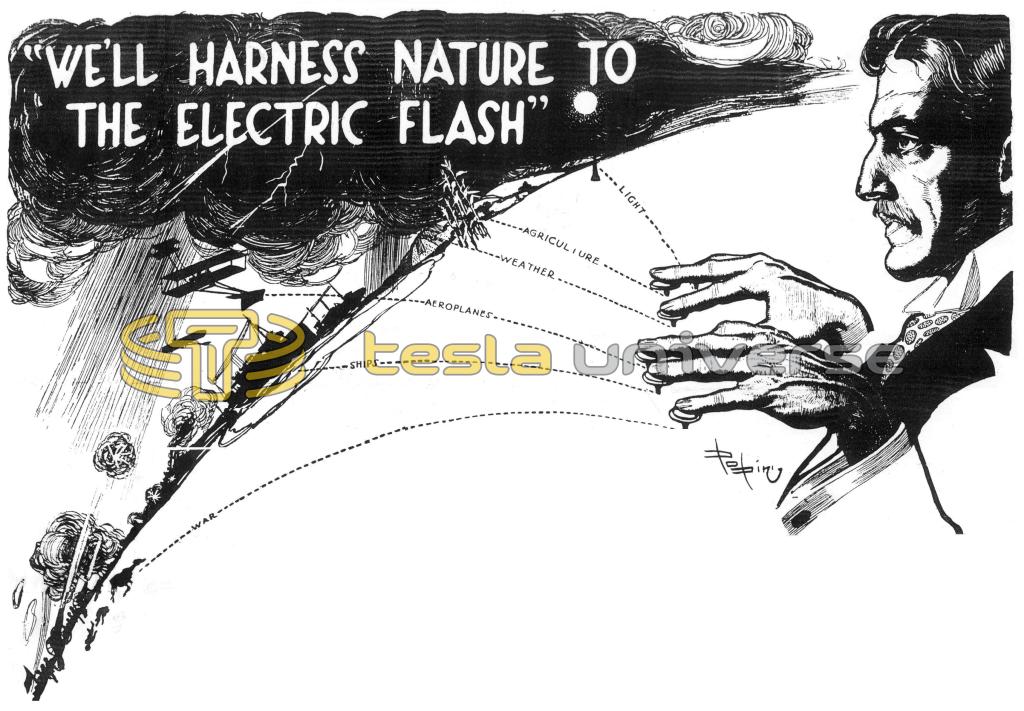
Funnelless Ships, Engineless Aeroplanes, Rainfalls in the Deserts, Annihilation of Armies All to Be Controlled by the Man at the Button, Say the Scientists - A Dream of Wireless Energy Soon May Be Realized.
By W. S. Couch.
The problem of energy solved!
That is the latest promise of Nikola Tesla to the world.
Within a year this wizard of the wires promises to demonstrate that he can deliver electrical energy without the help of wires from any point to any point in the world for domestic and commercial use. The Boer in Pretoria will be able to buy his house light and heat from Denver.
Tesla promises the perfection of the airship by his system.
"It will abolish war," he declares.
A recent London cable told of an address by Prof. Ferranti before the Institution of Royal Engineers, in which the scientist predicted remarkable and undreamed of development in electricity. Prof. Ferranti talked of a universal supply at a minimum of the present cost, and he spoke of controlling weather with the cheap current thus generated.
Nikola Tesla smiled when this despatch was shown to him.
"Yes," he said. "I know Prof. Ferranti, and I know to what he refers. It is the general problem of electricity, the basic problem of wireless electricity, on which we have all been working. I am satisfied that I have solved it, and I hope to demonstrate my success within a year. The possible regulation of the weather is a comparatively easy feature. We'll harness Nature with the electric flash.
"Even a schoolboy can see how the directed use of a practically unlimited electrical current can affect the weather. Rain could be produced, for instance, without difficulty. What appeals to the imagination more is the possibility that an electrical current could be sent to any point, at any distance, without wires. You need put no limit on your imagination when you let it turn on that idea."
A talk with Nikola Tesla is like an interview with a Jules Verne, who has the scientific equipment to make his remarkable fiction come true in real life. In that connection it is worth noting again that modern science has reduced a good deal of the Verne fiction to hard, sound fact. Tesla has undertaken to supply both the fairy story and the magic touch which makes all real in the final transformation scene.
Prof. Ferranti said in his London address that "all things now achieved by coal could better be done with electricity. Consequently all coal should be converted into electricity at a few big centres and retailed from them. This would save annually 90,000,000 tons of coal."
"What Prof. Ferranti says about coal is fundamental," commented the New York scientist. "But you must not forget the water power, more important than coal, of which the professor does not speak. England has not water powers, but they are to be a most important factor in future American development. The harnessing of these water powers and the delivery of their energy is the great industrial problem of to-day."
Official Washington devoted a large part of its attention to this same problem last winter. The Ballinger-Pinchot controversy was one of the big questions for Congress and the National Administration to settle. It hinged in part on the future value to the nation of coal in Alaska, but also and to a much greater extent on the water power possibilities there and on the public lands in the West. Clifford Pinchot promised the greatest dividends to the public from this property of theirs if they would hold title to it. The "riches" and the "bank account" and the "resources" of the nation, he called those Western waterfalls.
Should Nikola Tesla succeed in making good his prophecy, no glowing words that Pinchot ever spoke would equal the result. The coal and water power of Alaska are out of the reach of the United States to-day, and it is difficult for the people of Alaska to get the benefit of them. As far as that is concerned, no man has yet shown the country a way to distribute the energy of writer power to any extent. The many falls of the Western mountains already harnessed have their distribution limited by the heavy wire that must carry the current, the cost of the circuit, and, still more, by the loss of the current the further it is carried.

Water power companies, as a rule, have yet to pay dividends, or at least respectable ones. The harnessing of Niagara Falls, even, has failed to produce the gold mine which was confidently expected. This present limit on water power, and the general failure of water power companies to realize on anything like their expectations, was the chief argument offered by the opposition to Gifford Pinchot's attitude. Pinchot's answer has been to hold on and wait. Tesla promises to end the waiting within the year.
"There ought to be nothing to startle people in the proposal to transmit electrical energy as I promise to do it," smiled Nikola Tesla. "The history of electrical development has been a continued story of what the public thought impossibilities becoming practical method. It is obvious that improvement now lies along the path of transmission of the current without waste. I have contributed my current carried in hydrogen gas underground. That system guards against all loss of energy. It is underground, however.
"The people have seen wireless telegraphy grow from a theory to the practical working of the wireless. In this system, however, the wave lengths are sent broadcast. They radiate in every direction.
"If transmission without loss or waste of energy is possible and practical, and if wireless transmission is possible and practical, is the transmission of electrical energy through the atr and without loss of energy an impossible feat for the imagination? Such transmission, of course, would have to have direction, and an easily controlled direction. It would not do to turn your energy loose to radiate to any point as the wireless waves are turned loose. Obviously this would mean a dissipation of the energy which it is desired to conserve.
"I do not propose now, hastily and in an interview, to describe my discovery. During the coming year I expect to give my demonstration, and then there will be time enough for its discussion in detail and in scientific and accurate terms. Take my word for it, though the problem is solved.
"Think what possibilities it offers," added the inventor, after a moment's reflection. "What will it mean to the development of aeroplanes and aerial flight? It takes off the limit for the flyers.
"I had been studying the problem of the air with an eye to just this thing for many years before the present aviators succeeded in floating themselves, rather to the surprise of students. I had believed they must wait for just this command of electrical energy of which I have been speaking. They must wait for it now to make any real conquest of the air. The improvement of the automobile, with its improvement of the gasoline engine, has given them a motive power. This gasoline engine, if you will stop and think, is the only new thing right now in airships. The wings, the frame, the shape, everything but the light, effective motor power, had been perfected for a long time. You can find books printed many years ago, years before the Wright brothers began to experiment, with pictures of all these curious, birdlike shapes and forms built in canvas and light framework with which we are now growing daily more familiar.
"The gasoline engine, adapted from the automobile, gave the experimenters of to-day their long-desired motive power. They applied it promptly to the construction of their predecessors, and they are flying. This flying of to-day, however, is elemental, like a child learning to walk. It is strictly limited by the faults of the engine. Imperfect as, it is and limited in its capabilities even at its most perfect point.
"Such possibilities in the use of electrical energy as I intend to demonstrate will instantly enlarge the field of aeroplane flight to an extent which I hesitate to predict."
"Will the airman have a lighter engine?" the inventor was asked.
Tesla laughed outright.
"No engine at all," he declared."But you must not ask for details. I am not ready to explain my discovery.
"The matter of war is easy," he replied to a question asking light on his statement that his discovery ought to end such conflicts. It does not require a diagram, does it, to see how impossible such control of electrical energy as I have described would make war, either on sea or land? I have told you that this energy can be sent from the Rocky Mountains to South Africa to light the home of some Boer. This without wires and without waste. Can you imagine the terrible result of such power directed against an army or a battleship? It will never have to be so directed, I assure you."
It is necessary when you listen to Nikola Tesla talking electricity and the possibilities of its future use to remember that this man's hand is now in the machinery of almost every motor in operation. That gives you an anchor for your mind in what is now an every-day something.
"But the motor was once looked upon as a visionary thing," laughs Tesla. He challenges the public to respectful attention for his prophecies on the evidence of past electrical miracles now come to be everyday realities. The new efforts at invention and application are no more impossible or bizarre, Tesla declares, than established achievements of today seemed to be in their inception.
Tesla's proposition to handle electrical current without wires but under control over any distance is not put forward by him as a remarkable or extraordinary thing.
"If you follow the development of study and experiment with electricity or any world force," he says, "you will not be surprised when the world reaches its logical results."
Tesla was early at the wireless. He soon proposed to transmit sight as well as sound. His proposition was not merely to send a photograph over the wires, which has been done, but actually to enable parties to a long distance telephone conversation to see each other as they talked. Perhaps his next proposal was a "cold storage" insulation of wires. By running them underground, through water, he undertook to eliminate the waste of electrical energy in transmission. Tesla was a pioneer in the study of X-rays, or Roentgen rays, as they have come to be known. He made recognized improvements here. He evolved a system of illumination without wires or globes. He devised an electrical oscillator which he applied, or planned to apply, in connection with several of his other devices. He had a multiple motor intended to handle most economically the power of Niagara Falls.
Then broader notions attracted his attention. He argued for the use of electricity as a farm fertilizer. He discussed the use of a sea automaton for use in naval warfare. This motor boat was to be directed from the shore by a delicately sensitized plate and used with deadly and irresistible effect against the enemy. Tesla announced what he thought was a communication with Mars. At least his instruments registered what he believed he could demonstrate was a message from Mars. Tesla published a plan for the communication of sound without wires. He suggested that electricity could be used in disease for the destruction of all bacilli; that it could possibly cure consumption.
Now he proposes such a handling of electrical power as would revolutionize the world.
"Why not?" demands Tesla. "If the principle is the same, what difference does the size of the problem make?"
Tesla's idea, then, appealing as it is to the layman, will meet the instant challenge of many of his fellows in the world of volts and insulations.
Wirelessly operated clock.
Portable wireless station, where messages are received while you walk.
A Parisian garden with giant flowers obtained by wireless electro-culture.
Raising plants by wireless electro-culture at one of the Italian experimental stations.
Webmaster note: The original article included additional images not included here. These have been omitted due to extremely poor quality. The captions from these images is provided above in the hopes that they can be included in the future and to provide reference to their purpose.

Reprints
- "We'll Harness Nature to the Electric Flash" (reprint)Seattle Post — December 11th, 1910