Nikola Tesla Articles
Wireless Telegraphy (Mar. 31, 1899)
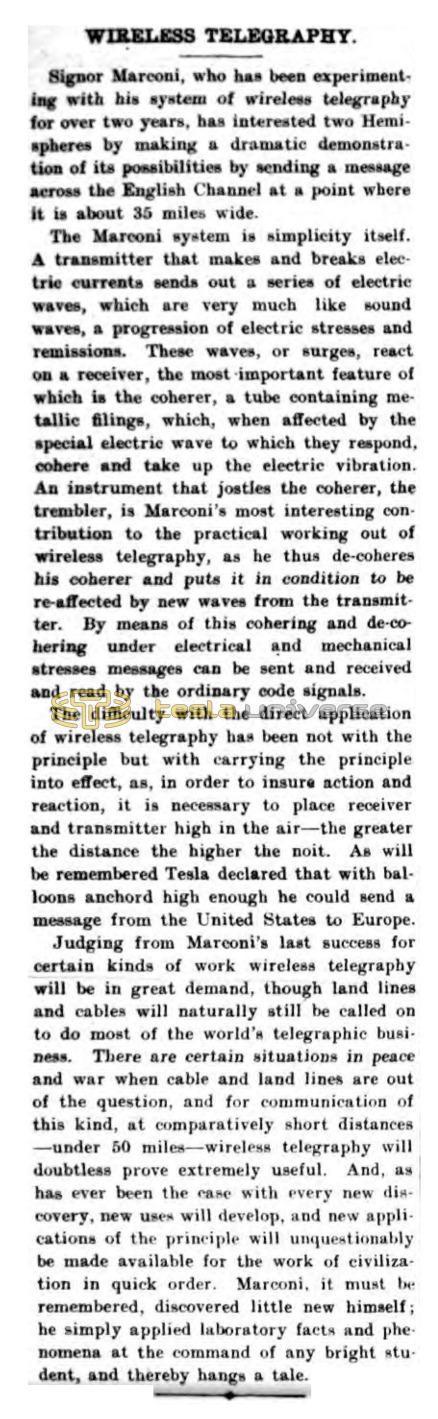
Signor Marconi, who has been experimenting with his system of wireless telegraphy for over two years, has interested two Hemispheres by making a dramatic demonstration of its possibilities by sending a message across the English Channel at a point where it is about 35 miles wide.
The Marconi system is simplicity itself. A transmitter that makes and breaks electric currents sends out a series of electric waves, which are very much like sound waves, a progression of electric stresses and remissions. These waves, or surges, react on a receiver, the most important feature of which is the coherer, a tube containing metallic filings, which, when affected by the special electric wave to which they respond, cohere and take up the electric vibration. An instrument that jostles the coherer, the trembler, is Marconi's most interesting contribution to the practical working out of wireless telegraphy, as he thus de-coheres his coherer and puts it in condition to be re-affected by new waves from the transmitter. By means of this cohering and de-cohering under electrical and mechanical stresses messages can be sent and received and read by the ordinary code signals.
The difficulty with the direct application of wireless telegraphy has been not with the principle but with carrying the principle into effect, as, in order to insure action and reaction, it is necessary to place receiver and transmitter high in the air—the greater the distance the higher the noit. As will be remembered Nikola Tesla declared that with balloons anchord high enough he could send a message from the United States to Europe.
Judging from Marconi's last success for certain kinds of work wireless telegraphy will be in great demand, though land lines and cables will naturally still be called on to do most of the world's telegraphic business. There are certain situations in peace and war when cable and land lines are out of the question, and for communication of this kind, at comparatively short distances — under 50 miles — wireless telegraphy will doubtless prove extremely useful. And, as has ever been the case with every new discovery, new uses will develop, and new applications of the principle will unquestionably be made available for the work of civilization in quick order. Marconi, it must be remembered, discovered little new himself; he simply applied laboratory facts and phenomena at the command of any bright student, and thereby hangs a tale.