Nikola Tesla Articles
The Wizard of Electrical Science
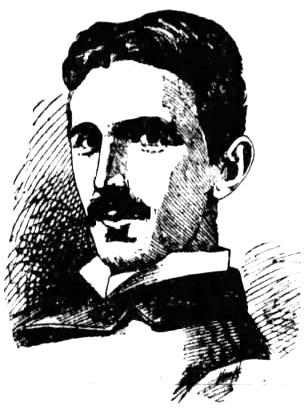
Nikola Tesla is today the most interesting personality in the department of electrical investigation and engineering invention in the world.
The fire which lately destroyed the Tesla laboratory in New York, consuming all the recent devices and creations of his ingenuity — the results of years of such labor as only such a man is capable of — had in it a touch of the tragic. But at any rate, it has directed public attention afresh to the character and achievements of this wonderful and still youthful inventor.
It is natural that the world should look with wonder оп its great inventors. What they do often has the appearance of being the work of an especial "creative faculty."
They seem to be men who have made rather than merely formed something. In an age like the present, when so much of the world's industries depend upon mechanical uses of nature's forces, the inventor becomes one of the greatest of public benefactors. This is especially the case when the saying economics — saving in time and in other expenditures — are so necessary. The available supply of the world's coal, for instance, is no doubt limited. Should this supply be prematurely exhausted the calamity would be beyond calculation. Engineering invention, if it can, must devise methods for its most economical utilization and expenditure.
Are these other forces of nature still lying dormant or being let run to waste — powers that are wanted in helping out the tremendous tasks which the eager workers of the world are having in hand? There is Niagara, with its seemingly almost infinite power, running to waste. Who can by searching find out nature's secret methods and fit the apt contrivance to the natural law so that that and other similar wasting forces may come into play along with the other working forces of this "industrial age?"
These are some of the questions which nobody has studied more deeply or with more surprising success than Nikola Tesla.
But who is this deep prier into nature's mysteries, this wonder-working magician? Where did he come from? How came he here? And how came he to be what he is, to do the things which have already made his name so famous?
In the first place, this Nikola Tesla, though plainly enough a man of genius, is no magician. He is no mere visionary. He is no child of luck. His achievements have been no accidents. He is one of the most logical of men. He has not jumped to conclusions. Every perceptive faculty has been alert; but so have all other co-ordinate faculties of the mind been alive and alert, each faculty instant in the doing of its own part toward the wanted and waited for result.
President Jordan, of the Leland Stanford university, is right in insisting, as he does in a recent strikingly just article in one of the educational reviews, that "genius" should be taken as the "model in education." The man of true genius, when he does things which men wonder at and admire, has no lazy fiber in his brain. All the faculties work — work at their best. And they work at their best because they work suitably and all together.
But Nikola Tesla — in America he is one of our "immigrants," as Ericsson was, as Agassiz was and some other such people whose names and services the new world will not soon let die. Tesla now 38 years of age. He is by birth a Slav. His boyhood home was in the borderland of eastern Austria, where Slav and Turk have so often struggled for the mastery. He was born in Smiljan, in the province of Lika. His father was a clergyman of the Greek church, who had hoped to have his son succeed him in the sacred office.
As for his education, he spent four years in the public school, three years in the real school, three years in the higher real school at Cortstatt, and two or three years in the polytechnic school in Gratz, Austria.
By this time young Tesla had become so absorbed in his electrical studies, experiments and scientific ideas, that he saw, as he expressed it, felt that he must "get into" the gulf stream of electrical thought. Accordingly, breaking away from all ties and traditions of the past, in 1881, he came to Paris, presently obtaining employment as an electrical engineer. It was not long, however, before it became plain to him that America was the place for him. Associated for a time with Edison, in whose shop he took off his coat the day he landed in America, he threw himself into the midstream of the then extraordinary intensity of electrical investigation and invention.
In 1887 the Tesla Electric Company of New York having been formed, he devised and brought into use the epoch marking motor for multiphase alternating currents, thus dispensing both with commutator and brushes.
Tesla was engaged about this time contemporaneously with Prof. Ferrarise, an independent inventor, in perfecting the demonstration of the enormously important principle of the rotary field motor — a new system of electric distribution and transmission of power by means of alternating currents.
The various Tesla patents having been acquired by the Westinghouse Electric Company, they began at once to be put to use in many ways, to the inestimable advantage of the world's growing mechanical industries. In the year 1890 Mr. Tesla, severing his connection with the Westinghouse company, devoted himself to the study of alternating currents of high frequencies and very high potencies. His lectures on "Experiments with Alternating Currents," delivered before the American Institute of Electrical Engineers, and shortly after repeated before similar bodies in London and in Paris and elsewhere in the summer of 1891, marked a fresh era era in the evolution of electrical applied science.
At the present time Tesla is devoting himself to the working out of another great invention, but this time in the department of mechanical engineering known as the oscillator, from which immensely important results are anticipated if successful. This new mechanical contrivance is a combination of the steam engine and the dynamo, by which, it is is said, an engine of a given power can be made about one-fortieth the weight of the ordinary engine of the same power. In the oscillator the piston travels its path to and fro 100 times a second, or oftener if required. In one form of the oscillator two pistons are used that go out and in the the opposite ends of the cylinder at at the same time, thus balancing their motion and relieving the apparatus from the rapid shock of vibration.
Just how revolutionary this new step in both steam and electrical engineering is destined to be is not yet wholly certain. But in view of what is already as good as certain that electricity is destined, and that before long, to take the place chiefly of steam in railway and other traction, in the opinion of those most competent to judge, its importance can hardly be overstated. The problem, the worst to be met, has been to devise the best type of engine for driving the simplest and most economical form of dynamo. Of course, until the problem has been completely worked out, there remain some things about it which the wary inventor "keeps to himself and scarcely tells to any."
Some of Mr. Tesla's most brilliant experiments of startling beauty have had to do with phenomena of light and heat, as produced by electrostatic forces acting between charged molecules or atoms. AS described by Mr. Marten, perfecting a generator that would give him currents of several thousand alternations per second, and inventing his disruptive coil, he has created electrostatic conditions that have already modified many accepted notions about electricity. For one thing. it has been supposed that one or two thousand volts' potential would surely kill, but Mr. Tesla has been seen receiving through his hands currents of a potential of more than 200,000 volts, vibrating 1,000,000 times a second, and manifesting themselves in dazzling streams of light. An actual flame is in this way produced, of intense whiteness, that does not consume anything, "bursting from the ends of an induction coil as though it were a bush on holy on holy ground," with such vibrations as can be maintained by a potential of 3,000,000 volts. Mr. Tesla expects some day to clothe himself in a robe of lambent fire that will be altogether harmless. Indeed, such currents as he now uses, he says, would keep a naked man warm at the north pole; and as for possible curative uses of such currents, who can say, or gainsay in electrical science and engineering during the past 10 or 12 years?
Another of the ideas which Tesla is working out is that of the transmission of intelligence, and perhaps of power, across wide spaces without the use of any connecting wire. This, of course, is not any experiment of trying to "do something by means of nothing." It is entirely scientific; it is an effort to utilize the earth itself as an electric conductor. It is an attempt to get at the law of those earth currents of electrical force in a way to devise some method of getting the mastery of them, and of bringing parallel currents, though widely separated in space, into "resonating," relations with each other, the one electrical current being turned to the other.
As Mr. Tesla himself has said: "In connection with resonance effects and the problem of transmission of energy over a single conductor, I would say a few words in a problem which constantly fills my thoughts, and which concerns the welfare of all. I mean the transmission of intelligible signals, or, perhaps, even power, to any distance without the use use of wires. I am dally becoming more more and more convinced of the practicability of the scheme; and though I know full well that the majority of scientific men will not believe that such results can be practically and immediately realized, yet I think that all consider the developments of recent years by a number of workers to have been such as to encourage thought and experiment in this direction. My conviction has grown so strong that I no longer look upon this plan of energy or intelligence transmission as a mere theoretical possibility, but as a serious problem in electrical engineering which must be carried out some day. The idea of transmitting intelligence without wire is the natural outcome of the most recent results of electrical investigations." Some enthusiasts, he says, have expressed their belief that telephoning to any distance by induction through air is possible; for himself, he he cannot stretch his imagination so far, but he declares his firm belief that it is practicable to disturb by means of powerful machines the electrostatic condition of the earth, and thus transmit intelligible signals, and perhaps power. We need not be frightened, he says, by the idea of distance. To the weary wanderer counting the mile posts the earth may appear very large; to the astronomer it appears very small. So, Tesla thinks, it may seem to the electrician. The "big earth," as we call it, contains a certain capacity for electricity; let the electricians of the world find out how to measure that capacity, and then, reasoning solidly from one point to another, find out how to convert the "art and mystery" into the art and mastery of it, for the world's everyday uses.
Nikola Tesla is man of a most interesting personality. Through his inventions he has begun to do the work of millions of workmen, so helping on immensely the possible achievements of the great world's industries in order to the growing comfort and happiness of mankind. This man, of whom America is now so proud, is not without honor in the region of his birth. The Order of the Eagle has just been conferred upon him by the prince of Montenegro, as previously the Order of St. Sava had been given him by the king of Servla.
