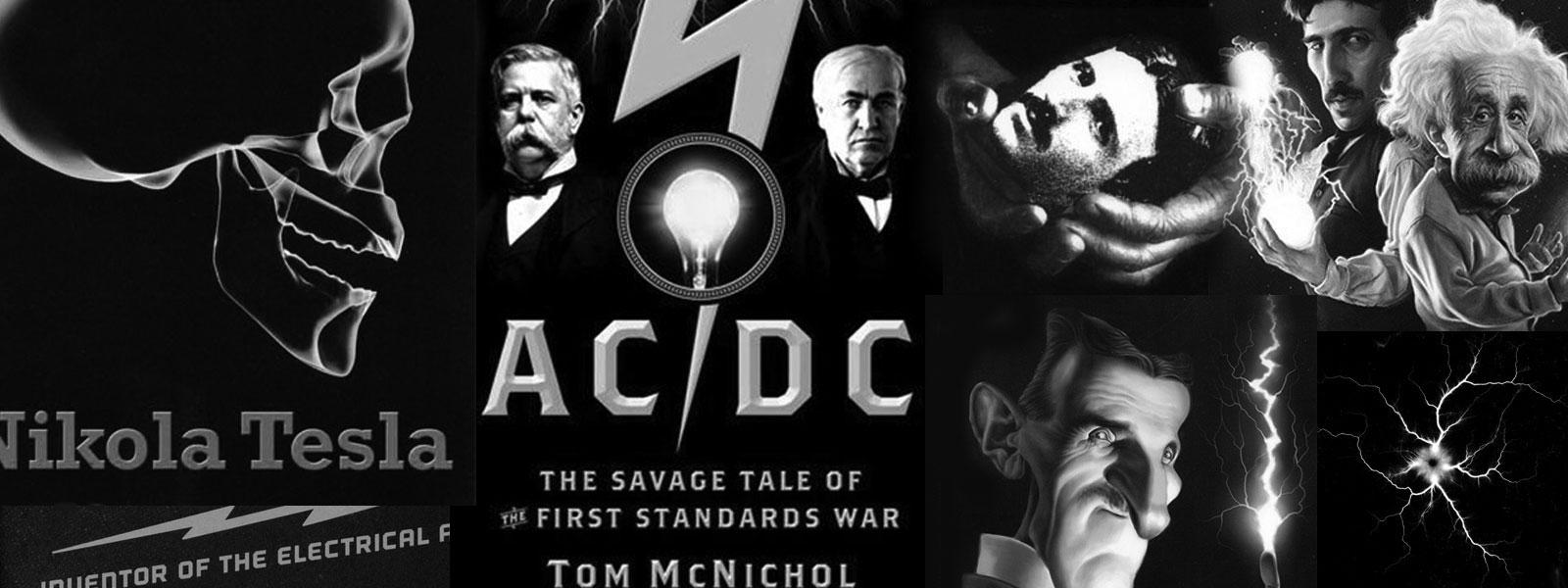
Nikola Tesla Books


IN SEARCH OF NIKOLA TESLA understand the physical world in some direct, non-rational way. I will begin with another scientist, Wolfgang Pauli. Some years ago I conducted a series of interviews for radio with several of the founders of modern physics. Although Pauli had died several years earlier, his name kept cropping up as the joker in the scientific pack. Pauli, a genius in his own right, was also the supreme critic, the voice of reason, the measure of other men's theories. He was seen by many older physicists as a scientist of unfailing intuition and one badly needed in our own time to clarify so much of the loose thinking and half-baked ideas which abound. Pauli had another side, which became of increasing importance to him. He was interested in areas of the mind which would be called mystical by most thinkers. With Carl Jung, he joined in an investigation of what they termed synchronicity. Pauli had begun by trying to understand how Johannes Kepler had first formulated his laws of planetary motion. He showed that the astronomer had made use of occult images or archetypes as the basis for his thinking. Later the scientist and the psychologist went further into this world of mind by attempting to chart the parallel flows of matter and thought which take place in our universe. Carl Jung defined synchronicity as a meaningful coincidence between physical and mental states. The other term he used for it was an 'Acausal connecting principle' between mind and matter, for it dealt with events for which no physical or logical cause-and-effect relationship was possible. One could extend Jung's definition to say that synchronicities were the manifestations of that harmony which exists between the unfolding of the physical and mental universe. An example from Jung's own life should help. In 1909, he visited Sigmund Freud in Vienna and the conversation turned to parapsychology, which held an attraction for Jung but was distasteful to Freud. In the heat of the conversation a sudden detonation occurred in Freud's bookcase. The two men started up in surprise and Jung drew attention to the incident as support for his argument. Freud dismissed this as 'sheer bosh' but Jung experienced an inner certainty that the event would occur again. 'I now predict that in a moment there will be another loud report,' he said to Freud and, sure enough, the event occurred again. 139
