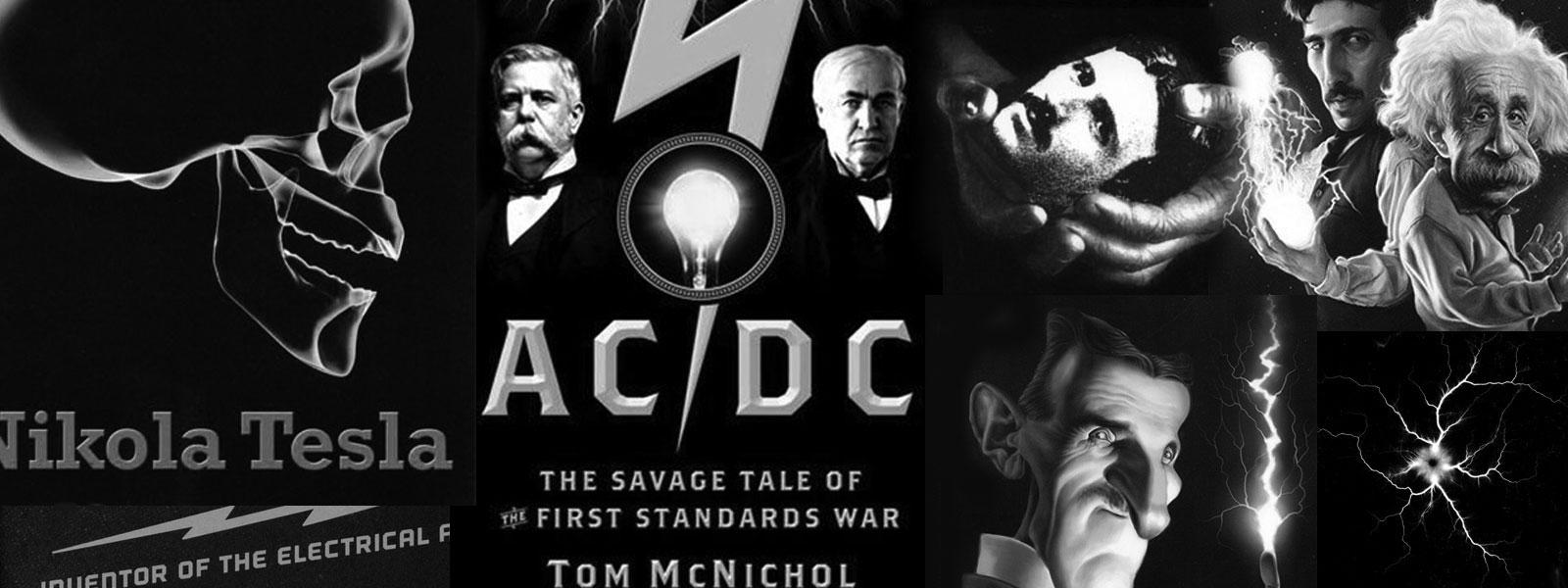
Nikola Tesla Books

myself as usual. When I was a short distance from the masonry, however, I was horrified to observe that the water had risen and was carrying me along swiftly. I tried to get away but it was too late. Luckily, though, I saved myself from being swept over by taking hold of the wall with both hands. The pressure against my chest was great and I was barely able to keep my head above the surface. Not a soul was in sight and my voice was lost in the roar of the fall. Slowly and gradually I became exhausted and unable to withstand the strain longer. Just as I was about to let go, to be dashed against the rocks below, I saw in a flash of light a familiar diagram illustrating the hydraulic principle that the pressure of a fluid in motion is proportionate to the area exposed and automatically I turned on my left side. As if by magic, the pressure was reduced and I found it comparatively easy in that position to resist the force of the stream. But the danger still confronted me. I knew that sooner or later I would be carried down, as it was not possible for any help to reach me in time, even if I had attracted attention. I am ambidextrous now, but then I was left-handed and had comparatively little strength in my right arm. For this reason I did not dare to turn on the other side to rest and nothing remained but to slowly push my body along the dam. I had to get away from the mill towards which my face was turned, as the current there was much swifter and deeper. It was a long and painful ordeal and I came near to failing at its very end, for I was confronted with a depression in the masonry. I managed to get over with the last ounce of my strength and fell in a swoon when I reached the bank, where I was found. I had torn virtually all the skin from my left side and it took several weeks before the fever had subsided and I was well. These are only two of many instanced, but they may be sufficient to show that had it not been for the inventor's instinct, I would not have lived to tell the tale. Interested people have often asked me how and when I began to invent. This I can only answer from my present recollection in the light of which, the first attempt I recall was rather ambitious for it involved the invention of an apparatus and a method. In the former I was anticipated, but the later was original. It happened in this way. One of my playmates had come into the possession of a hook and fishing tackle which created quite an excitement in the village, and the next morning all started out to catch frogs. I was left alone and deserted owing to a quarrel with this boy. I had never seen a real hook and pictured it as something wonderful, endowed with peculiar qualities, and was despairing not to be one of the party. Urged by necessity, I somehow got hold of a piece of soft iron wire, hammered the end to a sharp point between two stones, bent it into shape, and fastened it to a strong string. I then cut a rod, gathered some bait, and went down to the brook where there were frogs in abundance. But I could not catch any and was almost discouraged when it occurred to me dangle the empty hook in front of a frog sitting on a stump. At first he collapsed but by and by his eyes bulged out and became bloodshot, he swelled to twice his normal size and made a vicious snap at the hook. Immediately I pulled him up. I tried the same thing again and again and the method proved infallible. When my comrades, who in spite of their fine outfit had caught nothing, came to me, they were green with envy. For a long time I kept my secret and enjoyed the monopoly but finally yielded to the spirit of Christmas. Every boy could then do the same and the following summer brought disaster to the frogs. In my next attempt, I seem to have acted under the first instinctive impulse which later dominated me, ― to harness the energies of nature to the service of man. I did this through the medium of May bugs, or June bugs as they are called in America, which were a veritable pest in that country and sometimes broke the branches of trees by the sheer weight of their bodies. The 10 The Strange Life of Nikola Tesla
