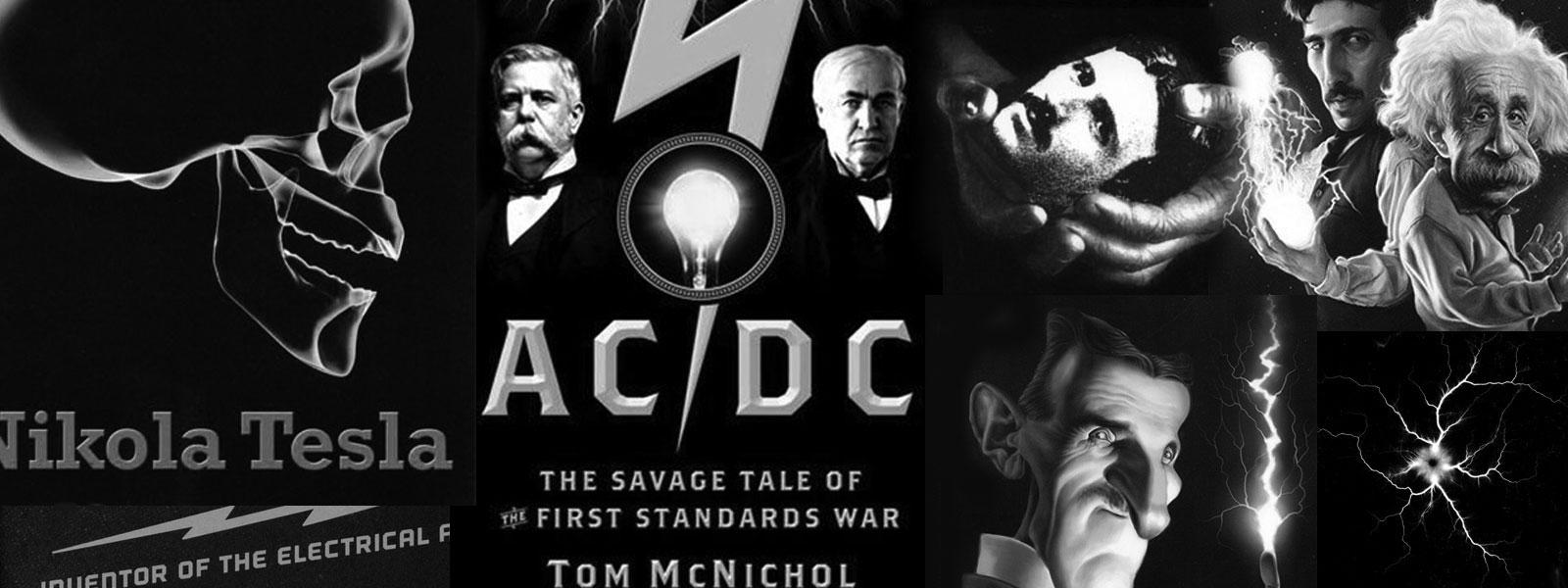
Nikola Tesla Books

the Mechanical Department, offered to form a stock company. The proposal seemed to me comical in the extreme. I did not have the faintest conception of what he meant, except that it was an American way of doing things. Nothing came of it, however, and during the next few months I had to travel from one place to another in France and Germany to cure the ills of the power plants. On my return to Paris, I submitted to one of the administrators of the Company, Mr. Rau, a plan for improving their dynamos and was given an opportunity. My success was complete and the delighted directors accorded me the privilege of developing automatic regulators which were much desired. Shortly after, there was some trouble with the lighting plant which had been installed at the new railroad station in Straßburg, Alsace. The wiring was defective and on the occasion of the opening ceremonies, a large part of a wall was blown out through a short-circiut, right in the presence of old Emperor William I. The German Government refused to take the plant and the French Company was facing a serious loss. On account of my knowledge of the German language and past experience, I was entrusted with the difficult task of straightening out matters and early in 1883, I went to Straßburg on that mission. Some of the incidents in that city have left an indelible record on my memory. By a curious coincidence, a number of the men who subsequently achieve fame, lived there about that time. In later life I used to say, "There were bacteria of greatness in that old town." Others caught the disease, but I escaped!" The practical work, correspondence, and conferences with officials kept me preoccupied day and night, but as soon as I was able to manage, I undertook the construction of a simple motor in a mechanical shop opposite the rail-road station, having brought with me from Paris some material for that purpose. The consummation of the experiment was, however, delayed until the summer of that year, when I finally had the satisfaction of seeing the rotation effected by alternating currents of different phase, and without sliding contacts or commutator, as I had conceived a year before. It was an exquisite pleasure but not to compare with the delirium of joy following the first revelation. Among my new friends was the former Mayor of the city, Mr. Sauzin, whom I had already, in a measure, acquainted with this and other inventions of mine and whose support I endeavoured to enlist. He was sincerely devoted to me and put my project before several wealthy persons, but to my mortification, found no response. He wanted to help me in every possible way and the approach of the first of July, 1917, happens to remind me of a form of "assistance" I received from that charming man, which was not financial, but none the less appreciated. In 1870, when the Germans invaded the country, Mr. Sauzin had buried a good sized allotment of St. Estephe of 1801 and he came to the conclusion that he knew no worthier person than myself, to consume that precious beverage. This, I may say, is one of the unforgettable incidents to which I have referred. My friend urged me to return to Paris as soon as possible and seek support there. This I was anxious to do, but my work and negotiations were protracted, owing to all sorts of petty obstacles I encountered, so that at times the situation seemed hopeless. Just to give an idea of German thoroughness and "efficiency," I may mention here a rather funny experience. An incandescent lamp of 16 c.p. was to be placed in a hallway, and upon selected the proper location, I ordered the "monteur" to run the wires. After working for a while, he concluded that the engineer had to be consulted and this was done. The latter made several objections but ultimately agreed that the lamp should be placed two inches from the spot I had assigned, whereupon the work proceeded. Then the engineer became worried and told me that Inspector Averdeck should be notified. That important person was called, The Strange Life of Nikla Tesla 21
