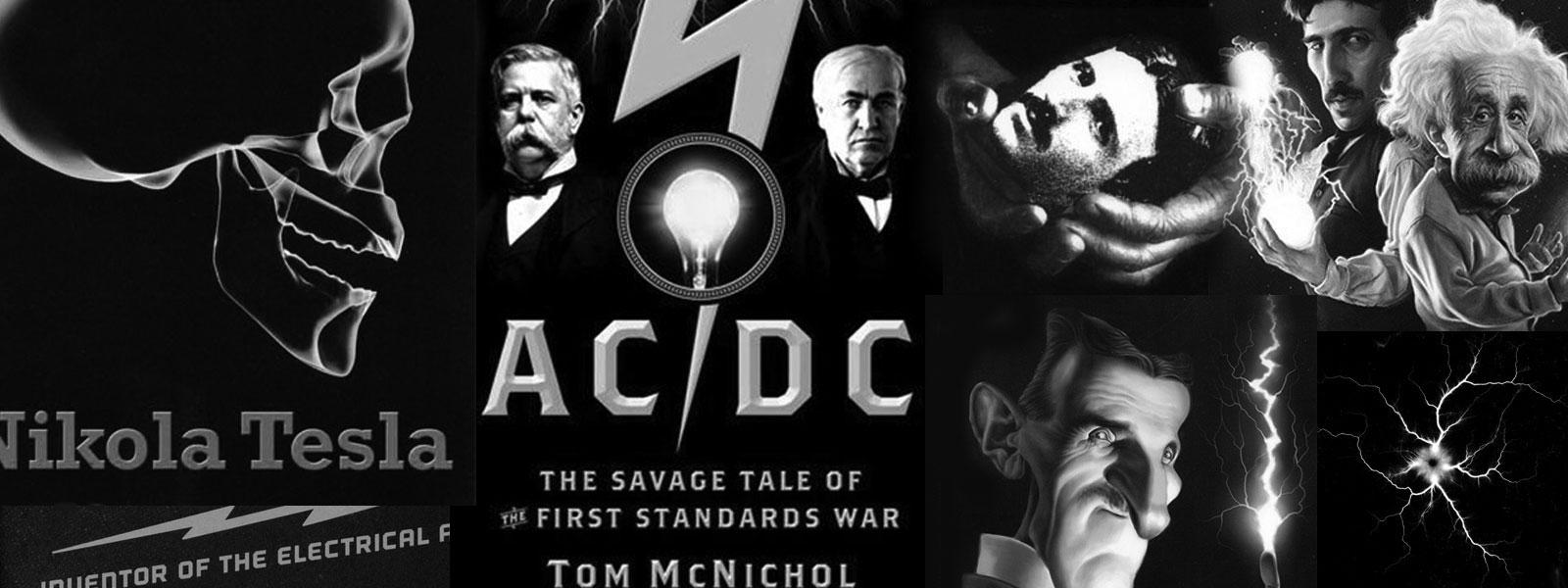
Nikola Tesla Books

the tune was lost, necessitating readjustment, and did not yet foresee what I discovered long afterwards, - a means of operating a machine of this kind at a speed constant to such a degree as not to vary more than a small fraction of one revolution between the extremes of load. From many other considerations, it appeared desirable to invent a simpler device for the production of electric oscillations. In 1856, Lord Kelvin had exposed the theory of the condenser discharge, but no practical application of that important knowledge was made. I saw the possibilities and undertook the development of induction apparatus on this principle. My progress was so rapid as to enable me to exhibit at my lecture in 1891, a coil giving sparks of five inches. On that occasion I frankly told the engineers of a defect involved in the transformation by the new method, namely, the loss in the spark gap. Subsequent investigation showed that no matter what medium is employed, -be it air, hydrogen, mercury vapour, oil, or a stream of electrons, the efficiency is the same. It is a law very much like the governing of the conversion of mechanical energy. We may drop a weight from a certain height vertically down, or carry it to the lower level along any devious path; it is immaterial insofar as the amount of work is concerned. Fortunately however, this drawback is not fatal, as by proper proportioning of the resonant, circuits of an efficiency of 85 percent is attainable. Since my early announcement of the invention, it has come into universal use and wrought a revolution in many departments, but a still greater future awaits it. When in 1900 I obtained powerful discharges of 1,000 feet and flashed a current around the globe, I was reminded of the first tiny spark I observed in my Grand Street laboratory and was thrilled by sensations akin to those I felt when I discovered the rotating magnetic field. 24 The Strange Life of Nikola Tesla
