Nikola Tesla Inventions
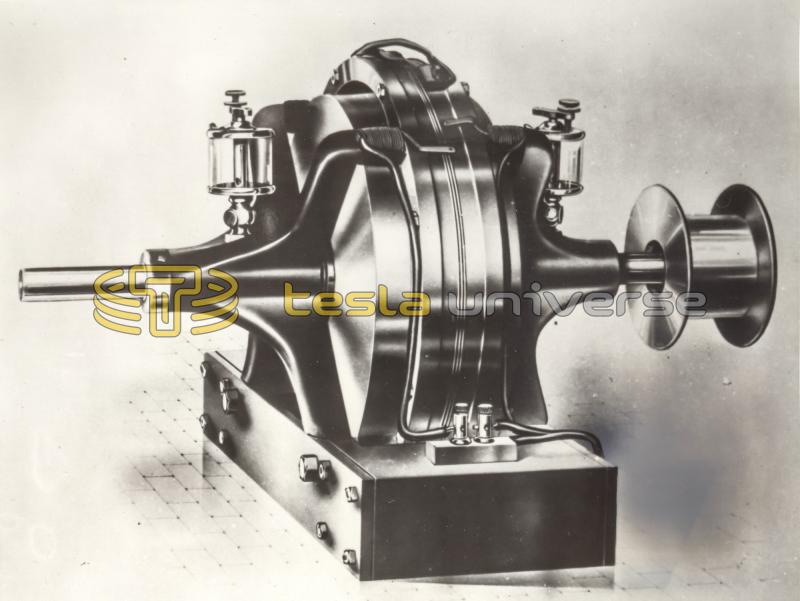
High-Frequency Alternator
Tesla developed high-frequency alternators in the early 1890s as mechanical sources of alternating current for his experiments with arc lighting, vacuum tubes, and high-frequency phenomena. These machines used a large number of poles — often several hundred — arranged around a ring-shaped field, allowing them to produce alternation rates of 10,000 to 30,000 per second when driven at practical speeds. Unlike ordinary power-frequency alternators, they were designed to generate currents whose rapid reversals reduced the heating and noise of arcs and enabled novel lighting and electrotherapeutic effects. Tesla built several experimental models, including machines with 384 and 480 poles, and demonstrated them powering lamps and other devices without the drawbacks of lower-frequency systems.
Although limited to roughly 20 kHz by mechanical constraints, these alternators provided Tesla with a reliable source of high-frequency current before he perfected the oscillatory transformer (Tesla coil) method of generating still higher frequencies through the discharge of condensers. They played a key role in his 1891-1893 lectures and in the early development of high-frequency techniques that later supported his work on wireless transmission and radio. The machines illustrated Tesla’s approach of adapting rotating machinery to produce the special current characteristics required for his research, bridging conventional electromechanical generation with the higher-frequency methods that followed.