Nikola Tesla Inventions
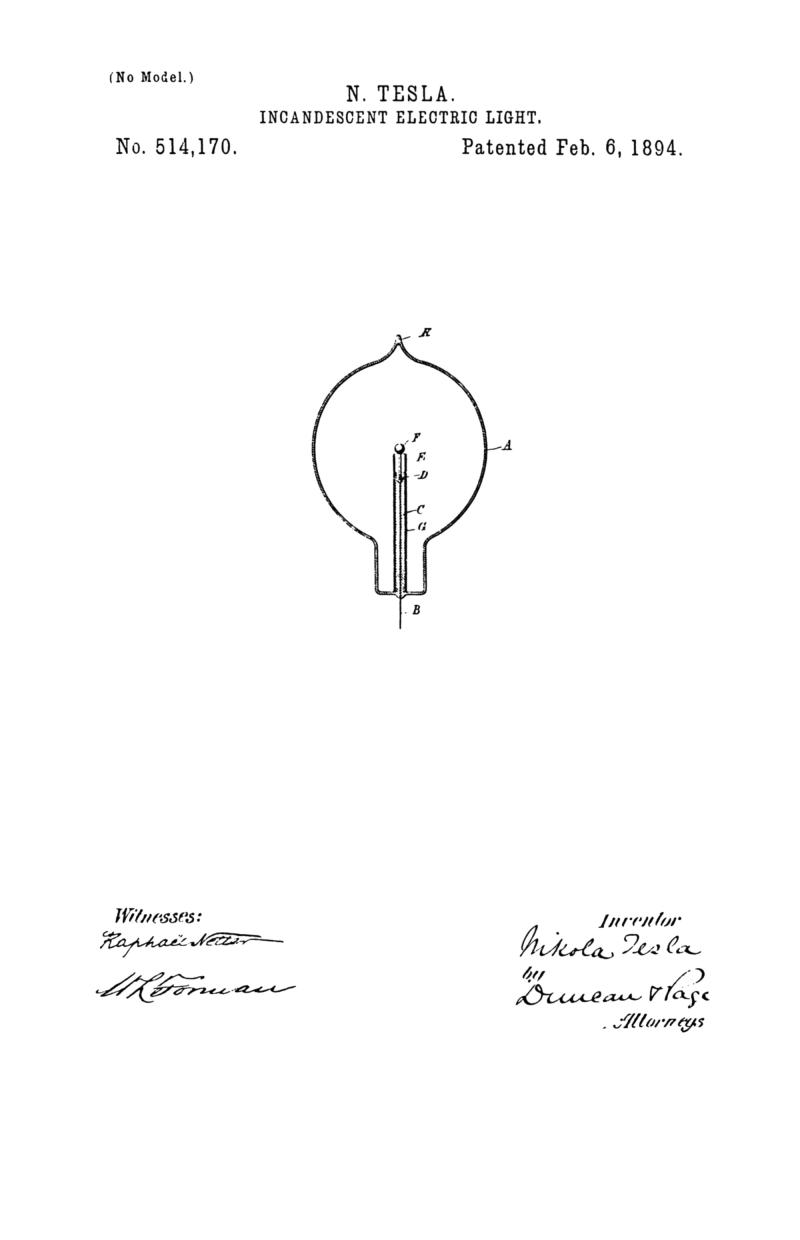
Incandescent Electric Light
Tesla's improvements to incandescent electric lights, patented in 1894 under U.S. Patent 514,170, focused on enhancing efficiency and longevity in carbon-button lamps by introducing a conducting screen or metallic tube around the lead-in conductor. This design confined electrical effects to the refractory light-giving button, preventing energy dissipation along the stem and allowing quicker, more uniform heating to high incandescence. In an exhausted globe, the button—made of durable material like carbon—mounted on an insulated support, with the screen shielding the conductor up to the button's union point. This concentrated current on the emissive element, reducing waste and improving brightness while extending lamp life compared to contemporary designs.
Building on his high-frequency expertise, Tesla aimed to rival Edison's filament bulbs with a more robust, vacuum-based system suitable for alternating current. The patent described combinations for single-terminal operation, foreshadowing aspects of gas-discharge lighting. Though not commercially dominant, these innovations influenced early electric lighting evolution and contributed to Tesla's broader work in efficient illumination, including precursors to fluorescent concepts. Modern interpretations link it to high-vacuum tubes and specialized lamps, highlighting Tesla's efforts to optimize energy use in an era of competing lighting technologies.