Plans
High Tension Condensers
By Curtis Kissel
Many Tesla and Oudin coils which are mechanically and electrically correct will not always develop the efficiency or rating expected of them by the constructor.
The writer found that the difficulty was rather with the spark gap and condenser than with the coil proper. The spark gap was fitted with double silver sparking points, delicately adjustable, and, with the condenser described below, discarded coils taken out of storage operated splendidly, giving a flaming ten-inch spark.
The condenser is made of 8 x 10 inch photographic plates. Twelve plates are used and the gelatine coating or film is removed with hot water. After every trace is taken off the plates are further cleaned with clear water and Dutch Cleanser, wiped with a clean rag and held near the fire to complete the drying.
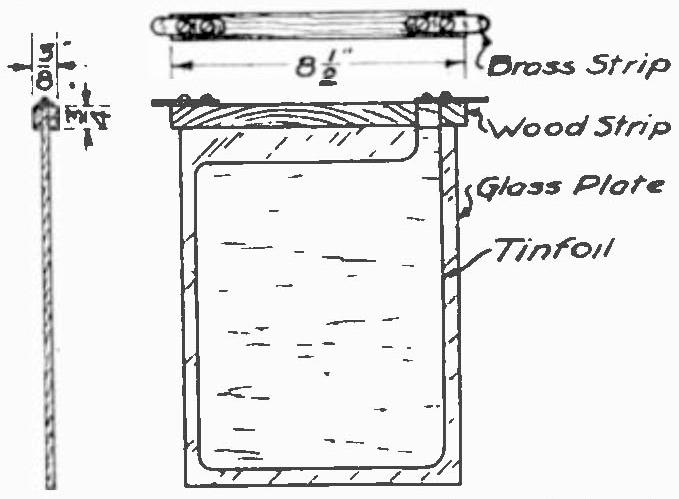
Wooden sticks 8 1/2 inches long, 3/4 inch wide and 3/8 inch thick come next. They may be made of straight grained pine or poplar. The sticks are placed in a vise and a groove cut lengthwise on the 3/8th edge with a rip saw to a depth of about a quarter of an inch. The groove may be widened a little if necessary by running a thin piece of broken glass through it so as to scrape off the sides. The glass plates must fit freely in these grooves or they may be strained and break.
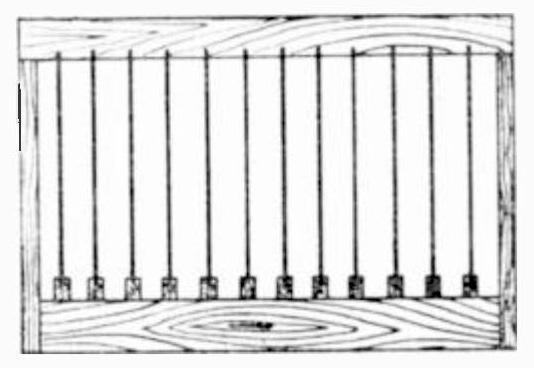
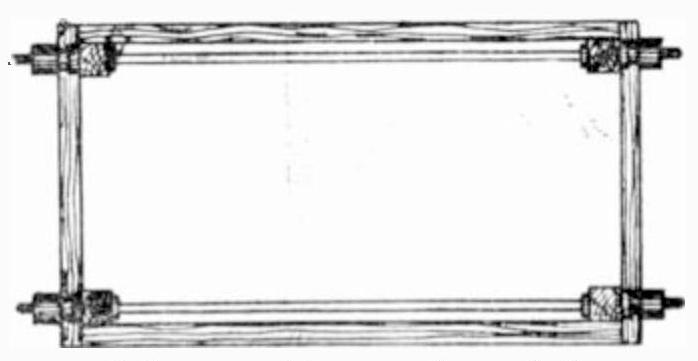
Twelve sticks are thus prepared and are boiled in paraffin, and when the sticks after removal from the melted paraffin have become cool, the plates are to be fastened into them. A temporary fitting rack is shown in Fig. 2, which is self-explanatory. The grooves in the upper bar are spaced about 1½ inches apart. The groove in one of the sticks is now filled with rather thick shellac varnish and one of the plates is pressed into it, the 8 inch wide side being used. The plate is worked back and forth a little so as to get it well seated; the wood should project one quarter inch from each side. The surplus shellac is wiped away while it is still liquid. The other plates are also shellacked into their respective sticks and are left standing in the frame for forty-eight hours. Any surplus shellac which is now dry is scraped off and the stick is sandpapered smooth.
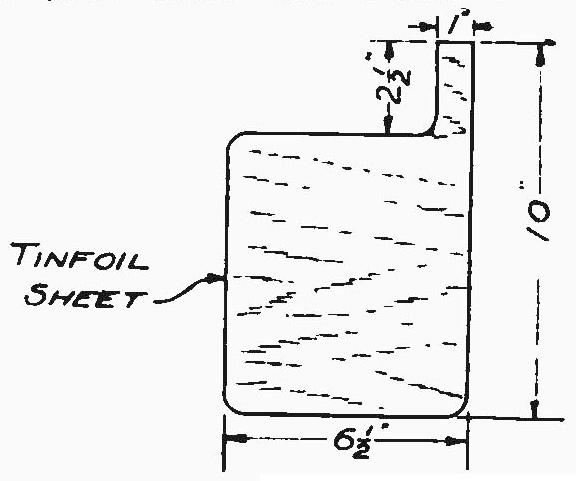
The tin foil for the coating should run about 1600 square inches to the pound and be of the best quality. One pound will cover both sides of the twelve plates. The writer has tried shellac, banana oil, varnish, and glue for attaching the tin foil, and found that LePage's glue is about the best. The tin foil is cut into sheets 10 x 6 1/2 inches, two for each plate. There is a lug on each of them and the corners are rounded.
A plate is placed on a level board, the glue is spread over its surface with the addition of water, and is worked all over the surface with the fingers. One of the tin foil sheets is placed on this, allowing a three-quarter inch margin on three sides; at the top there is a 1 1/2 inch margin. Keeping the fingers wet, smooth down the foil. It is now rolled with a wet photographer's print roller squeezing out surplus glue and water and air bubbles. The rolling should be done from the center of the foil towards the edges. The connecting tin foil lug is also glued nicely to the glass and its end is carried around the stick on top of the pane. The plate is wiped up with a wet sponge and put aside to dry. It will be understood that in coating the two sides the lugs are set one to the left and one to the right.
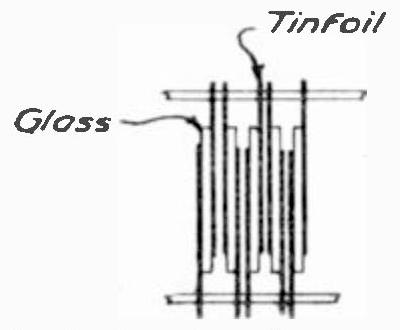
Brass strips are screwed down to each end of the sticks, the inner end covering the tin foil lugs. They are secured with wood screws; the screws are covered with glue before being screwed down. The wood strips are now shellacked and when dry are painted with black enamel paint, only, however, for appearances' sake. The corners of the tin foil being rounded, tends to prevent brush discharge from the corners. Now the plates are coated with a thin coat of resin or resin and beeswax mixed, two parts of resin and one wax, which is applied by dipping into the hot mixture. The plates are first heated, then lowered into the tank with an even motion, and then quickly withdrawn with the same uniform motion and with the same speed. There must be no stop and no jerky motion.
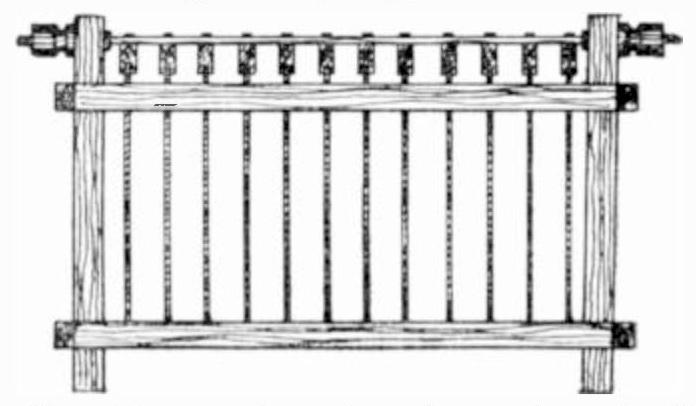
Figure 4 shows the rack for holding the plates of the finished condenser. It will be observed that the rods on which the brass strips on the tops and ends of the sticks rest, take care, one of one set of plates and the other of another. The rods should be one-quarter inch round brass and threaded for the nuts. Porcelain bushings should be used in the uprights for the rods to go through, and the plates are to be spaced one inch apart.
