Nikola Tesla Articles
The Alternating Current Motor in Mining Work
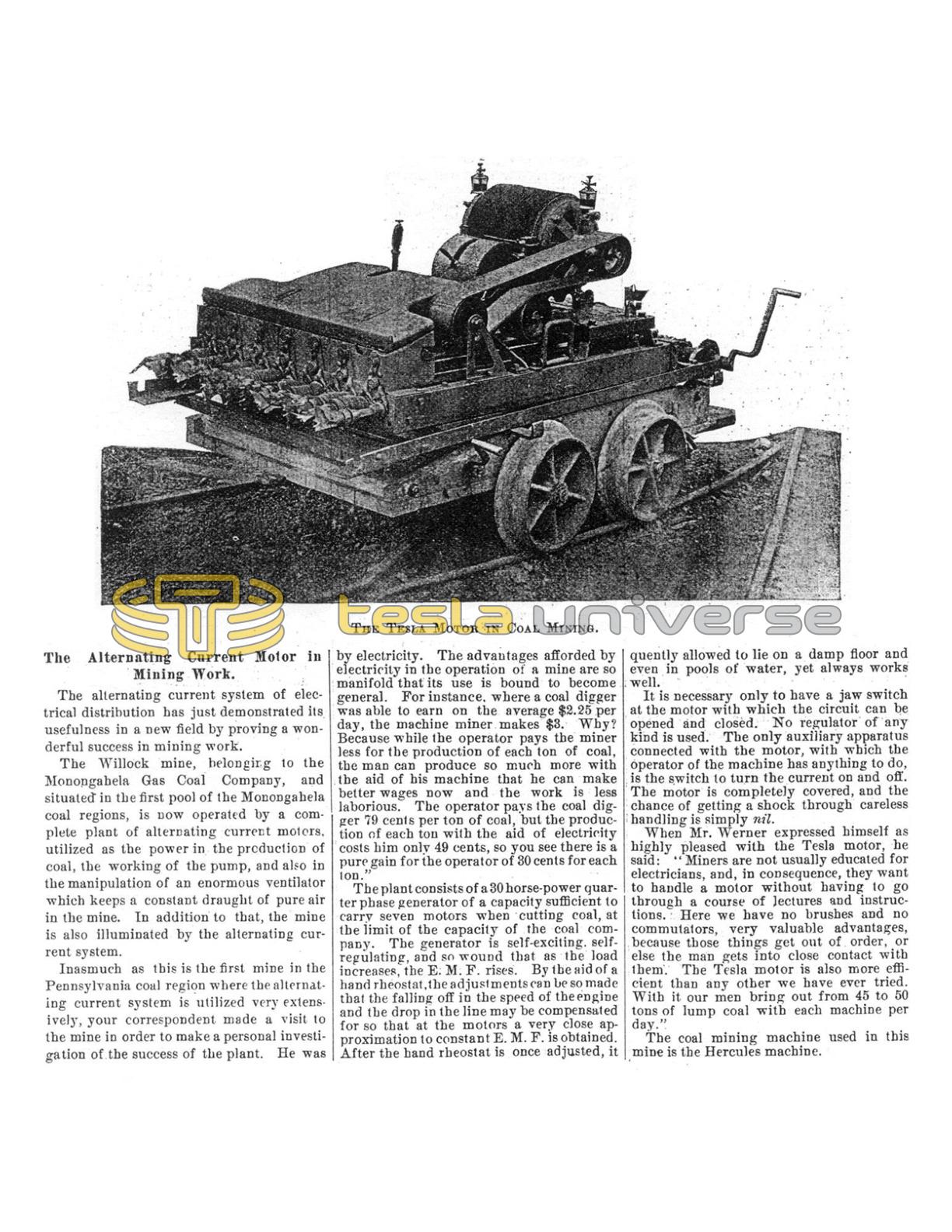
The alternating current system of electrical distribution has just demonstrated its usefulness in a new field by proving a wonderful success in mining work.
The Willock mine, belonging to the Monongahela Gas Coal Company, and situated in the first pool of the Monongahela coal regions, is now operated by a complete plant of alternating current motors, utilized as the power in the production of coal, the working of the pump, and also in the manipulation of an enormous ventilator which keeps a constant draught of pure air in the mine. In addition to that, the mine is also illuminated by the alternating current system.
Inasmuch as this is the first mine in the Pennsylvania coal region where the alternating current system is utilized very extensively, your correspondent made a visit to the mine in order to make a personal investigation of the success of the plant. He was very much aided in his efforts through the courtesy of Mr. John Werner, the mill boss, a man who is himself a mechanical genius of ability. During a conversation with him, he said: "I believe that electric mining has no greater prospects anywhere than just in the coal fields of Pennsylvania. The reasons for this are so many that I hardly know where to commence to enumerate them. Coal mining in Pennsylvania was never such a poor trade as it is now, in fact, it is so bad that a native-born American will have nothing more to do with the work. The result has been that the business has fallen into the hands of foreigners of the very lowest class, such as Hungarians, Poles and Italians. Then again, the price of coal has gone down to such an extent, induced, of course, by competition, that it is impossible to get many intelligent men who will do the work for the small wages a miner is able to make. This condition of affairs caused the coal operators to hail the advent of electricity as a coal miner with great delight, and I believe that it will not be very long before every mine in the country will be operated by electricity. The advantages afforded by electricity in the operation of a mine are so manifold that its use is bound to become general. For instance, where a coal digger was able to earn on the average $2.25 per day, the machine miner makes $3. Why? Because while the operator pays the miner less for the production of each ton of coal, the man can produce so much more with the aid of his machine that he can make better wages now and the work is less laborious. The operator pays the coal digger 79 cents per ton of coal, but the production of each ton with the aid of electricity costs him only 49 cents, so you see there is a pure gain for the operator of 30 cents for each ton."
The plant consists of a 30 horse-power quarter phase generator of a capacity sufficient to carry seven motors when cutting coal, at the limit of the capacity of the coal company. The generator is self-exciting, self-regulating, and so wound that as the load increases, the E. M. F. rises. By the aid of a hand rheostat, the adjustments can be so made that the falling off in the speed of the engine and the drop in the line may be compensated for so that at the motors a very close approximation to constant E. M. F. is obtained. After the hand rheostat is once adjusted, it is unnecessary to make further adjustments, for the self-regulating devices are automatic. Three wires are carried from the collector at the end of the generator shaft to the switchboard, and pass through the switchboard instruments and main line switches directly into the mine. On the switchboard is a direct reading voltmeter and an ammeter. The E. M. F. at the motor is 300 volts.
Where the distances become very great, a higher E. M. F. may, of course, be used. The mine is wired with high class rubber covered wire, and the insulation of each wire is practically continuous from the time the wire leaves the main switch in the power house until it reaches the end of the circuit. At the entrance of each room, and also at convenient points throughout the mine, switches are located and safety catches inserted. This insures safety from short-circuiting, and also allows any portion of the circuit to be cut off from the generator without interfering with the work in other parts of the mine. From the switch in the room to the coal-cutting machine, the current is carried by a three-wire cable. This cable is highly insulated and covered with a protecting braid, which, though frequently allowed to lie on a damp floor and even in pools of water, yet always works well.
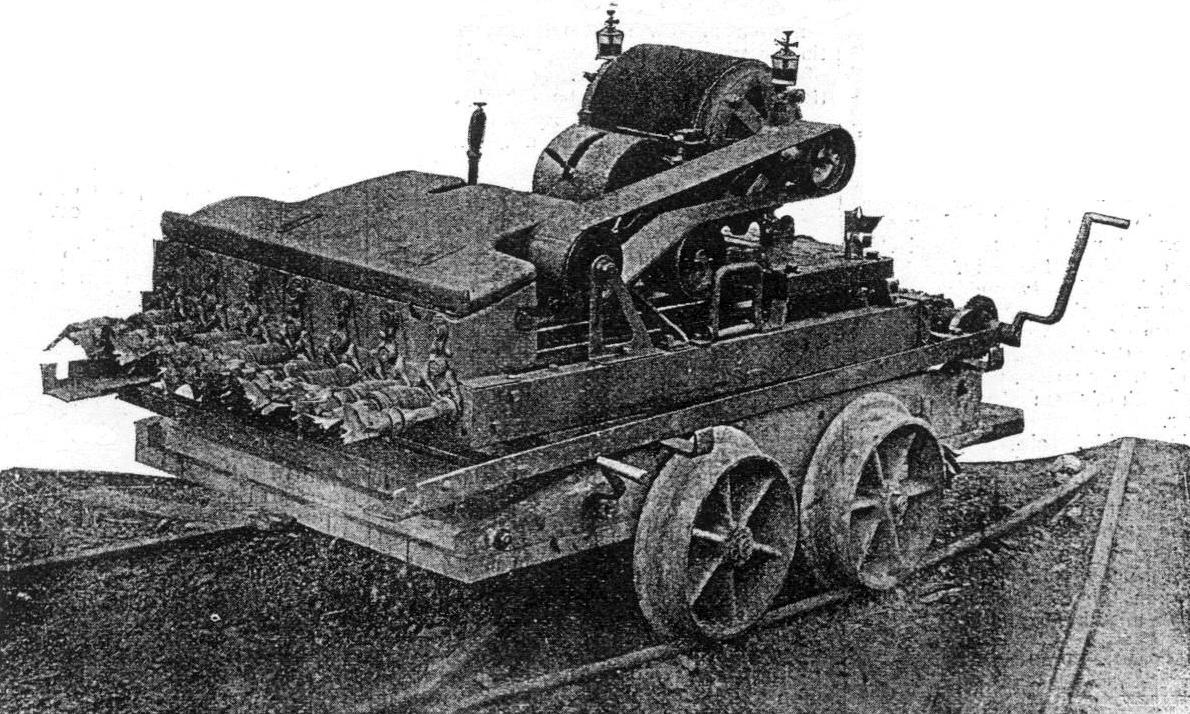
It is necessary only to have a jaw switch at the motor with which the circuit can be opened and closed. No regulator of any kind is used. The only auxiliary apparatus connected with the motor, with which the operator of the machine has anything to do, is the switch to turn the current on and off. The motor is completely covered, and the chance of getting a shock through careless handling is simply nil.
When Mr. Werner expressed himself as highly pleased with the Tesla motor, he said: "Miners are not usually educated for electricians, and, in consequence, they want to handle a motor without having to go through a course of lectures and instructions. Here we have no brushes and no commutators, very valuable advantages, because those things get out of order, or else the man gets into close contact with them. The Tesla motor is also more efficient than any other we have ever tried. With it our men bring out from 45 to 50 tons of lump coal with each machine per day."
The coal mining machine used in this mine is the Hercules machine.