Nikola Tesla Articles
Another Tesla Patent
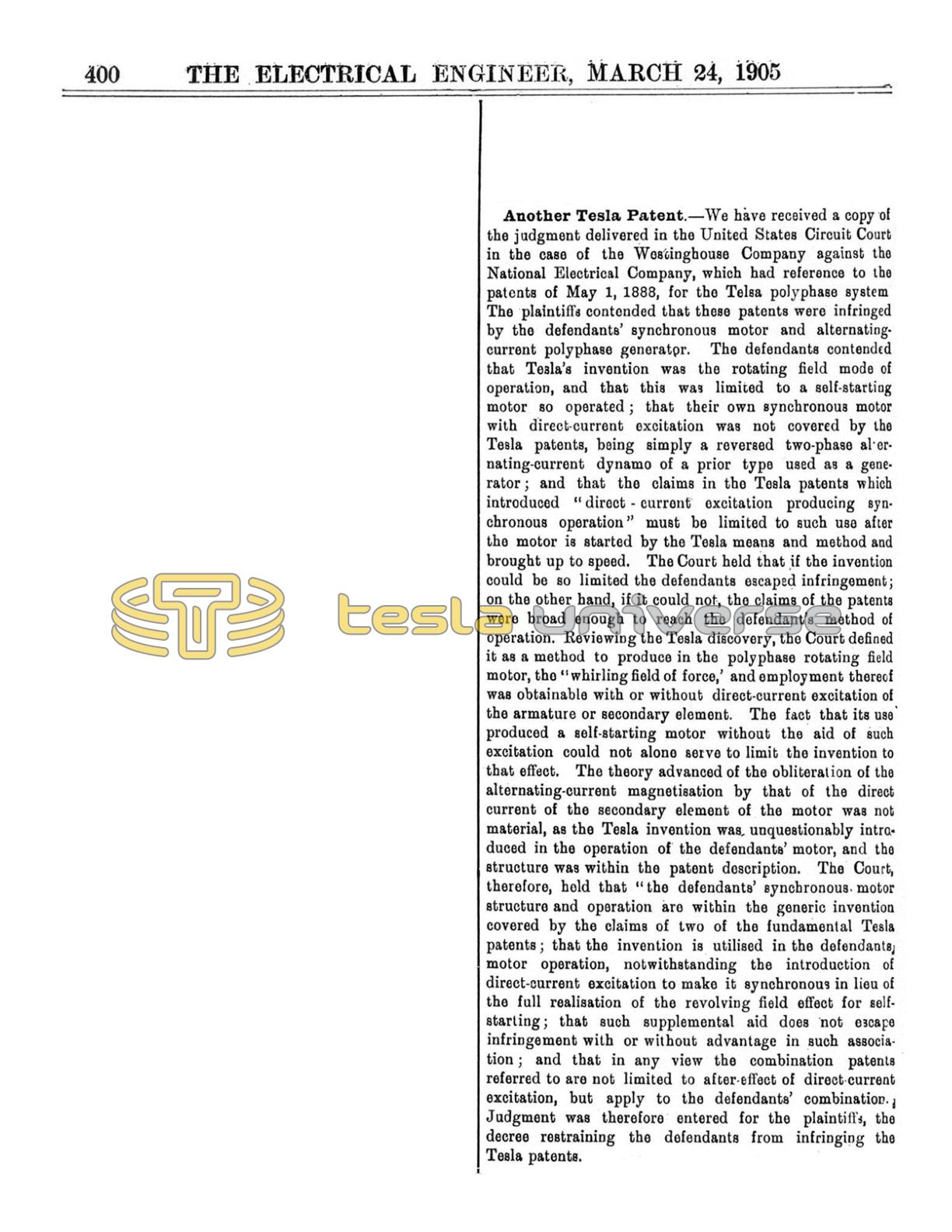
We have received a copy of the judgment delivered in the United States Circuit Court in the case of the Westinghouse Company against the National Electrical Company, which had reference to the patents of May 1, 1888, for the Tesla polyphase system The plaintiffs contended that these patents were infringed by the defendants' synchronous motor and alternating-current polyphase generator. The defendants contended that Tesla's invention was the rotating field mode of operation, and that this was limited to a self-starting motor so operated; that their own synchronous motor with direct current excitation was not covered by the Tesla patents, being simply a reversed two-phase alternating-current dynamo of a prior type used as a generator; and that the claims in the Tesla patents which introduced "direct current excitation producing synchronous operation" must be limited to such use after the motor is started by the Tesla means and method and brought up to speed. The Court held that if the invention could be so limited the defendants escaped infringement; on the other hand, if it could not, the claims of the patents were broad enough to reach the defendant's method of operation. Reviewing the Tesla discovery, the Court defined it as a method to produce in the polyphase rotating field motor, the "whirling field of force," and employment thereof was obtainable with or without direct-current excitation of the armature or secondary element. The fact that its use` produced a self-starting motor without the aid of such excitation could not alone serve to limit the invention to that effect. The theory advanced of the obliteration of the alternating-current magnetisation by that of the direct current of the secondary element of the motor was not material, as the Tesla invention was, unquestionably introduced in the operation of the defendants' motor, and the structure was within the patent description. The Court, therefore, held that "the defendants" synchronous. motor structure and operation are within the generic invention covered by the claims of two of the fundamental Tesla patents; that the invention is utilised in the defendants, motor operation, notwithstanding the introduction of direct-current excitation to make it synchronous in lieu of the full realisation of the revolving field effect for self-starting; that such supplemental aid does not escape infringement with or without advantage in such association; and that in any view the combination patents referred to are not limited to after-effect of direct current excitation, but apply to the defendants' combination. Judgment was therefore entered for the plaintiff's, the decree restraining the defendants from infringing the Tesla patents.