Nikola Tesla Articles
Broadcasting Power
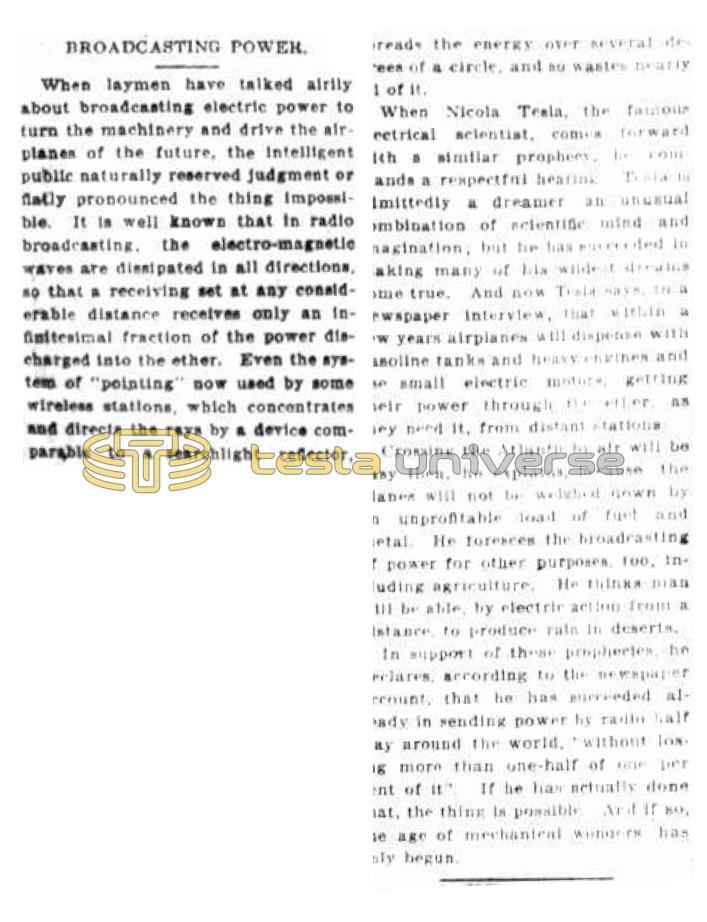
When laymen have talked airily about broadcasting electric power to turn the machinery and drive the airplanes of the future, the intelligent public naturally reserved judgment or flatly pronounced the thing impossible. It is well known that in radio broadcasting, the electro-magnetic waves are dissipated in all directions, so that a receiving set at any considerable distance receives only an infinitesimal fraction of the power discharged into the ether. Even the system of “pointing” now used by some wireless stations, which concentrates and directs the rays by a device comparable to a searchlight reflector, spreads the energy over several degrees of a circle, and so wastes nearly all of it.
When Nicola Tesla, the famous electrical scientist, comes forward with a similar prophecy, he commands a respectful hearing. Tesla is admittedly a dreamer, an unusual combination of scientific mind and imagination, but he has succeeded in making many of his wildest dreams come true. And now Tesla says, in a newspaper interview, that within a few years airplanes will dispense with gasoline tanks and heavy engines and use small electric motors, getting their power through the ether, as they need it, from distant stations.
Crossing the Atlantic by air will be easy then, he explains, because the planes will not be weighed down by an unprofitable load of fuel and metal. He foresees the broadcasting of power for other purposes, too, including agriculture. He thinks man will be able, by electric action from a distance, to produce rain in deserts.
In support of these prophecies, he declares, according to the newspaper account, that he has succeeded already in sending power by radio half way around the world, “without losing more than one-half of one per cent of it.” If he has actually done that, the thing is possible. And if so, the age of mechanical wonders has only begun.