Nikola Tesla Articles
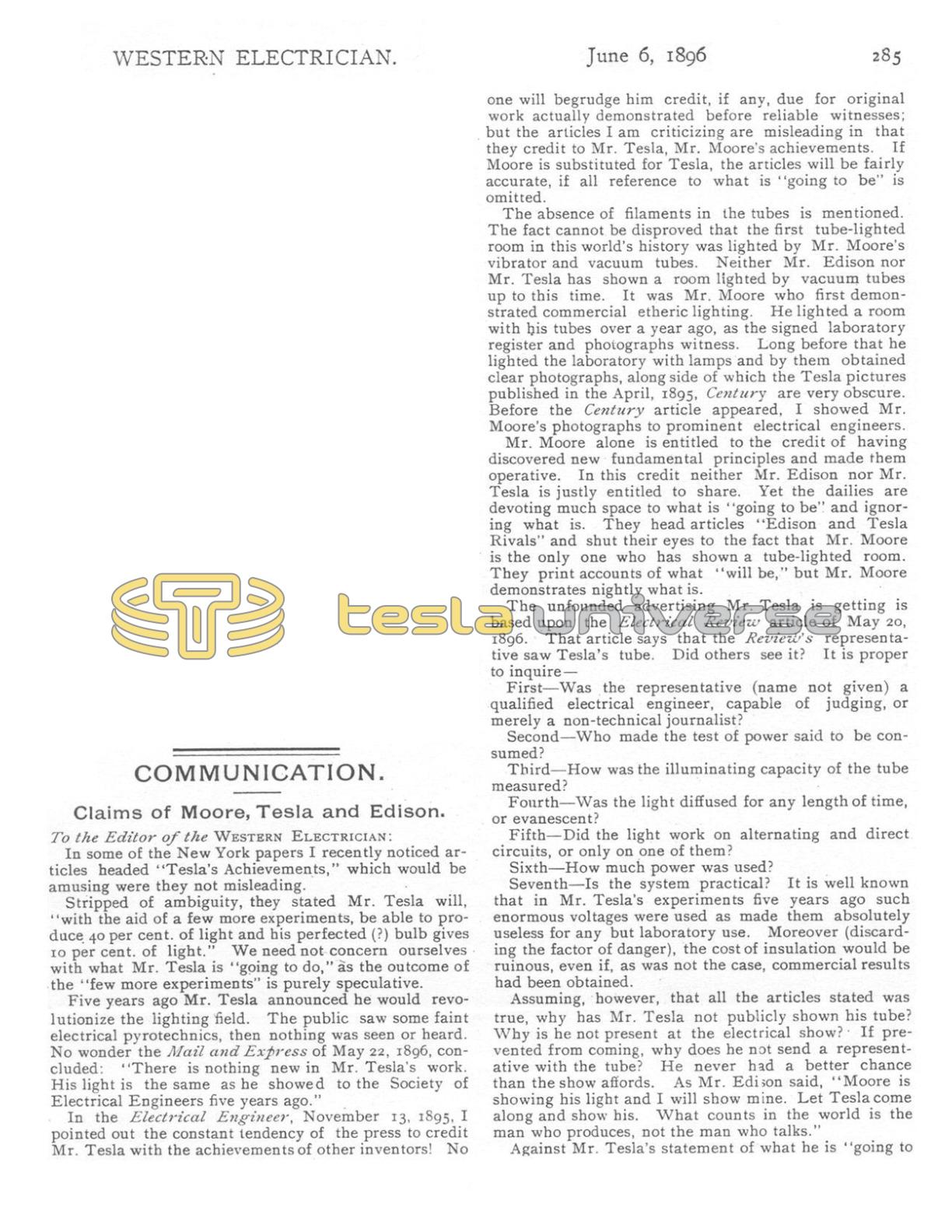
Claims of Moore, Tesla and Edison
To the Editor of the Western Electrician:
In some of the New York papers I recently noticed articles headed "Tesla's Achievements," which would be amusing were they not misleading.
Stripped of ambiguity, they stated Mr. Tesla will, "with the aid of a few more experiments, be able to produce 40 per cent. of light and his perfected (?) bulb gives 10 per cent. of light." We need not concern ourselves with what Mr. Tesla is "going to do," as the outcome of the "few more experiments" is purely speculative.
Five years ago Mr. Tesla announced he would revolutionize the lighting field. The public saw some faint electrical pyrotechnics, then nothing was seen or heard. No wonder the Mail and Express of May 22, 1896, concluded: "There is nothing new in Mr. Tesla's work. His light is the same as he showed to the Society of Electrical Engineers five years ago."
In the Electrical Engineer, November 13, 1895, I pointed out the constant tendency of the press to credit Mr. Tesla with the achievements of other inventors! No one will begrudge him credit, if any, due for original work actually demonstrated before reliable witnesses; but the articles I am criticizing are misleading in that they credit to Mr. Tesla, Mr. Moore's achievements. If Moore is substituted for Tesla, the articles will be fairly accurate, if all reference to what is "going to be" is omitted.
The absence of filaments in the tubes is mentioned. The fact cannot be disproved that the first tube-lighted room in this world's history was lighted by Mr. Moore's vibrator and vacuum tubes. Neither Mr. Edison nor Mr. Tesla has shown a room lighted by vacuum tubes up to this time. It was Mr. Moore who first demonstrated commercial etheric lighting. He lighted a room with his tubes over a year ago, as the signed laboratory register and photographs witness. Long before that he lighted the laboratory with lamps and by them obtained clear photographs, alongside of which the Tesla pictures published in the April, 1895, Century are very obscure. Before the Century article appeared, I showed Mr. Moore's photographs to prominent electrical engineers.
Mr. Moore alone is entitled to the credit of having discovered new fundamental principles and made them operative. In this credit neither Mr. Edison nor Mr. Tesla is justly entitled to share. Yet the dailies are devoting much space to what is "going to be" and ignoring what is. They head articles "Edison and Tesla Rivals" and shut their eyes to the fact that Mr. Moore is the only one who has shown a tube-lighted room. They print accounts of what "will be," but Mr. Moore demonstrates nightly what is.
The unfounded advertising Mr. Tesla is getting is based upon the Electrical Review article of May 20, 1896. That article says that the Review's representative saw Tesla's tube. Did others see it? It is proper to inquire —
First — Was the representative (name not given) a qualified electrical engineer, capable of judging, or merely a non-technical journalist?
Second — Who made the test of power said to be consumed?
Third — How was the illuminating capacity of the tube measured?
Fourth — Was the light diffused for any length of time, or evanescent?
Fifth — Did the light work on alternating and direct circuits, or only on one of them?
Sixth — How much power was used?
Seventh — Is the system practical? It is well known that in Mr. Tesla's experiments five years ago such enormous voltages were used as made them absolutely useless for any but laboratory use. Moreover (discarding the factor of danger), the cost of insulation would be ruinous, even if, as was not the case, commercial results had been obtained.
Assuming, however, that all the articles stated was true, why has Mr. Tesla not publicly shown his tube? Why is he not present at the electrical show? If prevented from coming, why does he not send a representative with the tube? He never had a better chance than the show affords. As Mr. Edison said, "Moore is showing his light and I will show mine. Let Tesla come along and show his. What counts in the world is the man who produces, not the man who talks."
Against Mr. Tesla's statement of what he is "going to do," the discriminating electrical public will place what Mr. Moore actually did and is doing. Mr. Tesla lectured in 1891 and has shown absolutely nothing since. Mr. Moore's record follows:
1891. Mr. Moore claimed he could produce better results than Mr. Tesla showed in his lecture.
1893, Sept. 20. Mr. Moore read his paper before the American Institute of Electrical Engineers on "A New Method for the Control of Electric Energy." Discussion followed, and the paper was printed in the Institute's Transactions.
1894, April 1. Mr. Moore showed fine photographs from unretouched negatives taken by his lamps.
1894, July. Mr. Moore's article on "The Light of the Future" appeared in Cassier's Magazine, nine months ahead of the Tesla (Century) article.
1895, May. Mr. Moore lighted a room in his laboratory with vacuum tubes for the first time in history.
1895, December. Mr. Moore was photographed by his tubes and a full-page reproduction appeared in the Electrical Engineer, New York, the Electrical Review, London, and elsewhere.
1896, April 22. Mr. Moore lectured before the American Institute of Electrical Engineers on "Recent Developments in Vacuum Tube Lighting," and showed many forms of lamps and tubes, closing by lighting the hall with 27 vacuum tubes. The photograph of the hall, taken by those tubes after a five-minute exposure, from an unretouched negative, appeared in the Electrical Engineer on May 5, 1896.
1896, May 4. Mr. Moore lighted up Governor Morton by a frame of seven feet six inch tubes as he opened the electrical exposition, and showed the signs "N. E. L. A." and "Let There Be Light" above Governor's Morton's head.
1896, May 6. Mr. Moore lectured under the auspices of the National Electric Light association (President Wilmerding presiding) and lighted the stage with his vacuum tubes.
1896, May 16. Mr. Moore lighted his tubes in the form of flying arrows, and kept them lighted while Dr. Depew made his speech.
1896, May 20. Mr. Moore participated in the American Institute of Electrical Engineers' discussion of his paper, and, by exhibiting his apparatus and tubes, more than proved his claims. He scored a great victory, and the parties who, before making the tests, had denied his claims, admitted Mr. Moore was right and they were wrong.
1896, May 4 and every weekday to date. Mr. Moore's chamber of light has been visited by thousands, who have seen and wondered at his artificial daylight. They make an unimpeachable crowd of witnesses to the great simplicity and inexpensiveness of his apparatus and its low voltage.
Is it not singular (to say the least) that only after Mr. Moore made this unimpeachable record did newspaper articles appear, stating what Messrs. Edison and Tesla were "going to do."
Yet many of the dailies are silent about Mr. Moore, and even the lecture he delivered at the request of the National Electric Light association was only referred to by one of the electrical journals, although the hall was filled with a thousand delegates and others. President Wilmerding held one of the tubes and showed the induction effects when Mr. Moore lighted the stage.
Mr. Moore's demonstrations have greater historic value than press effusions, and these demonstrations cannot be ignored.
Mr. Moore is most willing to continue his public demonstrations after the electrical show closes. Will Mr. Tesla show his tubes at the same time? Let instruments be used by competent electrical experts. Then let the results of the competitive test be published authoritatively. The public will always prefer actual achievements to speculative theories.
The Goebel litigation showed conclusively the unwisdom of allowing incorrect statements to go unrefuted when made. This is one of my reasons for writing this letter. If further argument be needed to demonstrate that Mr. Moore was absolutely first in the vacuum tube lighting field (ahead of Messrs. Edison and Tesla) it will be found in the fact that he secured in the last three years some 20 patents for his inventions in vacuum tube lighting, and further, that a number of his applications are awaiting action in the Patent Office. At no time were there any "references" to Edison or Tesla, and the patents were only issued after Mr. Moore had gone to Washington, set up a miniature laboratory in the United States Patent Office, and proved to the examiners that they were wrong when they originally wrote "each of the claims therefore must be denied on the ground of inoperativeness." Although the examiners said his system would not work by any known law, Mr. Moore proved that it did work, came off a victor at all points and received his patents.
The editor of the Electrical Review saw Mr. Moore's laboratory lighted by vacuum tubes in 1894 and was photographed at that time by the light of the tubes. On the day the Review published the Tesla article, Mr. Moore appeared before the American Institute of Electrical Engineers and submitted his apparatus for tests.
The result of the tests made by such men as Prof. W. A. Anthony, Prof. Nichols of Cornell, Nelson W. Perry and others proved that Mr. Moore had understated rather than overstated, his claims. Let Mr. Tesla produce his tube, face the same searchlight, and if he passes muster, he will get all the credit really due him.
No matter what Mr. Edison, Mr. Tesla or anyone else may produce, the fact remains that to D. MacFarlan Moore alone belongs the credit of first having produced commercial light by means of vacuum tubes.
It is largely to put this fact indisputably on record that I have written this letter.
EDWARD J. WESSELS,
President Moore Electrical company.
Newark, N. J., May 25, 1896.