Nikola Tesla Articles
Editorial on Tesla's Lectures
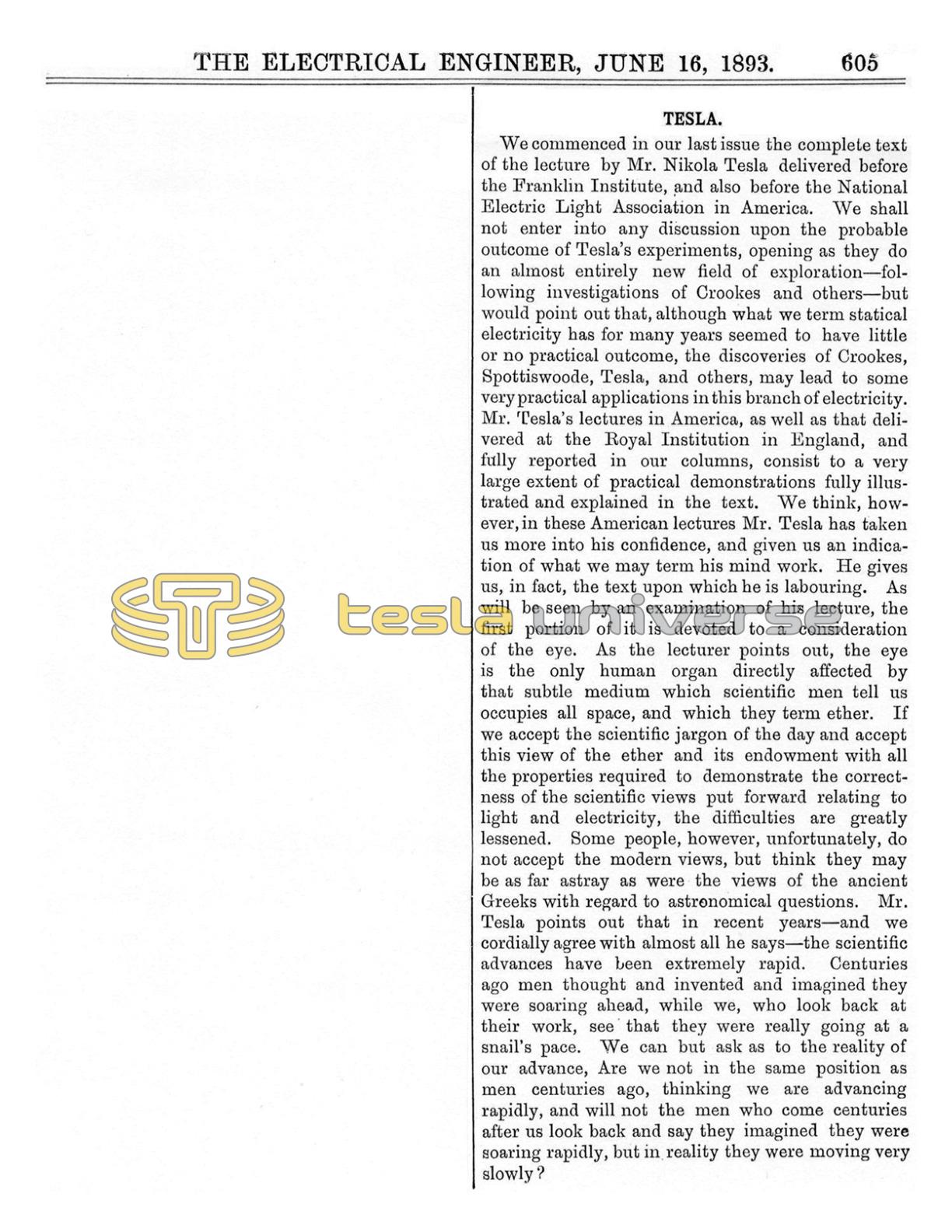
We commenced in our last issue the complete text of the lecture by Mr. Nikola Tesla delivered before the Franklin Institute, and also before the National Electric Light Association in America. We shall not enter into any discussion upon the probable outcome of Tesla's experiments, opening as they do an almost entirely new field of exploration — following investigations of Crookes and others-but would point out that, although what we term statical electricity has for many years seemed to have little or no practical outcome, the discoveries of Crookes, Spottiswoode, Tesla, and others, may lead to some very practical applications in this branch of electricity. Mr. Tesla's lectures in America, as well as that delivered at the Royal Institution in England, and fully reported in our columns, consist to a very large extent of practical demonstrations fully illustrated and explained in the text. We think, however, in these American lectures Mr. Tesla has taken us more into his confidence, and given us an indication of what we may term his mind work. He gives us, in fact, the text upon which he is labouring. As will be seen by an examination of his lecture, the first portion of it is devoted to a consideration of the eye. As the lecturer points out, the eye is the only human organ directly affected by that subtle medium which scientific men tell us occupies all space, and which they term ether. If we accept the scientific jargon of the day and accept this view of the ether and its endowment with all the properties required to demonstrate the correctness of the scientific views put forward relating to light and electricity, the difficulties are greatly lessened. Some people, however, unfortunately, do not accept the modern views, but think they may be as far astray as were the views of the ancient Greeks with regard to astronomical questions. Mr. Tesla points out that in recent years — and we cordially agree with almost all he says-the scientific advances have been extremely rapid. Centuries ago men thought and invented and imagined they were soaring ahead, while we, who look back at their work, see that they were really going at a snail's pace. We can but ask as to the reality of our advance, Are we not in the same position as men centuries ago, thinking we are advancing rapidly, and will not the men who come centuries after us look back and say they imagined they were soaring rapidly, but in reality they were moving very slowly?
But whatever may be the criticism upon the text which is causing Mr. Tesla to work, there can be but one view in regard to the energy he has thrown into his investigations and the wonderful facility which he seems to possess of looking into the very nature of these mysterious phenomena. According to the existing scientific view, electromagnetic phenomena are manifestations of energy which is supposed to be of the same class as those of radiant heat and light — that is, manifestations of energy through the medium of the ether. Our present knowledge leads the author of these lectures to look far ahead, and to point out that "the day when we shall know what electricity is, will chronicle an event probably greater and more important than any other recorded in the history of the human race. The time will come when the comfort, the very existence, perhaps, of man, will depend upon that wonderful agent." The author goes on to point out that when our coalfields are exhausted and our forests have disappeared, one thing will remain, according to our present knowledge — that is, to transmit power at great distances. Men will go to where Nature provides the power; they will harness the waterfalls, and transmit the energy from the points where Nature provides it to the points where they require it. Habitations and factories at a distance of hundreds — perhaps thousands — of miles may be supplied with heat, light, and energy, according to the requirements, from the centres which Nature provides. Such, we take it, is the text which has induced Mr. Tesla to work, and which he describes in the earlier part of his lecture.
The remaining part is descriptive of apparatus and experiments-experiments of the most ingenious and convincing character, giving results which must appeal in the strongest manner to everyone engaged in industrial operations, indicating, as they do, a new sphere of industrial activity. Mr. Tesla, like all real workers, is extremely modest as regards his achievements, but we cannot allow without protest these results to be considered as insignificant — the term he gives to them; and we think our readers will agree with us, when they have read the whole of his lecture, that far from being insignificant they are of the greatest significance, and that even in the short interval which has elapsed since his lecture in England and his lecture in America, considerable progress has been made in the direction in which he has devoted his attention.