Nikola Tesla Articles
Electric Lamps
Fed from Space, and Flames That Do Not Consume
The honors in electrical discovery and invention have hitherto been pretty evenly divided among the nations, but of late America has bid fair to leave little for the rest of the world to own or cultivate in this wonderful vided among the nations, but of late America has bid fair to leave little for the rest of the world to own or cultivate in this wonderful new domain of the arts and sciences. The modern telegraph is largely American. The telephone is wholly so. The great successful systems of electric light and power bear American names, and now American methods of operating electric railroads have begun to go around the globe, conquering and to conquer.
Columbia College a few weeks ago gave a remarkable exemplification of this significant state of affairs when, in the presence of an enthusiastic gathering of the foremost electrical talent of the country, a modest young Likan, Nikola Tesla by name, delivered a lecture in English on his discoveries of results with alternating currents of high frequency. At one bound he placed himself abreast of such men as Edison, Brush, Elihu Thomson, and Alexander Graham Bell. Yet only four or five years ago, after a period of struggle in France, this stripling from the dim mountain border-land of Austro-Hungary landed on our shores, entirely unknown, and poor in everything save genius and training, and courage inherited from many a chieftain who shed his blood in the ceaseless warfare with the unspeakable Turk. Work and recognition came slowly, but they came; and it needed simply that he should fall in the way of Mr. George Westinghouse, Jun., to have some of his earliest inventions here appreciated. Those inventions, dealing as they do with the difficult problems of the utilization of alternating currents for motive power, are in themselves fundamental and far-reaching; but Mr. Tesla has now utterly eclipsed them by his experiments and methods for obtaining the electric light electrostatically. In a word, his lecture at Columbia - which merely as a rhetorical performance touched on the marvellous, as coming from a foreigner, by its lucid explanations in pure, nervous English of subtle ideas and obscure phenomena - showed two things very clearly. It showed not only that he had gone far beyond the two distinguished European scientists Dr. Lodge and Professor Hertz in grasp of the electro magnetic theory of light, but that he had actually made apparatus by which electrostatic waves or "thrusts" would give light for ordinary every-day uses.
On the occasion of this memorable lecture Mr. Tesla held his audience in complete captivity of attention and admiration for over three hours. Since that time the mere report of the nature of his experiments has aroused the intensest curiosity in Europe, and the full text of his lecture, of which this article affords but suggestive outline, is awaited there most anxiously. It is felt by all who are conversant with the subject that the point of new departure in all our work for introducing electricity universally as a means of interior illumination must be taken from the revelations at Columbia. There is given us, moreover, many a fascinating glimpse of facts and truths still in the background.
The transition from the tallow dip to the candle and the oil lamp marked one stage in the march of improvement, which, passing on to the introduction of gas, has, in our day, reached the high form of development exhibited in the little incandescent lamp of 16-candle-power, and the powerful arc lamp ranging up to 100,000-candle-power and more, and sending its beams from the light-house, in some instances, as far as 60 miles. We have characterized the present electrical methods as highly developed forms of illumination, and so they are, compared with those which have gone before; but Mr. Tesla's discoveries leave no room for doubt that before long we shall see further improvements, which cannot fail to have a marked influence on the methods which will be adopted in the future. The faint glow exhibited in the Geissler tube, which has for a long time constituted one of the stock experiments of every lecturer on physics, has frequently been suggested as one of the methods by which we could obtain the ideal form of illumination - light without heat. Experiments in this direction had, however, led to very little, and even the remarkable experiments of Professor Crookes on radiant matter, which will be fresh in the minds of many, and which were first brought out nearly twenty years ago, led us no nearer the desired goal. More recent experimenters, among them Dr. Hertz and Dr. Lodge, had struck out in a line which promised good results; but it has remained for Mr. Tesla to crystallize and define the methods and the apparatus by which, in all probability, the difficult problem will be solved.
Before entering into a description of Mr. Tesla's methods it will be well to explain in brief the steps which have led to the results which we are now about to consider. He began by taking what is known as an induction or spark coil, capable of generating electric sparks similar to those which we are all familiar with in connection with the static frictional electric machine, and which is described in every school-book on physics. These spark coils have heretofore been operated by means of currents which were periodically interrupted only a few times per second, or by what are called alternating currents, such as those largely used in our present forms of electric lighting, and which vibrate or alternate from 100 to 200 times a second. Mr. Tesla reasoned that if we could increase the number of vibrations or alternations in the current far above the number just mentioned, we would obtain greatly increased effects, and for this purpose he constructed a machine which gave him no less than 20,000 alternations per second. A few experiments convinced him that his theory was correct. The character of the spark or electrical discharge between the knobs connected to the coil operated with currents of this nature exhibited qualities quite different from those heretofore observed. In fact, as the alternations are increased, no less than five distinct kinds of discharge may be noticed, beginning with a thin thread-like discharge, until finally the character of the discharge is changed to that of a hot flame issuing from the discharge knob.
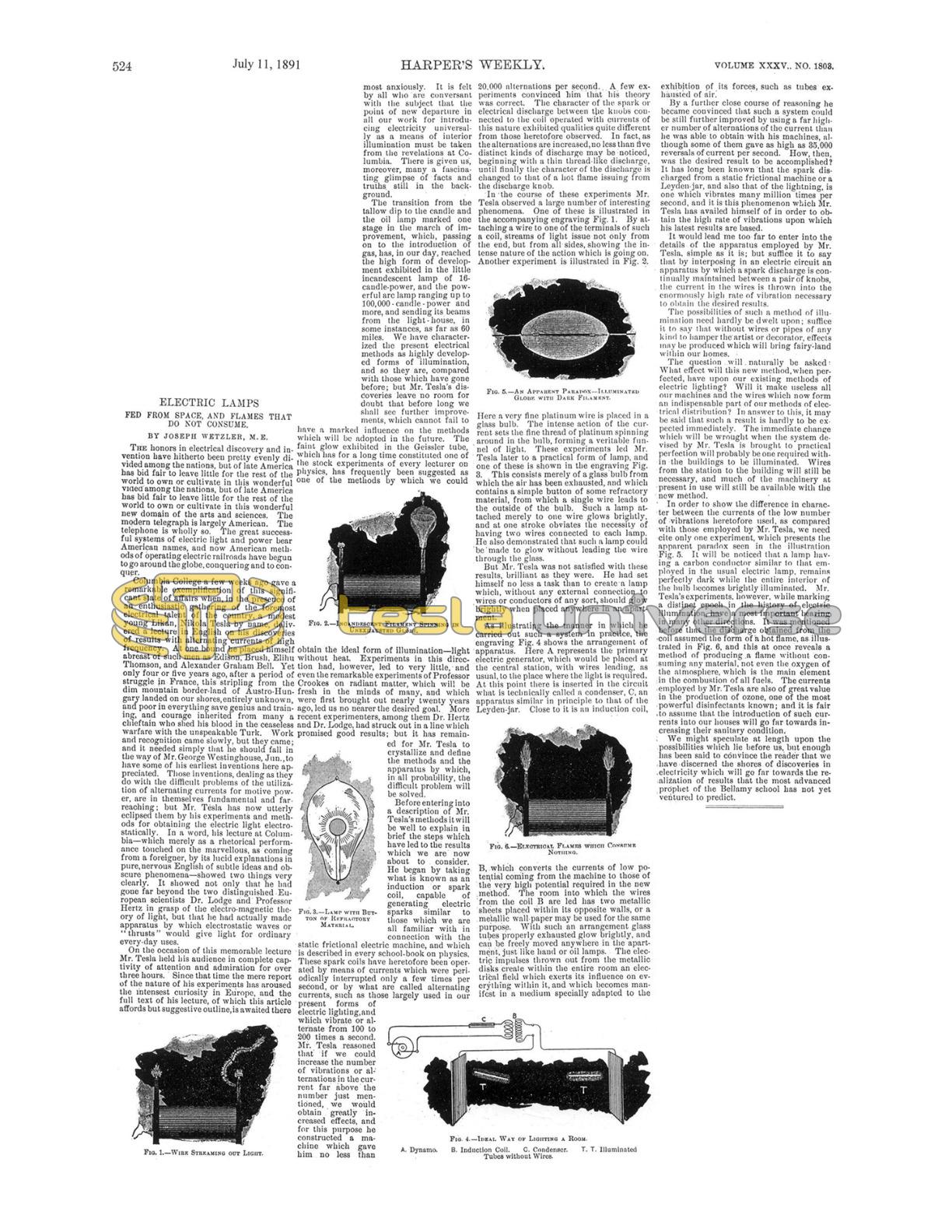
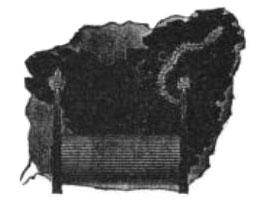
In the course of these experiments Mr. Tesla observed a large number of interesting phenomena. One of these is illustrated in the accompanying engraving Fig. 1. By attaching a wire to one of the terminals of such a coil, streams of light issue not only from the end, but from all sides, showing the intense nature of the action which is going on. Another experiment is illustrated in Fig. 2.
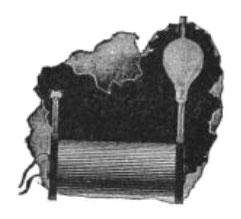
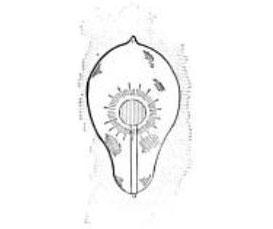
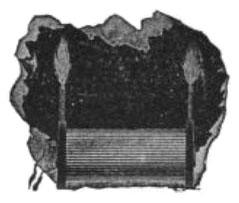
Here a very fine platinum wire is placed in a glass bulb. The intense action of the current sets the fine thread of platinum spinning around in the bulb, forming a veritable funnel of light. These experiments led Mr. Tesla later to a practical form of lamp, and one of these is shown in the engraving Fig. 3. This consists merely of a glass bulb from which the air has been exhausted, and which contains a simple button of some refractory material, from which a single wire leads to the outside of the bulb. Such a lamp attached merely to one wire glows brightly, and at one stroke obviates the necessity of having two wires connected to each lamp. He also demonstrated that such a lamp could be made to glow without leading the wire through the glass.
But Mr. Tesla was not satisfied with these results, brilliant as they were. He had set himself no less a task than to create a lamp which, without any external connection to wires or conductors of any sort, should glow brightly when placed anywhere in an apartment.
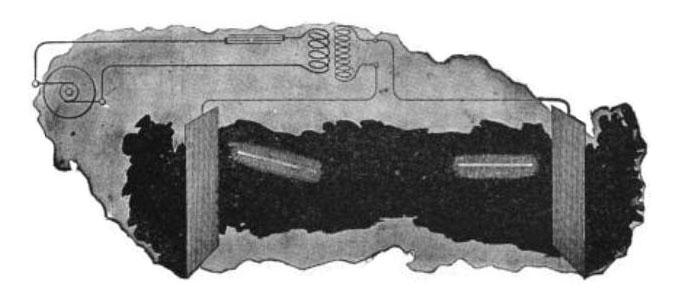
As illustrating the manner in which he carried out such a system in practice, the engraving Fig. 4 shows the arrangement of apparatus. Here A represents the primary electric generator, which would be placed at the central station, with wires leading, as usual, to the place where the light is required. At this point there is inserted in the circuit what is technically called a condenser, C, an apparatus similar in principle to that of the Leyden-jar. Close to it is an induction coil, B, which converts the currents of low potential coming from the machine to those of the very high potential required in the new method. The room into which the wires from the coil B are led has two metallic sheets placed within its opposite walls, or a metallic wall paper may be used for the same purpose. With such an arrangement glass tubes properly exhausted glow brightly, and can be freely moved anywhere in the apartment, just like hand or oil lamps. The electric impulses thrown out from the metallic disks create within the entire room an electrical field which exerts its influence on everything within it, and which becomes manifest in a medium specially adapted to the exhibition of its forces, such as tubes exhausted of air.
By a further close course of reasoning he became convinced that such a system could be still further improved by using a far higher number of alternations of the current than he was able to obtain with his machines, although some of them gave as high as 35,000 reversals of current per second. How, then, was the desired result to be accomplished? It has long been known that the spark discharged from a static frictional machine or a Leyden-jar, and also that of the lightning, is one which vibrates many million times per second, and it is this phenomenon which Mr. Tesla has availed himself of in order to obtain the high rate of vibrations upon which his latest results are based.
It would lead me too far to enter into the details of the apparatus employed by Mr. Tesla, simple as it is; but suffice it to say that by interposing in an electric circuit an apparatus by which a spark discharge is continually maintained between a pair of knobs, the current in the wires is thrown into the enormously high rate of vibration necessary to obtain the desired results.
The possibilities of such a method of illumination need hardly be dwelt upon; suffice is to say that without wires or pipes of any kind to hamper the artist or decorator, effects may be produced which will bring fairy-land within our homes.
The question will naturally be asked: What effect will this new method, when perfected, have upon our existing methods of electric lighting? Will it make useless all our machines and the wires which now form an indispensable part of our methods of electrical distribution? In answer to this, it may be said that such a result is hardly to be expected immediately. The immediate change which will be wrought when the system devised by Mr. Tesla is brought to practical perfection will probably be one required within the buildings to be illuminated. Wires from the station to the building will still be necessary, and much of the machinery at present in use will still be available with the new method.
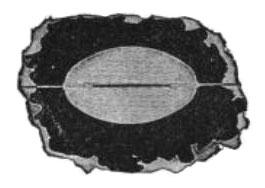
In order to show the difference in character between the currents of the low number of vibrations heretofore used, as compared with those employed by Mr. Tesla, we need cite only one experiment, which presents the apparent paradox seen in the illustration Fig. 5. It will be noticed that a lamp having a carbon conductor similar to that employed in the usual electric lamp, remains perfectly dark while the entire interior of the bulb becomes brightly illuminated. Mr. Tesla's experiments, however, while marking a distinct epoch in the history of electric illumination, have a most important bearing in many other directions. It was mentioned before that the discharge obtained from the coil assumed the form of a hot flame, as illustrated in Fig. 6, and this at once reveals a method of producing a flame without consuming any material, not even the oxygen of the atmosphere, which is the main element in the combustion of all fuels. The currents employed by Mr. Tesla are also of great value in the production of ozone, one of the most powerful disinfectants known; and it is fair to assume that the introduction of such currents into our houses will go far towards increasing their sanitary condition.
We might speculate at length upon the possibilities which lie before us, but enough has been said to convince the reader that we have discerned the shores of discoveries in electricity which will go far towards the realisation of results that the most advanced prophet of the Bellamy school has not yet ventured to predict.