
Nikola Tesla Articles
Experiments on Induction Coil Condensers
The following experiments were made to determine the relation between an induction coil and its condenser.
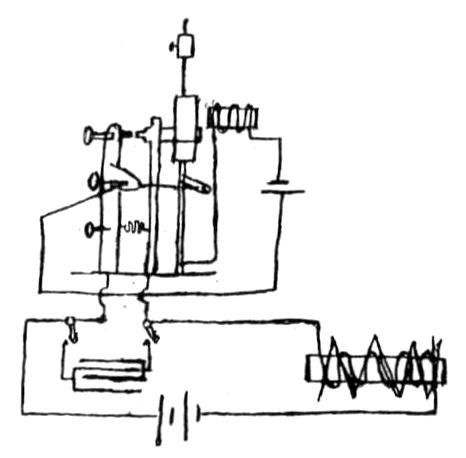
The apparatus used consists of an induction coil and a separate interrupter with a condenser in its base, so arranged with a separate contact that the breaks were made entirely independent of the battery strength passing into the induction coil, a separate cell of battery being used to run the interrupter. The separate interrupter has switches arranged to throw in or out of use the condenser connected to it. The induction coil has an interrupter and condenser of its own, but in making these experiments its interrupter was locked so it could not move, and, of consequence, its condenser was out of use.
I tried the arrangement as described above, and found I obtained from the secondary of the coil fair and vigorous sparks when the interrupter was in use, and the sparks at break of the primary were very small. On throwing out of use the condenser, I found exactly the opposite; the sparks from the secondary were very minute, and the sparks at the break of the primary were largo and bright. I attached in the circuit of the secondary a Leyden jar in shunt with the spark gap, and then, after removing the jar, I attached a Tesla coil. In both cases the condenser was without any effect; the electrical energy received being the same whether the condenser was in or out of use.
I also attached a double cathode Crookes tube to the Tesla coil, and failed to distinguish from the light received in a fluoroscope whether the condenser was in or out of use.
I attached several very sensitive Geissler tubes, one at a time, and examined the anodes and cathodes, striæ, and intensity of the light obtained. I failed to discover any difference in any respect, whether the condenser was in or out of use. It is evident that if there are any discharges at make of interrupter, they are not affected by the condenser being in use; neither has the condenser any influence on the striæ, nor the intensity of light obtained.
I now come to experiments where I found a difference in the phenomena. I attached to the secondary of the coil a Geissler tube made of six feet of glass tubing one-quarter of an inch in diameter, wound into a spiral of five and one-half inches of diameter; there being no bulbs around the electrodes; of consequence the discharges were confined to rather small spaces. The tube is inclined to be refractory to quite small discharges. I have found sparks too small to light it up fully.
With this tube I discovered a slight difference in the light attained, but not in the striæ or the anode and cathode. I, as a last test, attached two Crookes tubes. The first used would not receive the discharges when the condenser was out of use, nothing appearing but a faint glow, which I attributed principally to the discharges from the electro-static field surrounding the connections of the tube.
The other tube contains a lower vacuum, it being more suitable for a static machine, but with a spark-gap in series with the tube and coil, it gives X rays of considerable strength when the spark-gap is at its full length to hold the sparks, the X rays varying in strength with the length of spark-gap. This tube lighted up brightly with condenser out of use, but on opening a spark-gap in series I had, in a manner, no spark and the lights disappeared. My deductions from the above experiments are that the condenser destroys the spark at break of the primary, which is necessary to preserve the platinum points and makes the spark in the secondary. If the arrangement used does not require a spark larger than the one obtained without condensers to break across an air space, the condenser is entirely without effect in the results obtained. Where an airspace has to be crossed the spark must be of sufficient length to pass it or there will be no discharge. I have noticed, sometimes, that in experimenting with Crookes tubes and a fluoroscope there would be a sudden dark space, a discharge having failed to pass, and I also noticed at such failures the spark at the break of primary was very bright.
From the above experiments, I think the cause of the dark spaces is fully explained. The extra discharges at break do not pass into the condenser; the dark discharges are the same as if there was no condenser in use. With Geissler tubes, that are sensitive, there are no dark spaces seen.
I will now give an experiment somewhat different from the above, hoping I will be pardoned for the digression. I have often noticed that when an interrupter, attached to the core of an induction coil, was in operation, and a spark-gap was in circuit with the secondary of the coil, that if the spark-gap was closed, or very nearly so, there was an interference of some nature with the running of the interrupter. I energized a coil from an exceedingly weak cell of battery, and found that the interrupter would run as long as the spark-gap was well open, but as soon as closed the interrupter would stop.
I do not propose to theorize concerning it; I only give it as a peculiar experiment. I depend upon experiments almost entirely for my information, believing they are the only reliable criteria.
If my experiments are of any benefit, my object in publishing them has been obtained.
