Nikola Tesla Articles
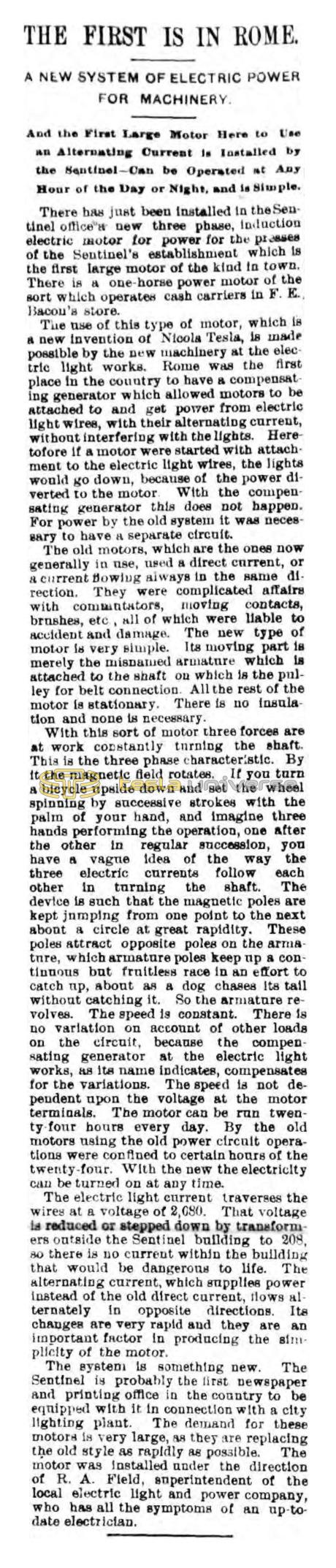
The First is in Rome
A NEW SYSTEM OF ELECTRIC POWER FOR MACHINERY.
And the First Large Motor Here to Use an Alternating Current is Installed by the Sentinel — Can be Operated at Any Hour of the Day or Night, and is Simple.
There has just been installed in the Sentinel office's new three phase, induction electric motor for power for the presses of the Sentinel's establishment which is the first large motor of the kind in town. There is a one-horse power motor of the sort which operates cash carriers in F. E. Bacon's store.
The use of this type of motor, which is a new invention of Nikola Tesla, is made possible by the new machinery at the electric light works. Rome was the first place in the country to have a compensating generator which allowed motors to be attached to and get power from electric light wires, with their alternating current, without interfering with the lights. Heretofore if a motor were started with attachment to the electric light wires, the lights would go down, because of the power diverted to the motor. With the compensating generator this does not happen. For power by the old system it was necessary to have a separate círcuít.
The old motors, which are the ones now generally in use, used a direct current, or a current flowing always in the same direction. They were complicated affairs with comantators, moving contacts, brushes, etc, all of which were liable to accident and damage. The new type of motor is very simple. Its moving part is merely the misnamed armature which is attached to the shaft on which is the pulley for belt connection. All the rest of the motor is stationary. There is no insulation and none is necessary.
With this sort of motor three forces are at work constantly turning the shaft. This is the three phase characterístic. By it the magnetic field rotates. If you turn a bicycle upside down and set the wheel spinning by successive strokes with the palm of your hand, and imagine three hands performing the operation, one after the other in regular succession, you have a vague idea of the way the three electric currents follow each other in turning the shaft. The device is such that the magnetic poles are kept jumping from one point to the next about a circle at great rapidity. These poles attract opposite poles on the armature, which armature poles keep up a continuous but fruitless race in an effort to catch up, about as a dog chases Its tail without catching it. So the armature revolves. The speed is constant. There is no variation on account of other loads on the circuit, because the compensating generator at the electric light works, as its name indicates, compensates for the variations. The speed is not dependent upon the voltage at the motor terminals. The motor can be run twenty-four hours every day. By the old motors using the old power circuit operations were confined to certain hours of the twenty-four. With the new the electricity can be turned on at any time.
The electric light current traverses the wires at a voltage of 2,080. That voltage is reduced or stepped down by transformers outside the Sentinel building to 208, so there is no current within the building that would be dangerous to life. The alternating current, which supplies power instead of the old direct current, flows alternately in opposite directions. Its changes are very rapid and they are an important factor in producing the simplicity of the motor.
The system is something new. The Sentinel is probably the first newspaper and printing office in the country to be equipped with it in connection with a city lighting plant. The demand for these motors is very large, as they are replacing the old style as rapidly as possible. The motor was installed under the direction of R. A. Field, superintendent of the local electric light and power company, who has all the symptoms of an up-to-date electrician.