Nikola Tesla Articles
The Genius and Imaginative Mind of Nikola Tesla
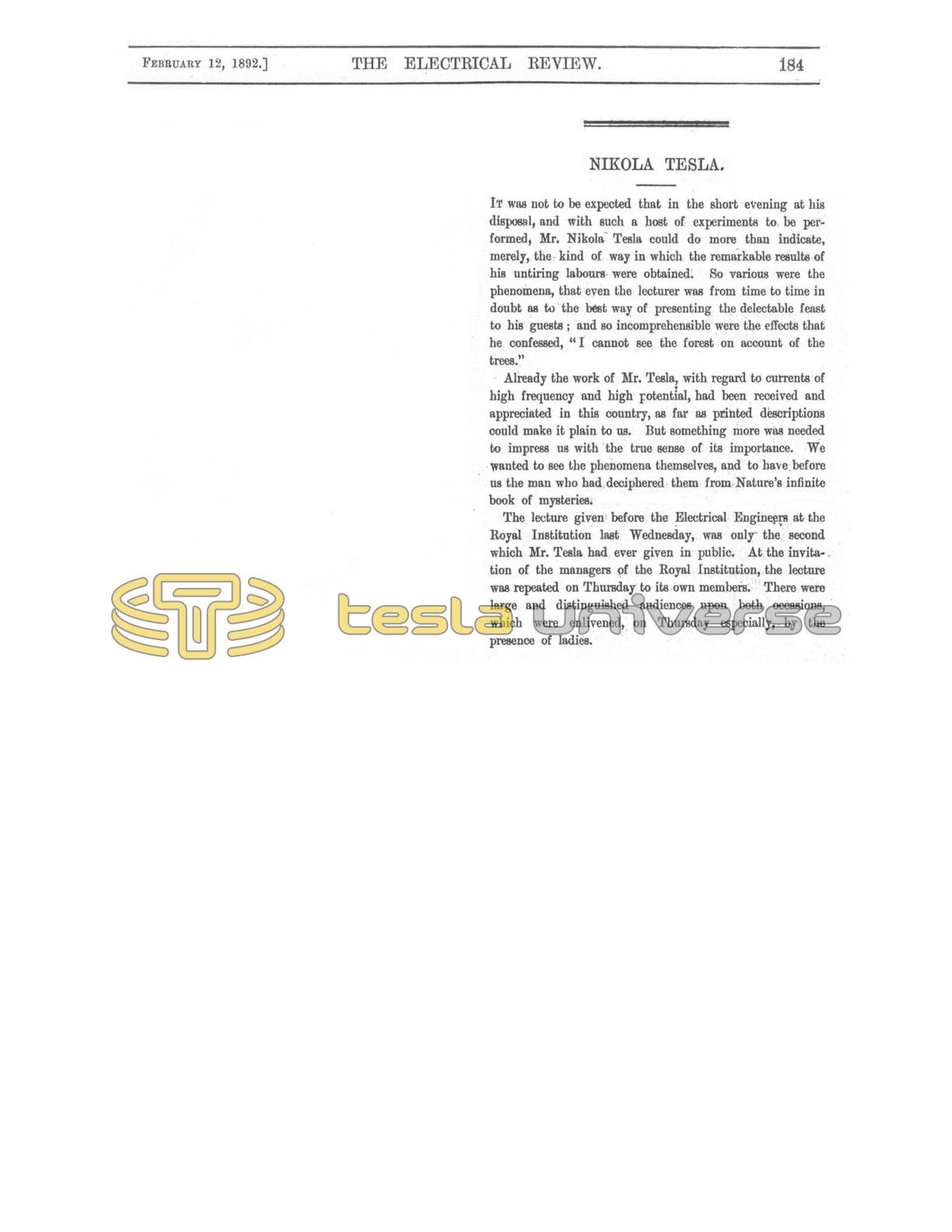
It was not to be expected that in the short evening at his disposal, and with such a host of experiments to be performed, Mr. Nikola Tesla could do more than indicate, merely, the kind of way in which the remarkable results of his untiring labours were obtained. So various were the phenomena, that even the lecturer was from time to time in doubt as to the best way of presenting the delectable feast to his guests; and so incomprehensible were the effects that he confessed, "I cannot see the forest on account of the trees."
Already the work of Mr. Tesla, with regard to currents of high frequency and high potential, had been received and appreciated in this country, as far as printed descriptions could make it plain to us. But something more was needed to impress us with the true sense of its importance. We wanted to see the phenomena themselves, and to have before us the man who had deciphered them from Nature's infinite book of mysteries.
The lecture given before the Electrical Engineers at the Royal Institution last Wednesday, was only the second which Mr. Tesla had ever given in public. At the invitation of the managers of the Royal Institution, the lecture was repeated on Thursday to its own members. There were large and distinguished audiences upon both occasions, which were enlivened, on Thursday especially, by the presence of ladies.
The first lecture which Mr. Tesla delivered on the subject of high frequencies and high potentials, was given before the American Institute of Electrical Engineers, at Columbia College, N.Y., in May, 1891. It is reported upon in our columns for July and August of that year.
With researches on high rates of discharge we naturally connect the names of such men as Crookes, Rayleigh, Spottiswoode, and De la Rue. It would appear, also, that Mr. Rankin Kennedy had already demonstrated the possibility of lighting by the means which Mr. Tesla has followed, when in 1882 Mr. Kennedy patented (No. 4,752) a method for "Intensifying fluorescent and phosphorescent electric lighting, whereby the same is rendered serviceable for illuminating purposes, and apparatus for effecting the said intensification."
Throughout his lectures, Mr. Tesla has shown a deep sense of his appreciation for those who have been before him in the field, and everywhere he has specially acknowledged his indebtedness to Mr. Crookes, whose fascinating little book he declares gave him the initiative to labour in the direction of electrical discharge. To all who would claim priority in this or any research, we recommend a careful reading of the eloquent little speech with which Mr. Tesla replied to the vote of thanks on Thursday at the Royal Institution. For this purpose we have printed it in our columns.
Mr. Tesla has many more things in view, than those he introduced to us last week. Not a third of the experiments he had prepared were actually shown, on account of the limits of time. It will be well, therefore, to reserve any criticism or discussion of the results, until Mr. Tesla has had the opportunity of describing them in detail; this, we believe, he intends to do through the press, at an early date.
It may be observed that the high frequency and high potential are obtained from an induction coil of a special form, and receiving in its primary, a special oscillatory current. Mr. Tesla sends the current from an alternating dynamo into the primary of a transformer, the secondary being connected through a magneto-static interrupter to two brass knobs, between which a series of discharges takes place. From these knobs are taken leads to the primary terminals of an induction coil, not directly, however, but through a capacity formed by Leyden jars. It is thus seen that when a spark occurs at the brass knobs, an oscillatory discharge surges through the added capacity, and the primary of the induction coil. The rate of these oscillations is about one million per second. The effect of the passage of this current, through the primary, is to produce at the secondary terminals a current, not only of high frequency, but of high potential.
When phenomena, such as those developed by Mr. Tesla, are brought before us, it is usual to seek out, on the principle of reversibility, the complimentary set of facts, advancing from where they stop, to find a return path with new beauties. In this, case the result of such a line of thought leads us to the endeavours of Becquerel and Minchin to obtain currents and E.M.Fs. from electrodes, when acted upon by solar rays. In the Philosophical Magazine for March, 1891, Prof. Minchin writes: "It is conceivable that a photo-electric battery may yet be found which will simply act as a transformer of the energy it receives from the sun, while its own materials, being merely the implements used in the process, may be almost wholly unmodified."
The latest experiments with photo-electric cells have established the remarkable fact that when a suitable capacity is connected to them, they can be changed from an insensitive to a sensitive state by the action of a Hertz oscillator at a distance of many feet. How is this? Another analogy lies in the fact that of the liquids used in connection with the original experiments with silver plates, those which were fluorescent, such as eocine, sulphate of quinine, and fluorescine, seemed to suggest a connection between fluorescence and the electrical effect. In would be a revelation, indeed, if the light of Mr. Tesla's experiments could be found to illuminate the mysteries of those of Prof. Minchin, and vice versâ.
The idea of using electric lamps, without the intervention of leads, will remind some of our readers of the extraordinary telephonic experiments of Prof. Dolbear, when he delighted his audience by removing the wires connected to his receiver, and fixing the instrument some yards away from the terminals, invited those that had ears to, hear. There is, of course, a great distinction to be drawn between these results and those of Mr. Tesla. The nature of the undulations in the two cases are probably widely different.
If to the genius and imaginative mind of Mr. Tesla the number and complexity of ideas revealed by his experiments are so great that he owns himself lost in them as in a forest of thoughts, to others the darkness must be deeper still. Yet, though we cannot see even the trees, we are grateful our distinguished visitor, for cutting us a little path, leading us a little way, and refreshing us with his great enthusiasm.