Nikola Tesla Articles
High-Potential Discharges
BY A. FREDERICK COLLINS.
The various manifestations of high-frequency and high-potential discharges offer a fertile field of research, especially for the amateur investigator, since it is a subject that has received comparatively little attention considering its significance as revealed in its recent applications to electrotherapy, radiography, and wireless telegra- phy.
The term electric discharge" is understood to include all modes of equalization of differences of potential between the terminals of a source of electrical energy on their connection by a conductor, by the removal of their charges by a stream of electrical particles of air, or by a sudden discharge that breaks down the air or other intervening dielectric. These are the three chief methods of restoring the electrical equilibrium, and are known respectively as the conductive, the connective, and the disruptive discharge.
The various forms may be further subdivided into alternating, arc, brush, brush and spray, dead-beat, flaming, glowing, lateral, oscillating, periodic, streaming, stratified, impulsive, and periodic discharges, and these may be produced by utilizing a source of direct or alternating current of low voltage, as for instance a commercial generator; a high-potential apparatus as an induction coil, or a high-potential, high-frequency arrangement, as a Tesla coil, depending upon the requirements of the various cases.
In this review we are concerned only with disruptive and connective discharges, the former in its application to wireless telegraphy and the latter in its relation to the human body. Since only potentials such as can be obtained with an ordinary induction coil are needed for disruptive discharges, these will be described first.
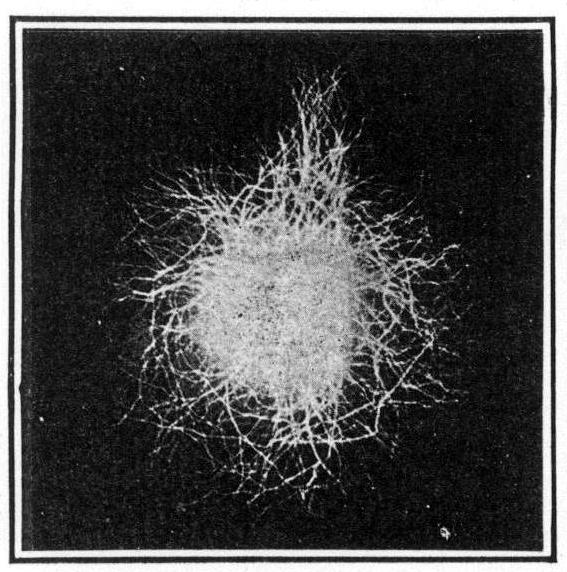
In the production of a discharge of this nature there are two diametrically opposite conditions involved, the first representing an oscillator and spark-gap in an unenergized and non-conductive state, and the second when it is energized and rendered highly conductive, thus completing the circuit. To bring about this result the arms of the oscillator are charged with high-potential energy impressed upon them, which is set up in the secondary of the coil in the form of currents. This kinetic energy is then converted into electrostatic energy, and when the static charge is maximum for a given resistance offered by the dielectric between the surfaces of the spark-gap electrodes heat is evolved in consequence, and when a certain critical temperature. is reached the positive electrode volatilizes, and it is this effect that forms the initiative in breaking down the dielectric of the spark-gap.
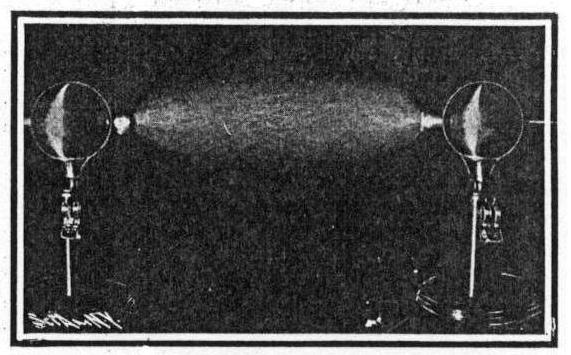
The law relating to the heat evolved states that it is proportional to the square of the charging current and to the resistance of the dielectric between the positive and negative electrodes forming the boundaries of the spark-gap. The energy that is emitted from the positive electrode is proportional to the potential difference impressed on the oscillator system and the specific inductive capacity, while it is inversely as the distance separating the spark-gap electrodes. The length of the spark that passes depends also largely on the following factors, namely, the difference of potential between them, the character of the medium that separates them, and on the density or pressure of the dielectric through which the discharge passes.
A decrease in the pressure of the medium serves to increase the distance through which a spark will pass, but a point is quickly reached wherein a further decrease has the effect of cutting down the length of the spark, and hence where a low vacuum will permit the passage of high-potential currents over longer distances than in air, a high vacuum retards them even though the potential may be considerably increased. Then again the metal of, which the electrodes are made determines the sparking capacity to a certain appreciable extent since some retard and others assist the process of volatilization, and finally the size and shape of the spark-gap-electrodes also have their effect upon the discharges.
From these considerations it will be observed that when the electrodes are placed closely together the strength of the charging current is increased, and hence the heat developed causes the temperature to rise. When the sparking distance is greater than the maximum difference of potential can easily break down, a faintly luminous discharge will be seen issuing from the positive electrode, especially if it should present any sharp points. This phenomenon occurs in virtue of the fact that metallic points are more easily heated than those in the form of spheres.
When the charge and temperature reach a critical value a conducting microscopic thread of gaseous vapor is developed and this is attracted to the negative electrode, to which it passes by the path of the least resistance. When this filament bridges the gap its diameter is very greatly increased, the resistance that was previously enormously high becomes minimum, and the current surges forth and back until the energy, of the system is damped out by the sum of the resistances.
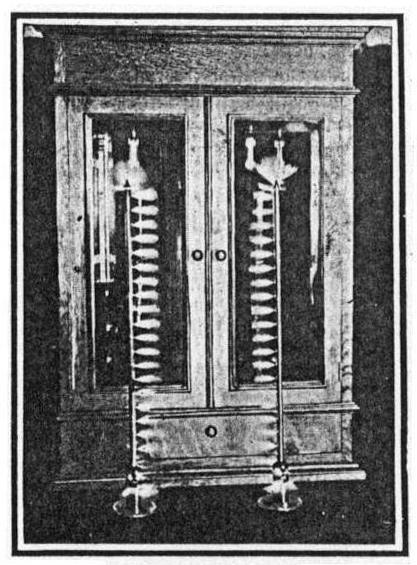
While Tesla was not the first to produce the varied and beautiful forms of convective discharges he was probably the first to systematically investigate them. Though convective discharges may be frequently observed from a pointed positive electrode of an induction coil, they are much more intense and brilliant when the potential and frequency of the oscillations are stepped up by means of a secondary transformer.
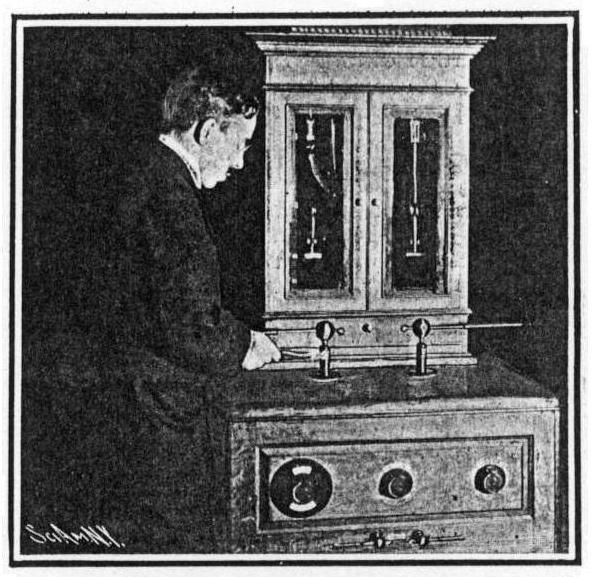
The compact apparatus for obtaining high-frequency and high-potential discharges shown in the illustrations was designed by Prof. Ovington, who repeated many of Tesla's experiments and introduced several new ones during the recent electrical exhibition at the Madison Square Garden.
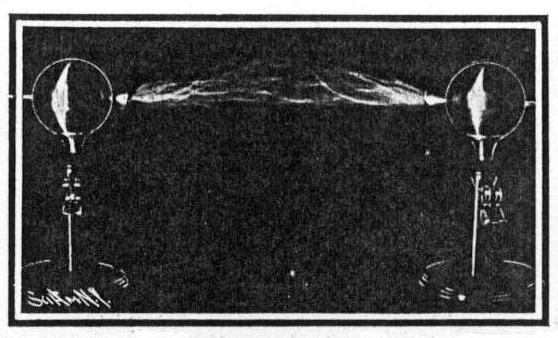
With high potentials and high frequencies the electrostatic field is collapsed more easily than when those of lower value are reached, while the oscillations increase the temperature developed by the transition of static into kinetic energy and for this reason the volume of vapor is increased and an arc discharge results.
The flaming and streaming discharges which are forms of the connective discharge are closely allied and occur when the frequency and potential is increased beyond a certain value; under these conditions the discharge assumes definite characteristics wholly different from those of the disruptive discharge. In these forms of discharge the energy passes between the electrodes as luminous streams. Such discharges obtained with high-frequency coils are different from those obtained with electrostatic machines, as they lack in the violet color developed by the positive static electrode as well as the bright glow of the negative electrode.
When the frequency and potential necessary to produce the flaming and streaming discharges is increased new phenomena result and a brush and spray discharge is obtained. With suitable electrodes comprising a large number of small points the emanations resemble jets from a gas-flame escaping under high pressure. According to Tesla "they not only resemble but they are veritable flames, for they are hot. Certainly they are not as hot as a flame of gas, but they would be so if the frequency and potential would be sufficiently high."
If the frequency and potential is further increased, the discharge will pass through several inches of solid glass. Ordinarily glass is an insulator of electricity, and yet in this case the streams flow through it apparently with the greatest freedom. The flow of luminous energy has a tendency to stream out and to be dissipated to such an extent that when the brush is produced at the positive electrode no disruptive discharges will occur, even though the hand or any conducting object is held within the stream, and what is even more singular, the luminous stream is not at all easily deflected from its path by the approach of a conducting body.
Under these remarkable conditions the energy loses its property of producing sensation when it comes in contact with or passes through the human body, and a person may now be connected with the source of high-potential and high-frequency currents and be completely charged, though he will feel nothing; that he is a portion of an oscillator, however, can be readily determined, for if a vacuum tube is brought near any part of his body it will glow due to the electric waves emanating from him. To illustrate how absolutely devoid the sensory nerves are to these currents, a vacuum tube may be held in the mouth, and a current passed through the lamp lights it and then continues on its course, passing through the membranes of the mouth, which are perhaps the most sensitive of any in the body, yet no sensation whatever is experienced. A half-dozen incandescent lamps may be lighted with current passing through the body and no sensation is felt although instant death would result were the rate of oscillation reduced within certain limits.
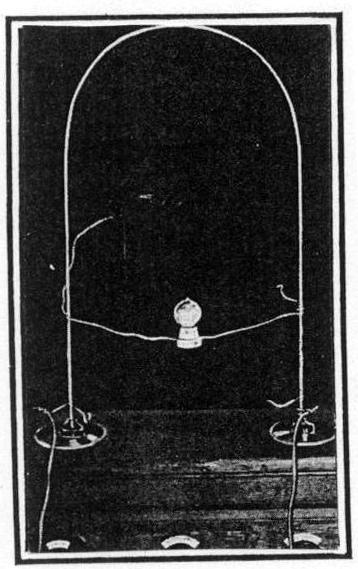
To show the impedance a copper bar of large diameter offers to a high-frequency current, an incandescent lamp is short-circuited across the former and the current is thus given the choice of two paths, an apparently easy one of small ohmic resistance and high impedance through the copper rod, or a seemingly more difficult one of large ohmic resistance and low impedance through the lamp. While an ordinary current would of course choose the former, the extraordinary current traverses the latter path.
The practical application of these discharges is found in radiotherapy. Their use is being extended more and more, and by many it is considered a rational method in therapeutic practice. Heat, light, and electricity when properly applied have accomplished surprising results. With the apparatus shown not only are all the various remedial manipulations of electricity available, but current is also supplied suitable for producing the X-rays, ultra-violet light, etc.