Nikola Tesla Articles
Inventions and Discoveries
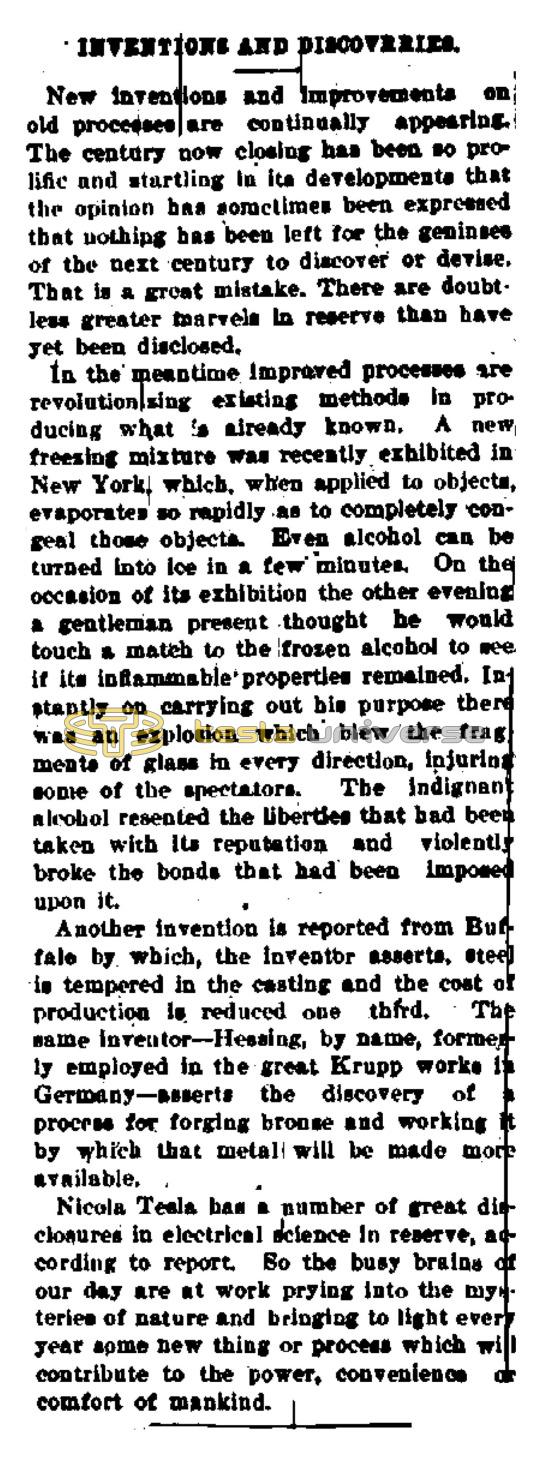
New inventions and improvements on old processes are continually appearing. The century now closing has been so prolific and startling in its developments that the opinion has sometimes been expressed that nothing has been left for the geniuses of the next century to discover or devise. That is a great mistake. There are doubtless greater marvels in reserve than have yet been disclosed.
In the meantime improved processes are revolutionizing existing methods in producing what is already known. A new freezing mixture was recently exhibited in New York, which, when applied to objects, evaporates so rapidly as to completely congeal those objects. Even alcohol can be turned into ice in a few minutes. On the occasion of its exhibition the other evening a gentleman present thought he would touch a match to the frozen alcohol to see if its inflammable properties remained. Instantly on carrying out his purpose there was an explosion which blew the fragments of glass in every direction, injuring some of the spectators. The indignant alcohol resented the liberties that had been taken with its reputation and violently broke the bonds that had been imposed upon it.
Another invention is reported from Buffalo by which, the inventor asserts, steel is tempered in the casting and the cost of production is reduced one third. The same inventor — Hessing, by name, formerly employed in the great Krupp works in Germany — asserts the discovery of a process for forging bronze and working it by which that metal will be made more available.
Nicola Tesla has a number of great disclosures in electrical science in reserve, according to report. So the busy brains of our day are at work prying into the mysteries of nature and bringing to light every year some new thing or process which will contribute to the power, convenience or comfort of mankind.