Nikola Tesla Articles
May Medicate Rays (reprint)
Streams of Chemicals May Be Projected Into the Body.
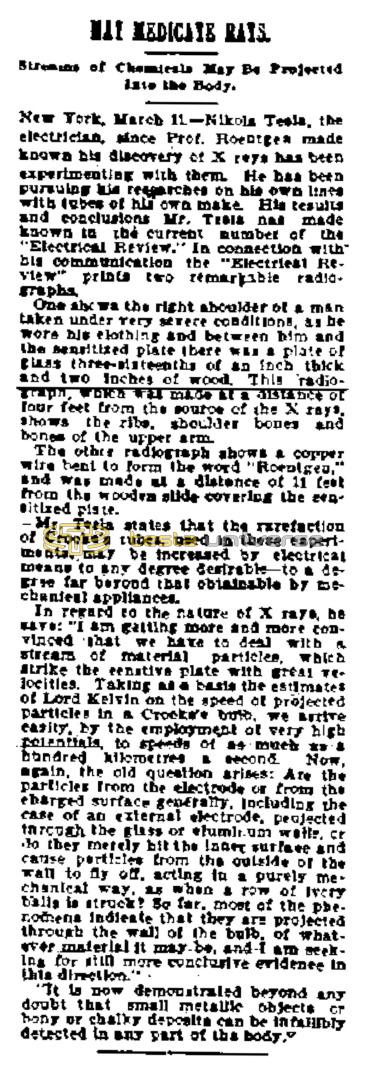
New York, March 11. — Nikola Tesla, the electrician, since Prof. Roentgen made known his discovery of X rays has been experimenting with them. He has been pursuing his researches on his own lines with tubes of his own make. His results and conclusions Mr. Tesla has made known in the current number of the “Electrical Review.” In connection with his communication the “Electrical Review” prints two remarkable radiographs.
One shows the right shoulder of a man taken under very severe conditions, as he wore his clothing and between him and the sensitized plate there was a plate of glass three-sixteenths of an inch thick and two inches of wood. This radiograph, which was made at a distance of four feet from the source of the X rays, shows the ribs, shoulder bones and bones of the upper arm.
The other radiograph shows a copper wire bent to form the word “Roentgen,” and was made at a distance of 11 feet from the wooden slide covering the sensitized plate.
Mr. Tesla states that the rarefaction of Crookes’s tubes, used in these experiments, may be increased by electrical means to any degree desirable — to a degree far beyond that obtainable by mechanical appliances.
In regard to the nature of X rays, he says: “I am getting more and more convinced that we have to deal with a stream of material particles, which strike the sensitive plate with great velocities. Taking as a basis the estimates of Lord Kelvin on the speed of projected particles in a Crookes’s bulb, we arrive easily, by the employment of very high potentials, to speeds of as much as a hundred kilometres a second. Now, again, the old question arises: Are the particles from the electrode or from the charged surface generally, including the case of an external electrode, projected through the glass or thallium walls, or do they merely hit the inner surface and cause particles from the outside of the wall to fly off, acting in a purely mechanical way, as when a row of ivory balls is struck? So far, most of the phenomena indicate that they are projected through the wall of the bulb, of whatever material it may be, and I am seeking for still more conclusive evidence in this direction.”
“It is now demonstrated beyond any doubt that small metallic objects or bony or chalky deposits can be infallibly detected in any part of the body.”
This article is a reprint from New York Herald of March 11th, 1896 and is intentionally not duplicated here.