Nikola Tesla Articles
Mr. Tesla on X-Ray Burns
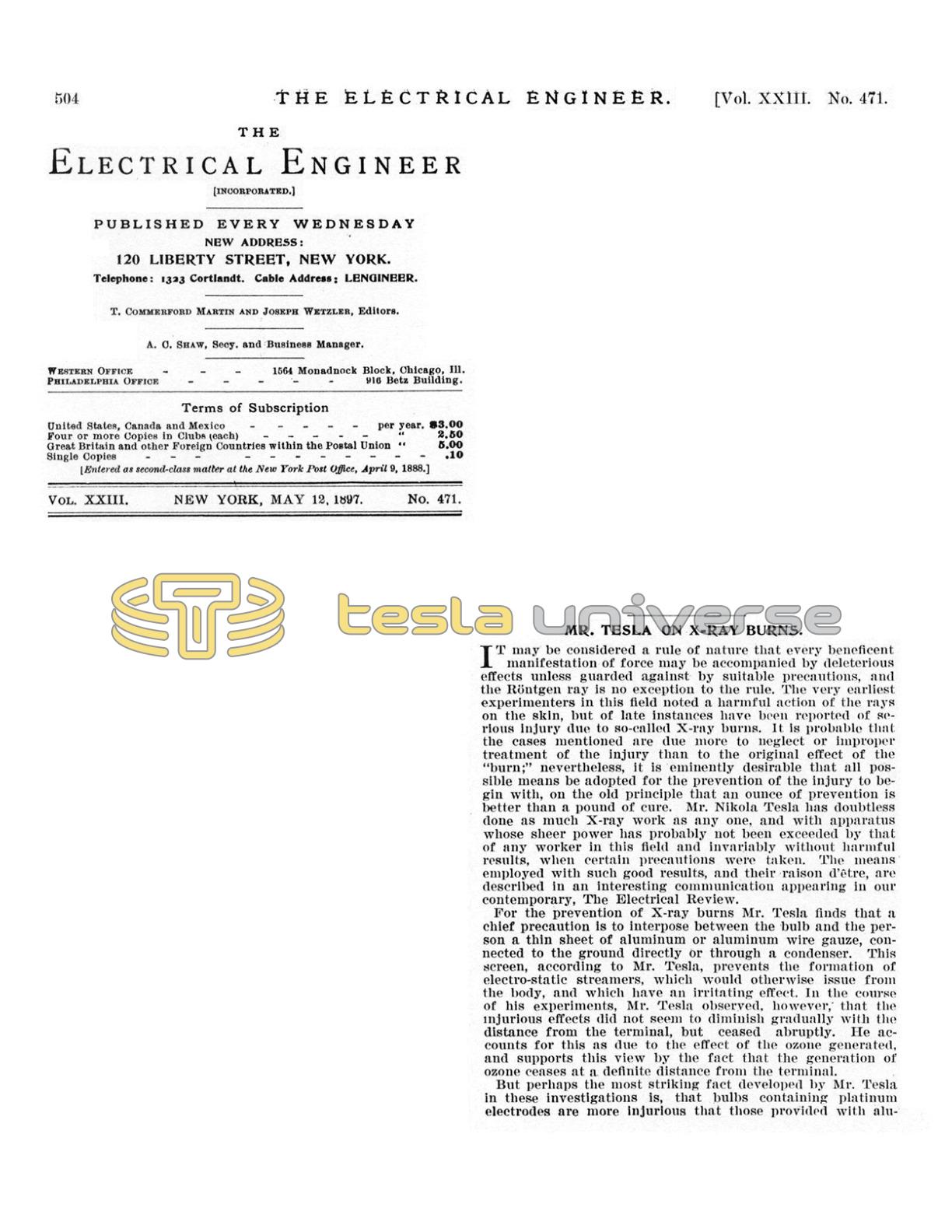
I may be considered a rule of nature that every beneficent manifestation of force may be accompanied by deleterious effects unless guarded against by suitable precautions, and the Röntgen ray is no exception to the rule. The very earliest experimenters in this field noted a harmful action of the rays on the skin, but of late instances have been reported of serious injury due to so-called X-ray burns. It is probable that the cases mentioned are due more to neglect or improper treatment of the injury than to the original effect of the "burn;" nevertheless, it is eminently desirable that all possible means be adopted for the prevention of the injury to begin with, on the old principle that an ounce of prevention is better than a pound of cure. Mr. Nikola Tesla has doubtless done as much X-ray work as any one, and with apparatus whose sheer power has probably not been exceeded by that of any worker in this field and invariably without harmful results, when certain precautions were taken. The means employed with such good results, and their raison d'être, are described in an interesting communication appearing in our contemporary, The Electrical Review.
For the prevention of X-ray burns Mr. Tesla finds that a chief precaution is to interpose between the bulb and the person a thin sheet of aluminum or aluminum wire gauze, connected to the ground directly or through a condenser. This screen, according to Mr. Tesla, prevents the formation of electro-static streamers, which would otherwise issue from the body, and which have an irritating effect. In the course of his experiments, Mr. Tesla observed, however, that the injurious effects did not seem to diminish gradually with the distance from the terminal, but ceased abruptly. He accounts for this as due to the effect of the ozone generated, and supports this view by the fact that the generation of ozone ceases at a definite distance from the terminal.
But perhaps the most striking fact developed by Mr. Tesla in these investigations is, that bulbs containing platinum electrodes are more injurious that those provided with aluminum electrodes, in support of which assertion he cites a number of experiments.
To sum up, Mr. Tesla advises: 1. The abandonments of bulbs containing platinum. 2. The substitution for them of a properly constructed Lenard tube, containing pure aluminum only. 3. The use of a protecting aluminum screen, as indicated above, or, instead of this, a wet cloth or a layer of fluid. 4. Exposure at no less distance than 14 inches, and preferably to expose longer at a greater distance. As regards other physiological influences of the X-ray, Mr. Tesla records the fact that since he has begun to work with the X-rays his health has been improved and he has been entirely relieved of a troublesome cough; this same effect was observed on an. other person. He has also observed that when the head is brought close to a powerful tube the effect is similar to that produced when working for some time with a noisy air gap. As the X-ray tube gives forth no sound, Mr. Tesla concludes that the tube produces violent explosions and concussions, which, though they are inaudible, have some effect on the bony structure of the head. Their inaudibility, he explains on the assumption that not air, but some finer medium, is concerned in their propagation. In conclusion, it may be stated that Mr. Tesla still adheres to his oft-expressed opinion, that the X-ray tube when in action emits a stream of small material particles. Some of his experiments would seem to indicate that these particles start from the outer wall of the tube; others again seem to prove that there is an actual penetration of the wall, and, in the case of a thin aluminum window, Mr. Tesla has not the least doubt that some of the finely disintegrated cathodic matter is actually forced through. Mr. Tesla stands practically alone in his advocacy of the corpuscular theory of the Röntgen rays, but his faith in its correctness seems to be growing stronger as time passes and his experiments multiply.